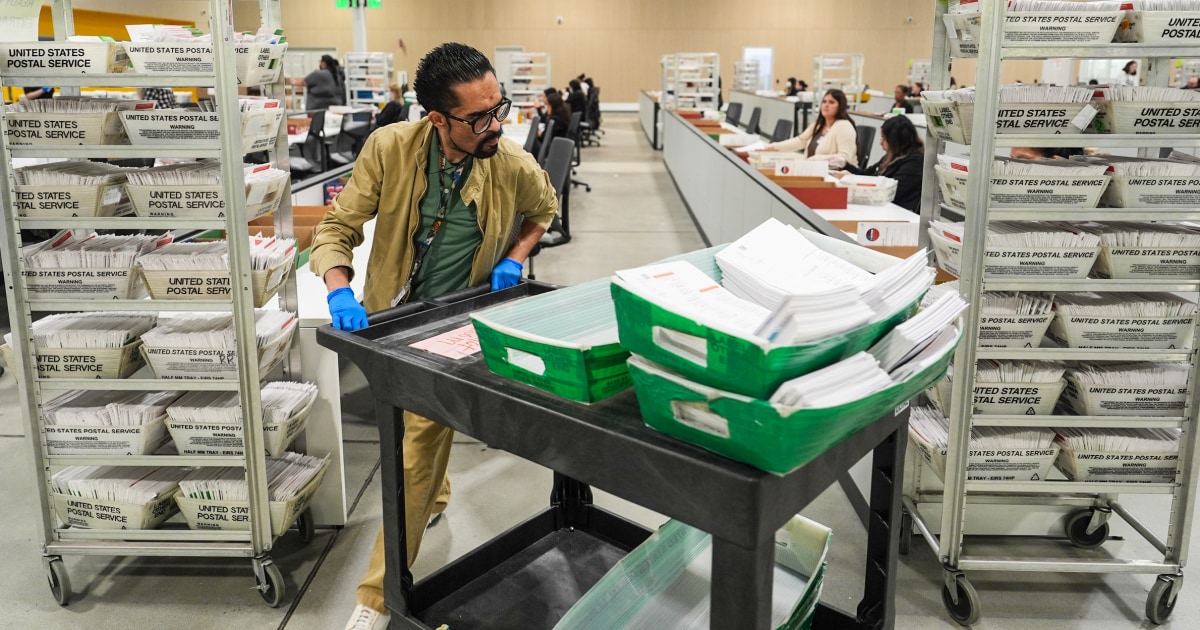
A federal appeals court on Monday ended the Justice Department’s lawsuit seeking to force California to set aside roughly 20,000 ballots, approving the department’s own motion to dismiss the case.
- The 9th Circuit dismissed the appeal in a 2-1 decision, saying it lacked jurisdiction.
- Judges faulted the Justice Department for filing suit less than three weeks before the Nov. 3 midterms.
- A related lawsuit by labor unions and voting groups was also dismissed this month.
- California officials said the federal list of suspected noncitizens lacked methodology and compilation details.
Appeals court rules it lacks jurisdiction
The U.S. Court of Appeals for the 9th Circuit granted a motion by Los Angeles County’s top elections official to dismiss the effort, ruling in a 2-1 decision that it lacked jurisdiction over the appeal. Judges Mark Bennett and Gabriel Sanchez said the federal government failed to allow a federal district court “adequate opportunity” to consider its request for temporary relief. Judge Patrick Bumatay dissented.
“The United States’s claimed emergency, at least in part, is a self-constructed one,” the 9th Circuit said in an unsigned opinion. “At least part of the delay here is attributable to the United States’s own delay in filing suit, in realizing that existing California state law governs the issuance and processing of ballots, in recognizing that California has millions of registered voters and processes ballots on a schedule aligned with that scale, and in communicating to the court its desired relief.”
Trump and Biden appointees concur; Bumatay dissents
Both Bennett, appointed by President Trump, and Sanchez, appointed by former President Joe Biden, authored concurring opinions. Bennett said that even if the court had reached the legal merits, he would have rejected the bid to force California to set aside ballots that may be cast by ineligible voters.
Bumatay, a Trump appointee, wrote in dissent that the federal government has a sovereign interest in safeguarding federal elections. “The question — does the federal government have the power to stop this potential attack on the integrity of our elections? Under both federal law and the Constitution, the answer must be ‘yes,'” he wrote. “Simply, the federal government has a sovereign interest in safeguarding federal elections and ensuring that the votes of noncitizens do not undermine our electoral results.”
Dispute over voter list and subpoenas
The lawsuit followed letters from Acting Deputy Attorney General Trent McCotter to California’s secretary of state and Los Angeles County Registrar-Recorder Dean Logan, giving them 48 hours to review a list of more than 20,000 registered voters the Trump administration believed were “likely” noncitizens who had been sent mail ballots.
Los Angeles County responded in a letter dated Oct. 15 that the list contained addresses throughout the state and did not include information about how it was compiled or how the county was to confirm citizenship status.
A lawyer for Los Angeles County said the Justice Department was asking Logan “to engage in an unlawful course of conduct.” On the same day, the Justice Department sued California, Secretary of State Shirley Weber and Logan, claiming state officials had failed to work with the federal government.
The federal government also threatened to charge California election workers who counted the contested ballots and issued criminal grand jury subpoenas to clerks in Los Angeles and Orange counties. A related lawsuit filed against the Justice Department by labor unions and pro-voting groups arguing the federal effort risked interfering with lawful election administration was also dismissed this month, NBC News reported.
Parallel effort in Alaska dropped
“Trump is illegally trying to seize powers in the Constitution entrusted to others so he can stay in power,” California Gov. Gavin Newsom said in a statement. “This lawsuit is just the latest step. Make no mistake: Trump’s assault on democracy won’t slow down.”
Keep reading

Tarleton State Visits Weber State Tuesday After Drake Upset; Hayes Earns UAC Honor
Josh Hayes was named UAC Newcomer of the Week on Monday, the first Texan to earn a conference...

Suns Sweep Road Trip to Escape West Basement; Rookie Maluach Shows Defensive Fluctuation
The Phoenix Suns swept a three-game road trip to climb out of the Western Conference basement, improving to...

Twinfield Parents Say Bullying, Violence Unchecked; Board Plans Forum
Parents told the Twinfield Union School board on Nov. 10 that bullying, physical violence and racial slurs have...

Dave Orcutt, ‘Mayor of Glen Burnie,’ Dies at 63 After Cancer Battle
David John “Dave” Orcutt, affectionately known as “the Mayor of Glen Burnie,” died at 63 after a battle...