The death toll from a 7.1-magnitude earthquake in Japan has reached 34, with thousands displaced across Kumamoto prefecture. Survivors and rescue workers face grueling conditions, battling sweltering heat, severe water shortages, and widespread infrastructure damage amid a race against time to save those still trapped.
Kumamoto Prefecture Death Toll Rises to 34 Amid Structural Collapses
Rescue operations entered a critical phase following a 7.1-magnitude earthquake that struck Japan’s southern main island of Kyushu, centering on the Kumamoto area. The Kumamoto prefectural government confirmed that the disaster had claimed 34 lives, while five people remained in critical condition and at least 86 others sustained injuries. The total marked an escalation from earlier figures reported during the immediate aftermath of the Tuesday tremor.
Much of the structural devastation concentrated at two major industrial and commercial sites. At the Nippon Paper Industries factory in Yatsushiro city, eight people died after part of a smokestack collapsed. Meanwhile, a violent explosion—believed to have stemmed from a gas leak—tore through the Aeon shopping centre in the town of Kashima, where approximately 3,000 customers had been evacuating into a parking lot. Kumamoto authorities confirmed that seven people died at the mall site among 11 individuals pulled from the wreckage.
Prime Minister Sanae Takaichi addressed the ongoing emergency response, noting the fluid nature of the crisis.
“The needs on the ground are constantly changing. To put to rest the people’s feelings of uncertainty, we will do all that needs to be done.”
Prime Minister Sanae Takaichi
Prime Minister Takaichi stated that the central government would take a leading coordination role, prioritizing the restoration of basic utilities while delivering fresh water to affected districts.
Infrastructure Failures and the Punishing Summer Heat
Beyond the immediate rescue zones, invisible threats compounded the misery for tens of thousands of residents. Nearly 19,000 homes remained without electricity, and vital water mains suffered severe damage with no immediate timeline for repairs. Akio Matsushita, a local official leading relief efforts in Yatsushiro, noted the daunting scope of the municipal crisis at the city hall, where toilets were out of order and emergency facilities had to be erected over sewer manholes.
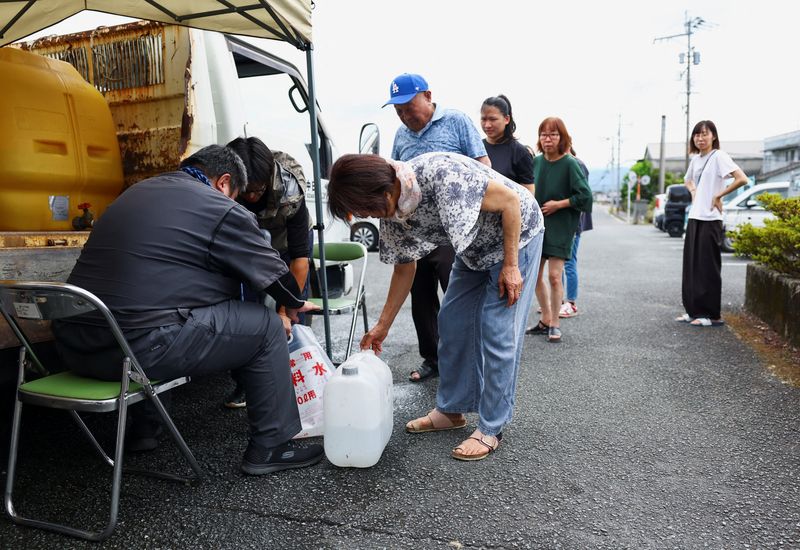
Because of the summer heat, the lack of water is especially difficult,
Matsushita said, adding that repair work would require painstaking effort.
Temperatures approaching 35 degrees Celsius (95 degrees Fahrenheit) transformed daily survival into an endurance test. The Ministry of Environment issued a heat stroke alert for the Kumamoto area as temperatures climbed toward 33 degrees Celsius. Medical personnel deployed to the region shifted their focus toward vulnerable populations. Yutaka Kobayashi, a dispatched doctor touring evacuation centres, emphasized the immediate health risks facing the elderly and injured.
Dr Yutaka Kobayashi To mitigate the sweltering conditions inside roughly 400 shelters housing more than 9,000 people, the Japan Self-Defense Forces began installing approximately 300 air-conditioning units across key sites.
Displaced Residents Seek Shelter in Cars as Economic Disruptions Ripple Outward
Evacuees navigated difficult choices between damaged homes vulnerable to aftershocks and crowded public shelters. In the hard-hit town of Hikawa, resident Yoshiaki Nakashima opted to sleep in his car alongside his dog rather than stay in an evacuation centre.
Yoshiaki Nakashima Nakashima explained that while vehicle sleeping posed physical discomfort, aftershocks made returning to damaged homes unappealing.
The region’s industrial backbone also suffered immediate disruptions. Manufacturers including Toyota, Honda, Nissan, Aisin, and Sony halted portions of their production, while Taiwan’s TSMC evacuated workers and briefly suspended operations to evaluate structural safety. Chief Cabinet Secretary Minoru Kihara noted that officials were closely monitoring supply chains, particularly within the semiconductor and automotive sectors, while rescue workers continued their race against time in temperatures forecast to climb even higher.
Keep reading

Macklemore Pledges $1 Million Ed Sheeran Tour Salary to Palestine Relief
American rapper Macklemore has announced that he will donate his entire $1 million salary earned as an opening...

Rachida Dati and Carlos Ghosn Face Trial in Paris Over Renault Payments
Former French culture minister Rachida Dati went on trial in Paris alongside fugitive former executive Carlos Ghosn, facing...
NBC4 News Helicopter Crashes in Chatsworth Killing Three
Three people were killed when a news helicopter used by NBC4 and Telemundo affiliates crashed and burst into...

China’s Defence Minister Dong Jun Urges Cooperation in AI and Outer Space
Chinese Defence Minister Dong Jun used the opening of the 13th Beijing Xiangshan Forum on September 16, 2026,...