
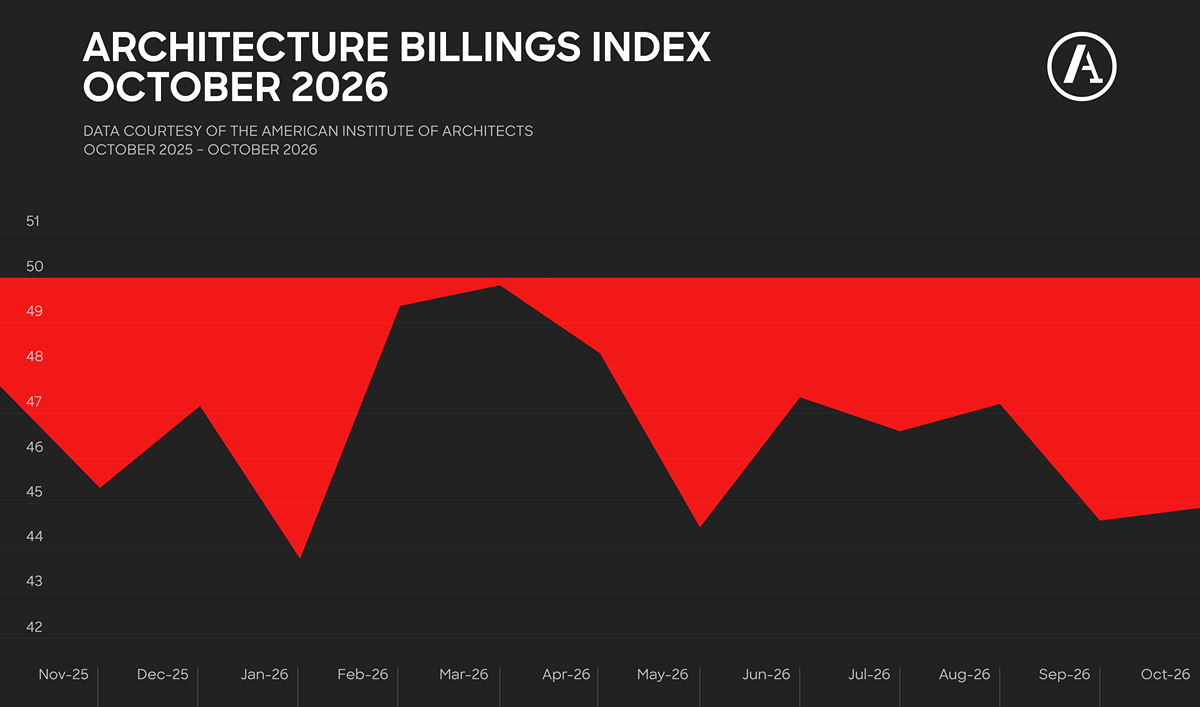
The Architecture Billings Index posted 44.9 in October, barely budging from September’s 44.7 and leaving the profession in contraction for more than four years.
The American Institute of Architects released the November 18 reading, and the number confirms what firm principals have been describing for months: clients are calling, but they are not signing. Inquiries climbed to 51.0 while the value of new design contracts slipped to 42.9. “Many projects simply don’t work on paper financially,” a 14-person multifamily firm in the Northeast told the AIA survey panel.
Commercial and industrial firms post sustained billings growth
The sector split is the story. Commercial and industrial firms logged a second consecutive month of billings growth — their first sustained expansion since 2022 — with a three-month average of 50.9 in September. Institutional firms sat at 47.6, multifamily residential at 42.9 and mixed practice at 41.5.
Institutional billings have now fallen for six straight months while backlogs held at 8.0 months, suggesting current jobs are grinding on but new ones are not arriving. Multifamily backlogs dropped sharply from 6.2 months in March to 4.8 months in September, the steepest decline of any group.
Regional map stays lopsided
Geography reinforces the unevenness. The Northeast posted the weakest conditions for a fourth straight month at 40.1 in October. The South softened to 44.3, the Midwest to 43.0, while the West held essentially flat at 49.8 for a third month. AIA Iowa pointed out that the Midwest’s September reading was its strongest since November 2025 before the October slide resumed.
For contractors and product suppliers, the read depends entirely on where the order book sits. Firms tied to higher education, public institutions or apartment construction face the weakest design pipelines. A 120-person institutional firm in the South gave the AIA a concrete reason for the slide: its higher-education clients face deep cuts in science and technology funding and tighter facility budgets, making project financing harder to count on.
Backlogs cushion the headline
The 44.9 headline looks worse than the pipeline feels. Average firm backlog stood at 6.2 months at the end of September, down from 6.6 months at the end of March but still substantial. Small firms billing under $250,000 a year actually saw backlogs rise from 3.1 to 3.8 months. AIA emphasized that the index measures breadth — how many firms report declines — not depth, so a majority can report slipping billings without every firm hurting badly.

Revenue surveys bear that out. AIA’s September poll found 45% of firm leaders expect 2026 net revenue below 2025, averaging a 2.9% decline. Small firms led the drop at 7.2%, Northeast firms at 5.7%, while large firms billing $5 million or more were flat.
Expectations for 2027 split almost evenly: 32% see revenue falling, 36% holding, 32% growing, for an average expected decline of 0.9%. Among those expecting a drop, 70% cited current projects winding down with fewer new ones coming, 56% blamed economic uncertainty keeping clients on the sidelines, and 54% pointed to high costs, elevated vacancy and restrictive financing.
Planning work fills part of the gap
October’s special survey asked about billings from work not intended to lead directly to design or construction. Firms said such activities averaged 9.7% of billings over the past year. Planning and pre-design dominated: 74% of firms named it their primary non-standard service.
Nearly a quarter of firm leaders said the share had grown in recent years, though Northeast firms were the least likely to report an increase (13%) and most likely to report a decrease (18%), suggesting the region’s non-design work is established practice rather than a downturn response.
For an owner whose project is waiting on financing, that offers a practical option. Most firms already sell planning and pre-design studies, and signed design contracts are scarce.
The number to watch next month
Inquiries have now risen in both September and October.
Keep reading

Des Moines Council Ends Argonne Armory Talks With White Lotus
The Des Moines City Council will vote Monday on whether to kill a second redevelopment deal for the...

NU Regents Call Emergency Meeting to Vote on Project Health Hospital
The University of Nebraska Board of Regents called an emergency session for Friday at 10:30 a.m. to decide...
Trump Administration Moves to Dismiss Lawsuit Challenging Peltola Win
"Now that the election is over and the voters sent a very clear message about the direction they...

Bears Host Saints at Soldier Field After Bye Week
The Chicago Bears, sitting at 7-2 after a bye week, host the 3-6 New Orleans Saints on Sunday...