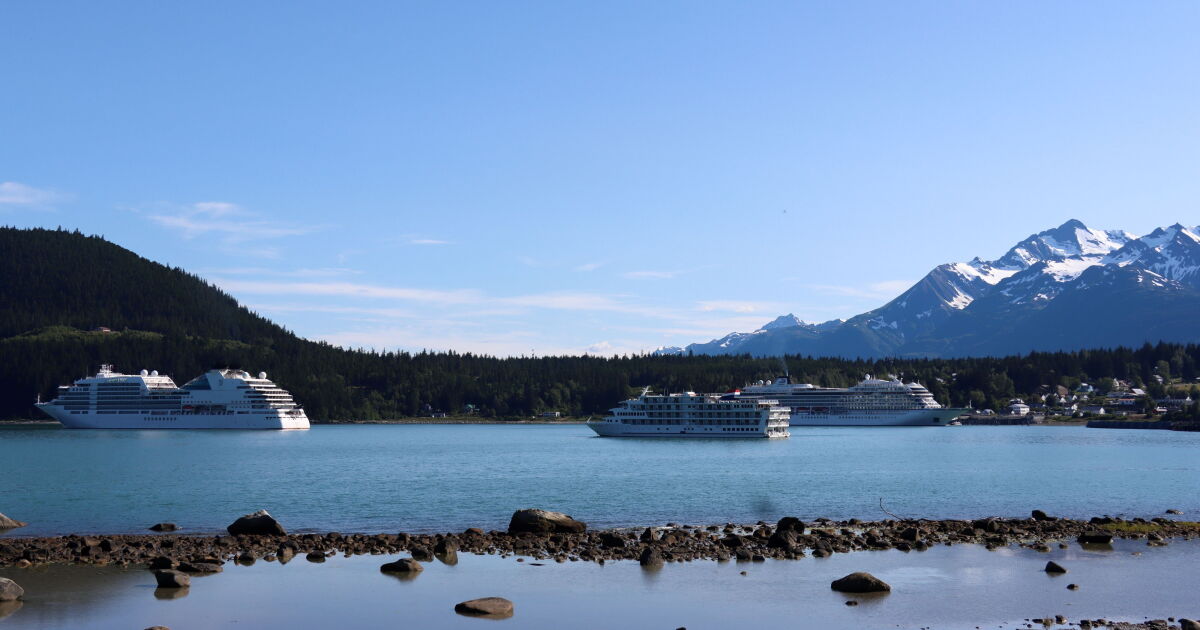
Alaska’s Department of Environmental Conservation halted underway cruise ship inspections on July 1 and will skip some boats altogether, a shift the agency did not publicly acknowledge until after KHNS asked the agency about them.
The change means ships with state discharge permits will be inspected once every two years, and only while in port. Of the 53 cruise ships that operated in Alaska this year, nearly half lacked state permits.
Under the new changes, DEC will not inspect those ships at all, according to inspection schedules and correspondence reviewed by KHNS. One such ship, the MSC Poesia, is the subject of a U.S. Coast Guard criminal investigation for “allegedly discharging oil illegally at sea,” CBS News reported.
Commissioner ordered halt with no public notice
“Apologies, we have just received guidance from our commissioner that we are not to perform underway inspections starting July 1,” Ben Eisenstein, who directs DEC’s cruise ship program, wrote to Norwegian Cruise Line environmental officer Cristian Iancu after a scheduled overnight inspection was canceled in July. The email, obtained through a records request, shows the directive came from Commissioner Randy Bates.
DEC did not announce the policy change. The agency acknowledged it months later in an opinion piece in a Juneau news outlet — after KHNS asked about the missing inspections.
Scrubber oversight dropped from routine inspections
Inspection forms revised after July 15 show DEC removed an entire section dedicated to open-loop scrubber compliance, KHNS reported. Those systems wash exhaust with seawater and discharge the contaminated washwater overboard, converting air pollution into water pollution.
“DEC could still request relevant information when conditions warrant,” spokesperson Sam Dapcevich wrote in an email, but the agency is shifting focus to discharges it formally regulates, such as treated sewage and greywater.
The move follows a 2025 standoff in which at least five Carnival Corp. ships blocked DEC efforts to review scrubber data and take washwater samples. Carnival argued the state lacked authority; Bates responded the agency “without question” had the authority and Carnival “has the obligation” to provide it. Negotiations over a joint sampling program “did not move forward” this summer, Dapcevich said.
Voters funded a program the state stopped running
Two years before 2008, voters passed a ballot measure that created the Ocean Rangers program, which placed independent marine engineers aboard ships. In 2008, 88% of large Alaska cruises carried independent marine engineers aboard to ensure the ships followed environmental regulations.
The program is still written into law, and the state still collects the $4-per-berth fee that funds it — but the revenue has not been used for its intended purpose since Gov. Mike Dunleavy defunded the program in 2019.
“The [inspection] program was sorely inadequate already. And now it’s worse,” said Gershon Cohen, a Haines resident who helped write a 2006 ballot measure that significantly increased cruise industry oversight in Alaska. “If someone’s not on the ship, not traveling with the ship while it’s underway, there is simply no way that the state could possibly know what’s going on.”
Former inspectors say underway access was essential
Bob Layko, who served as an Ocean Ranger for eight seasons, said underway inspections matter because engines and major systems run at full bore and key water discharges occur at sea. “If we weren’t there, they could do anything they want,” Layko said. “They knew there was an Ocean Ranger on board, and if I saw something, they would get reported.”
Alan Ladd, another former Ocean Ranger, said the industry needs “perpetual shoes on deck oversight, and I don’t care who does it, whether it’s a U.S. merchant mariner or somebody that works for ADEC.”
Lawmaker says agency had the budget and the authority
State Sen. Jesse Kiehl, a Democrat representing Southeast communities, said DEC requested the same budget as last year and did not tell the Legislature it planned changes. “DEC exists to make sure Alaskans have clean air and water. They have the legal authority, and they have the budget,” Kiehl said. “To just say, ‘You know what, screw it, [we’re] not doing the job,’ is a pretty skeevy decision.”
Cruise Lines International Association did not respond to detailed questions. A Carnival spokesperson said the company is “always open to sharing data and being transparent,” and that scrubber washwater is “tightly regulated” by the EPA and International Maritime Organization.
Jim Gamble, who directs Pacific Environment’s Arctic Program, said the state seems to be taking “the path of least resistance” amid pushback from an industry with “a lot of money, and a lot of lawyers, and all the time in the world to contest these things.”
Related reading
North Little Rock Adopts 2027 Budget, Delays Providence Park Funding to May
North Little Rock's City Council adopted a balanced 2027 budget on Monday, directing more than $33 million to...

American Airlines Nears Construction on Expanded Austin Admirals Club With Skyline Terrace
American Airlines nears construction start on expanded Austin Admirals Club with skyline terrace, View from the Wing reported....

Federal Judge Orders Release of New Jersey Family of 6 Held by ICE in Texas
A federal judge in San Antonio ordered the release of a Trenton family of six, including children ages...

Olympia Financial Group Arrangement Effective, Executive Pay Expected to Fall to $2.9M-$4.0M
Olympia Financial Group Inc. said its plan of arrangement became effective today, ending a profit-sharing compensation model that...