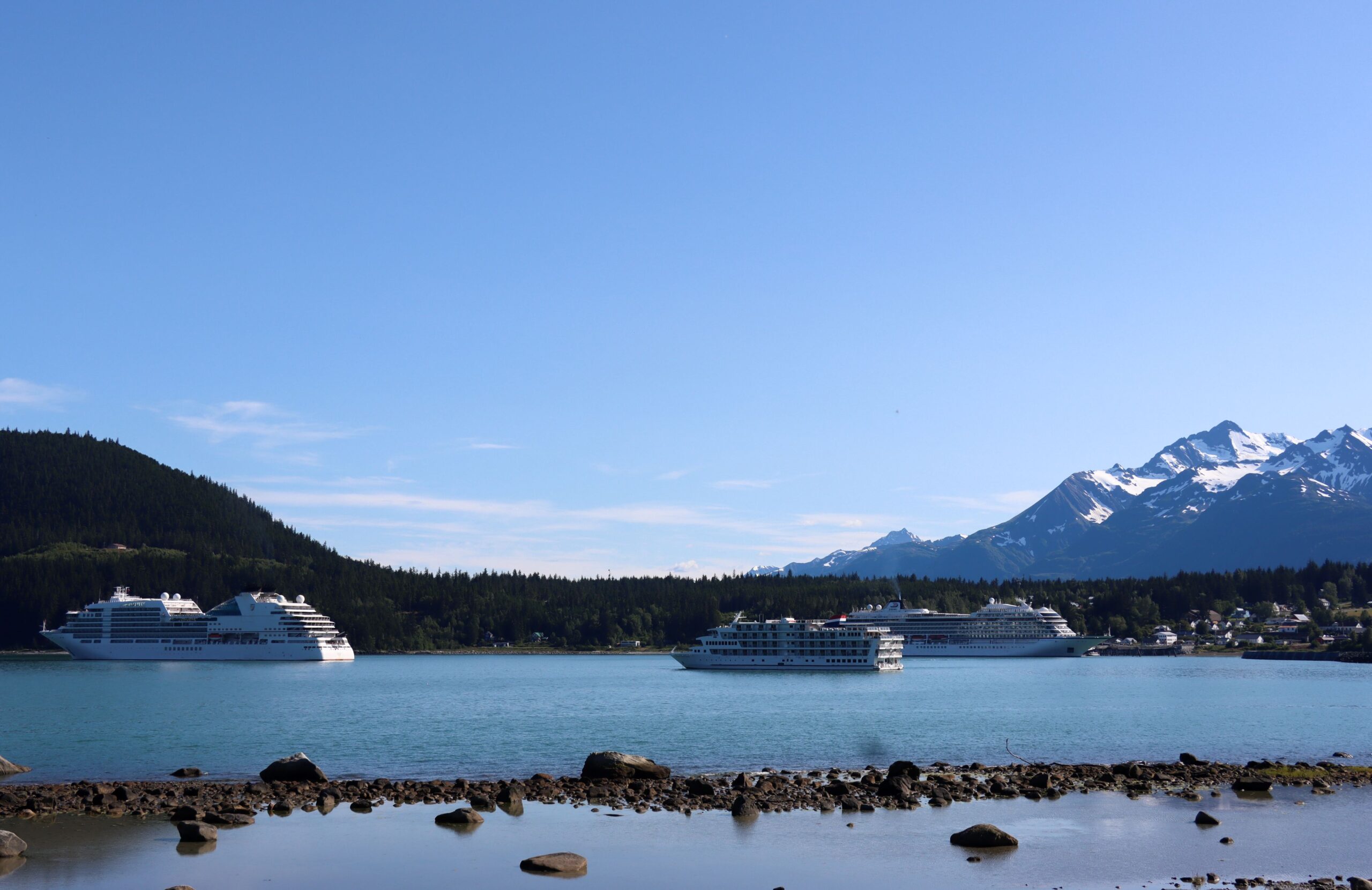
Alaska’s Department of Environmental Conservation halted underway cruise ship inspections on July 1 and cut the frequency of port inspections for permitted vessels to once every two years, KHNS Radio reported.
“Apologies, we have just received guidance from our commissioner that we are not to perform underway inspections starting July 1,” Ben Eisenstein, who directs DEC’s cruise ship program, wrote in an email to a cruise line environmental officer obtained through a records request.
Program scaled back without public notice
The agency made the changes with no notice to the public or some cruise lines, according to public inspection reports and correspondence reviewed by KHNS. DEC did not acknowledge the halted inspections until months later, in an opinion piece published in a Juneau news outlet after KHNS asked about them.
Previously, vessels holding state discharge permits underwent yearly inspections — one in port and one while underway. Ships without permits received a single in-port inspection. Now, DEC will not inspect non-permitted ships at all. Nearly half of the 53 cruise ships that operated in Alaska this year lacked state permits.
Ocean Rangers program defunded in 2019
Alaska’s oversight has declined since voters passed a 2006 ballot measure creating the Ocean Rangers program, which placed independent marine engineers on ships. In 2008, 88% of large Alaska cruises had Ocean Rangers aboard, funded by a $4-per-berth fee that the state still collects. Gov. Mike Dunleavy defunded the program in 2019. His administration has since tried to repeal it, arguing self-reporting and DEC oversight could fill the gap.
“The [inspection] program was sorely inadequate already. And now it’s worse,” said Gershon Cohen, a Haines resident who co-authored the 2006 ballot measure. “If someone’s not on the ship, not traveling with the ship while it’s underway, there is simply no way that the state could possibly know what’s going on.”
Underway inspections seen as critical
Former Ocean Rangers and legislators said underway inspections matter because engines and major systems run at full capacity and key water discharges occur at sea.
“If we weren’t there, they could do anything they want,” said Bob Layko, who served as an Ocean Ranger for eight seasons.
“They knew there was an Ocean Ranger on board, and if I saw something, they would get reported.”
State Sen. Jesse Kiehl, a Democrat representing Southeast communities, said the changes violate voter intent. “To not do any underway inspections, to only inspect each ship every second year, that’s not what the people of Alaska voted for,” Kiehl told KHNS.
Scrubber oversight also reduced
DEC also deleted a section of its inspection form focused on exhaust gas cleaning systems, known as scrubbers. Open-loop scrubbers convert air pollution into water pollution by releasing washwater containing stack pollutants back into the ocean. Carnival-owned ships violate federal scrubber standards hundreds of times a year, federal data shows, and the EPA has rarely enforced its permit.
In 2025, at least five Carnival Corp. ships blocked DEC efforts to review scrubber data and take washwater samples. Carnival said the state lacked authority over scrubber discharges. DEC Commissioner Randy Bates responded the agency “without question” has the authority to request and review the information, and that Carnival “has the obligation” to provide it.
Negotiations over a joint sampling program “did not move forward” this summer, agency spokesperson Sam Dapcevich said.
Dapcevich acknowledged in-port inspections “do not provide the same opportunity” to observe underway discharges but said the changes reduce travel and “related logistical complications.” He said DEC could still request scrubber information “when conditions warrant” but is shifting focus to discharges it formally regulates, like treated sewage and greywater.
“They need oversight, not just once a year, not just once every two years,” said Alan Ladd, another former Ocean Ranger. “They need perpetual shoes on deck oversight, and I don’t care who does it, whether it’s a U.S. merchant mariner or somebody that works for ADEC.”
The Alaska Department of Environmental Conservation, the state’s environmental regulatory agency, administers laws and regulations pertaining to water quality, shoreline management, and air quality, and conducts monitoring and scientific assessments. The department directs the cruise ship program, which previously conducted yearly in-port and underway inspections for vessels holding state discharge permits, and issues those permits under its regulatory authority.

Criminal investigation underway
Earlier this month, the U.S. Coast Guard launched a criminal investigation into the MSC Poesia for “allegedly discharging oil illegally at sea,” CBS News reported. 2026 was the ship’s first season in Alaska, and it did not hold a state discharge permit.
The Cruise Lines International Association did not respond to detailed questions. A Carnival spokesperson said the company is “always open to sharing data and being transparent,” and that scrubber washwater is “tightly regulated” by the EPA and International Maritime Organization.
Jim Gamble, who directs Pacific Environment’s Arctic Program, said the state appears to be taking “the path of least resistance” against an industry with “a lot of money, and a lot of lawyers, and all the time in the world to contest these things.”
He said he hopes Governor-elect Jonathan Kreiss-Tomkins will take a different approach. “The fact of the matter is, they’re producing a staggering amount of toxic wastewater, and just dumping it overboard,” Gamble said.
Keep reading
Chicago Feds Highlight $9M Crypto Rug Pull in DOJ Fraud Crackdown
Federal prosecutors in Chicago on Tuesday highlighted local cases tied to what the Department of Justice called its...

BLM Proposes Opening 118 Miles of Colorado Trails to Class 1 E-Bikes, Comment Period Ends Dec. 14
The Bureau of Land Management proposes opening 118 miles of western Colorado trails to Class 1 e-bikes, with...
Chris Cargill Argues IRS Data Shows Idaho Gaining as Washington Loses Income
In a column for Big Country News, Chris Cargill, president of the Mountain States Policy Center, argues that...

Live Nation Announces U2 North American Stadium Tour With Stephen Wilson Jr.
Live Nation announced a North American stadium leg for U2’s “Carnaval De Luz Presents: The Greatest Show on...