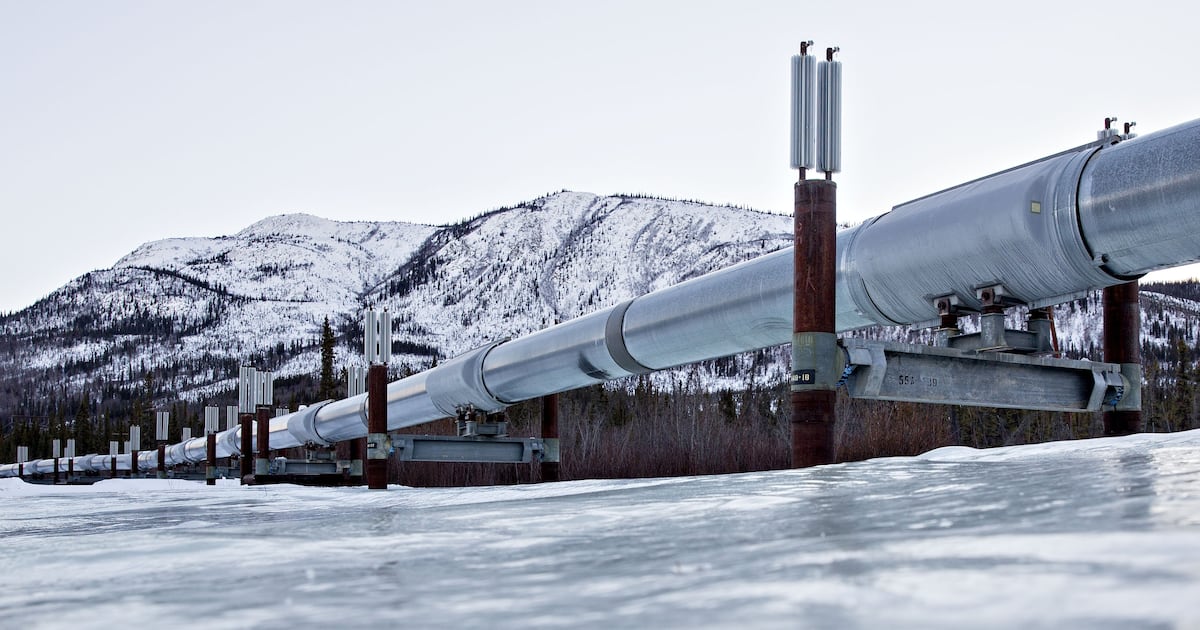
The Alaska LNG project has completed all federal and state environmental reviews and permitting, clearing the way for construction to begin as soon as a final investment decision and financing are secured, The Chosun Daily reported from the pipeline route in central Alaska.
Permitting complete, construction ready
A project official told The Chosun Daily Daily on November 8 that 100% of the required environmental impact assessments and key permits are finished. “Once the final investment decision (FID) and funding are finalized, construction can begin as early as tomorrow,” the official said.
Route follows existing pipeline corridor
The $54.5 billion project plans a 1.1-meter-diameter gas pipeline running roughly 1,300 kilometers from the North Slope to a liquefaction terminal at Nikiski on Cook Inlet. The line would be buried alongside the existing Trans-Alaska Pipeline System (TAPS), which carries crude from Prudhoe Bay to Valdez.

Engineering for permafrost and earthquakes
At Copper Center, 320 kilometers north of Anchorage, the current above-ground pipeline rests on supports spaced four to five meters apart. Each support carries rollers that let the pipe slide laterally during seismic events.
Aluminum heat-dissipating fins on the supports draw heat from the ground in winter, keeping permafrost stable — technology developed with the University of Alaska Fairbanks Permafrost Research Laboratory. The new gas line will be buried its entire length, per federal safety rules, using the same thermal control methods.
North Slope gas reserves could supply South Korea for decades
Confirmed North Slope gas reserves total 35–40 trillion cubic feet, with total resources exceeding 100 trillion cubic feet including adjacent undeveloped areas — enough to supply South Korea for more than 50 years. For decades, 7–8 billion cubic feet per day produced alongside oil at Prudhoe Bay have been reinjected for lack of a transport route to tidewater.
Alaskans support the pipeline for heating costs and jobs
Former U.S. Senator Mark Begich, a Democrat, told The Chosun Daily Daily that over 90% of Alaskans support the pipeline. “Bringing gas from the northern oil fields will reduce residents’ heating costs, create jobs, and provide a stable energy supply to South Korea, a key ally. It’s an essential path to mutual benefit,” Begich said.
He noted Alaska’s $100 billion permanent fund and a projected budget surplus exceeding $1 billion give the state financial capacity without heavy federal reliance. Susan Downing of the conservative outlet Alaska Story said support crosses party lines even after Democrats won the governorship and a Senate seat in the November 3 midterms.
Korean industrial role outlined
Begich identified specific Korean contributions: POSCO supplying line pipe, Korean shipbuilders and constructors building the liquefaction terminal and LNG carriers, and potential development of an AI data center in Alaska.
A project official contrasted the Alaska LNG timeline with other U.S. energy investments Korean firms are weighing, saying Texas gas-fired and nuclear projects “have not even begun site selection or environmental regulations,” while Alaska’s regulatory and local opposition hurdles are “almost completely resolved.”
Local view
Lana, 31, a supermarket employee in Glennallen near Copper Center, welcomed Korean investment. “The LNG development will bring more people to the region, greatly benefiting the local economy,” she told The Chosun Daily Daily. “We even sell Korean products like instant noodles at our store.”
Keep reading

Wizards Name Boomers Coach Caporn Interim Head Coach in NBA First
Washington fired Brian Keefe on Saturday after a 116‑91 home loss to Orlando, making him the first NBA...

Ryan Michael Shelton, 31, Dies in Virginia Beach
Ryan Michael Shelton died on November 26 at age 31, six days before his birthday. Born in Norfolk...
KKR Subsidiary Global Atlantic Hires Product Owner for Annuity Operations in Hartford or Des Moines
Global Atlantic Financial Group, the insurance subsidiary of KKR, is hiring a Senior Analyst Product Owner for its...

Minnesota Faces a Sharp Temperature Drop Sunday
Minnesota faces a sharp temperature drop Sunday after Saturday reached 54 degrees in the Twin Cities, with highs...