Alaska voters rejected a repeal measure backed by President Donald Trump for the second consecutive election, preserving the state’s top-four nonpartisan primary and ranked-choice general election system, the Associated Press reported.
- Voters defeated a ballot measure to repeal ranked-choice voting and nonpartisan primaries.
- This marks the second rejection of a repeal effort after a narrow 2024 defeat.
- Mary Peltola defeated incumbent Sen. Dan Sullivan in the U.S. Senate race.
- Democrat Jonathan Kreiss-Tomkins won the governor’s race with an outright majority.
Repeal measure fails under national scrutiny
The ballot measure would have dismantled the election system Alaska voters approved in 2020. A similar repeal effort failed narrowly in 2024. This year, the system faced intense scrutiny after an independent candidate named Dan Sullivan qualified for the four-person U.S. Senate general election ballot alongside the Republican incumbent of the same name.
President Trump railed against the system, calling it “disastrous, and very fraudulent,” and backed the repeal effort. Republican critics described the system as unnecessarily confusing, while advocates cast it as a fairer, less polarizing way to capture voter intent.
Senate race tests ranked-choice mechanics
The Senate race appeared likely to move to a ranked-choice tabulation after no candidate secured a first-round majority. The presence of two candidates named Dan Sullivan prompted allegations that the independent Sullivan was a Democratic-backed spoiler recruited to siphon votes from the Republican incumbent. Democrats denied recruiting him, and the independent Sullivan defended his candidacy.
Proponents argued the ranked-choice system could blunt any confusion. Voters had the ability to rank both Dan Sullivans and not rank Democrat Mary Peltola, for example. Ballot data showed voters who selected independent Daniel J. Sullivan as their first choice expressed different second choices — some ranking Republican Sullivan second, others ranking Peltola, and still others expressing no preference for either major-party candidate, MinnPost reported.

Cross-party coalitions decide statewide races
In the U.S. Senate race, Peltola defeated Republican incumbent Dan Sullivan with an outright majority. Ballot data indicated a ranked-choice runoff would have widened her margin, MinnPost reported. In the governor’s race, Democrat Jonathan Kreiss-Tomkins defeated three Republicans with an outright majority, becoming the state’s first Democratic governor since 1998.
His cross-party coalition included an endorsement from Republican U.S. Sen. Lisa Murkowski.
In the U.S. House race, Republican incumbent Nick Begich won over independent Bill Hill in a ranked-choice runoff after neither secured a first-round majority, MinnPost reported.
Minnesota cities adopt ranked-choice voting
MinnPost reported that Minnesota cities including Minneapolis, St. Paul, St. Louis Park, Bloomington and Minnetonka have adopted ranked-choice voting for local elections, with voters strongly preferring it to single-choice voting.
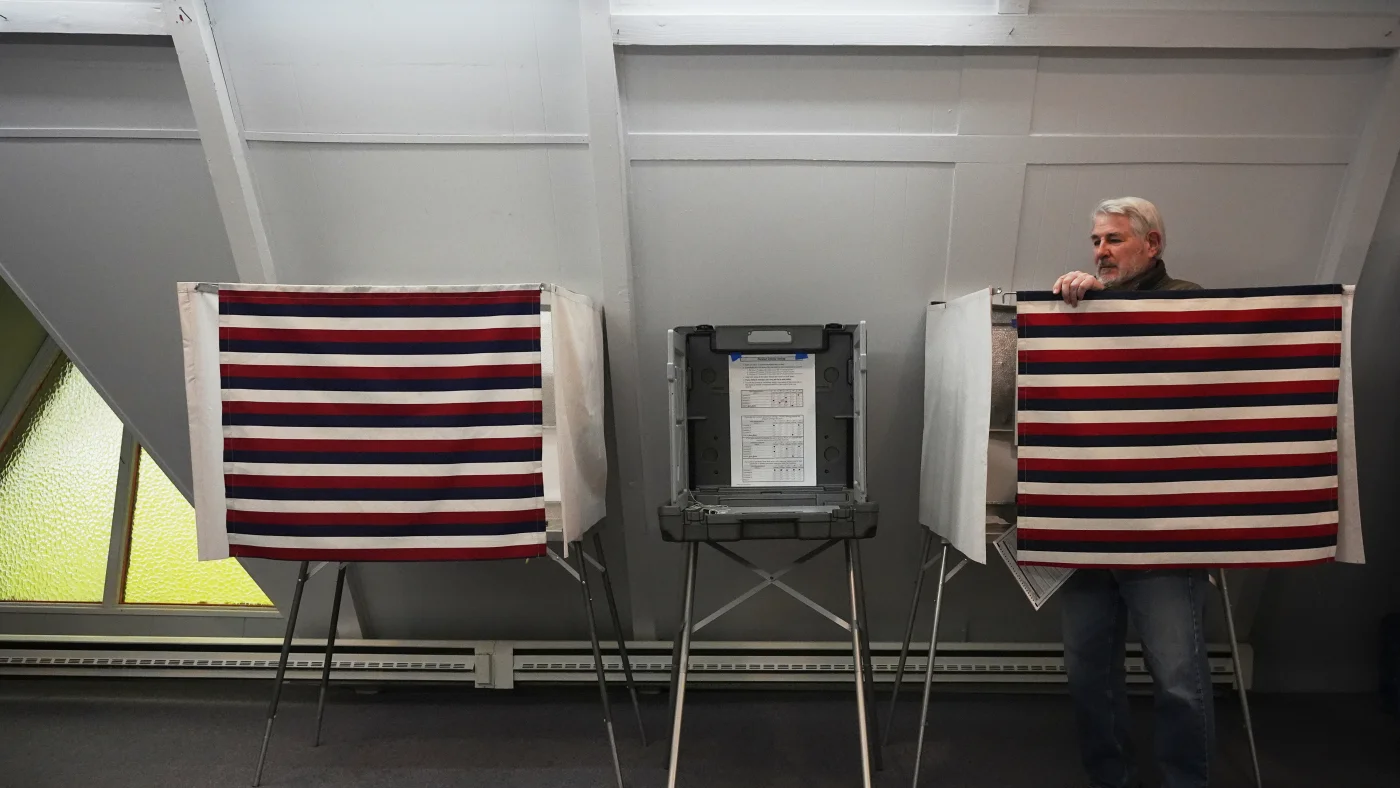
Alaska system differs from other states on primary structure
NPR reported that while California and Washington allow the top two vote-getters to advance from nonpartisan primaries, Alaska’s system sends the top four candidates to the general election. Ranked-choice tabulation then decides the winner if no candidate reaches a majority.
MinnPost said the movement for ranked-choice voting now spans more than 50 jurisdictions nationwide.
Momentum extends beyond Alaska
The movement now spans more than 50 jurisdictions nationwide. Massachusetts voters this year decided not to switch to a top-two nonpartisan primary system, and voters rejected all similar ballot measures in several states during the 2024 cycle, NPR reported.
“Alaskans of all political stripes have spoken: They want the freedom to vote for any candidate, regardless of party, in every taxpayer-funded election,” Nick Troiano, executive director of Unite America, said in a statement before the AP call.
“At a time when most general elections across the country are essentially coronations, the Last Frontier is showing that a better way is possible. It is time to honor the voters’ decision and move forward.”
Worth a look
- Nancy C. DeWitt, 83, Huntsville Resident and Longtime Church Member, Dies
- BU Softball Announces 2027 Schedule; Opens at Home March 19 vs Maine
- AI Automates Routine Work But Leaders’ Responsibility Grows, Entrepreneur Reports (archyde.com)
- NATO Vows Space Defense Following Reports of Russian Nuclear Satellite (newsarchyuk.com)

Nancy C. DeWitt, 83, Huntsville Resident and Longtime Church Member, Dies
Nancy C. DeWitt, a longtime Huntsville resident and member of Whitesburg Baptist Church for more than 50 years,...

BU Softball Announces 2027 Schedule; Opens at Home March 19 vs Maine
Boston University’s softball team will play its first 27 games on the road before opening the home schedule...

East Lansing Police Accepting Applications for 11-Week Citizens’ Academy Starting Feb. 3
The East Lansing Police Department is accepting applications for its 2027 Citizens' Police Academy, an 11-week program beginning...

DEA Allowed 1.4 Million Fentanyl Pills Into US During Sting, AP Reports
AP investigation finds DEA permitted at least 1.4 million pills to "walk" across six states. Previous reports cited...