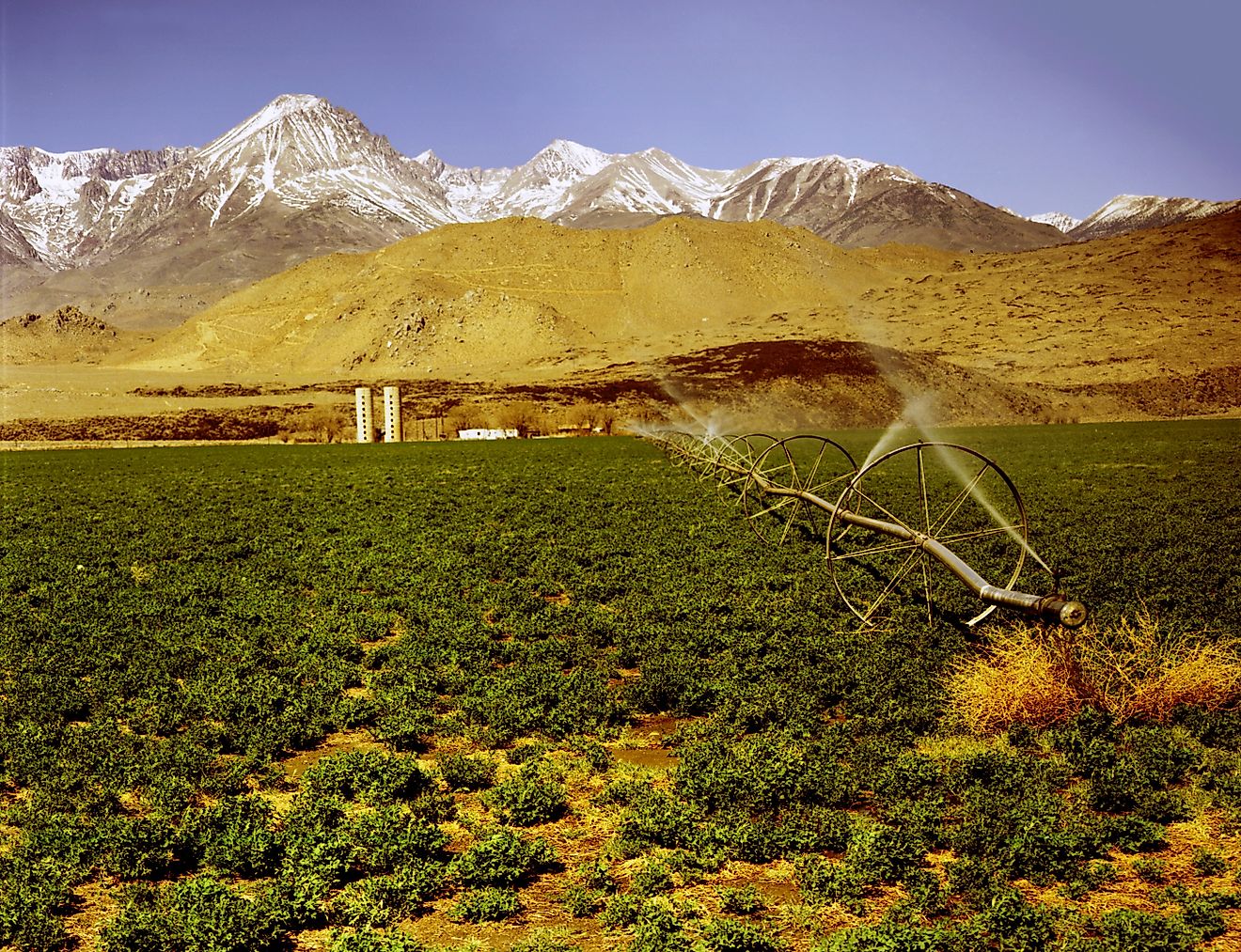
- Alfalfa used 5.2 million acre-feet in 2010, leading all crops.
- Almonds and pistachios together used 3.8 million acre-feet that year.
- Almond water use has since risen to an estimated 4.7–5.5 million acre-feet annually.
- Alfalfa returns roughly $170 per acre-foot versus $1,200 for almonds and pistachios.
Alfalfa occupies nearly one million irrigated acres across California, with an application rate of about 5.0 acre-feet per acre.
The crop’s total water footprint stems from the combination of that vast footprint and heavy per-acre use. Ownership is highly concentrated: just 15 percent of alfalfa farms control 63 percent of the total irrigated acreage, according to the World Atlas analysis of state data.
Measured by economic return, alfalfa lags far behind nut crops. In 2010, almonds and pistachios generated roughly $1,200 for every acre-foot of applied water on a crop valued at $4.4 billion. Alfalfa, using 5.2 million acre-feet, produced about $910 million — roughly $170 per acre-foot. Rice fell between them at approximately $374 per acre-foot.
When the denominator shifts to acre-feet applied per acre, the order changes. Irrigated pasture leads at 4.92 acre-feet per acre, followed by almonds and pistachios at 4.49. Alfalfa sits just behind at 4.48, with citrus at 4.23. Almonds are marginally thirstier per acre, but alfalfa’s greater total acreage makes it the larger aggregate user — at least in the 2010 snapshot.

Every clean crop-by-crop comparison traces back to the 2010 Department of Water Resources accounting. Almond acreage has changed enormously since. A September 2024 analysis estimated California’s 1.39 million bearing almond acres now draw 4.7 to 5.5 million acre-feet annually — 14 to 16 percent of all irrigated agricultural water. That range overlaps alfalfa’s 5.2 million acre-feet entirely, meaning almonds alone may have caught or surpassed alfalfa, even though the last authoritative head-to-head count says otherwise.
The trend has reversed. California almond acreage peaked around 1.65 million acres in 2021 and has fallen every year since, dropping to roughly 1.5 million acres. Approximately 210,000 acres were pulled out between 2022 and 2024, with new plantings at a multi-year low. Alfalfa acreage has shown no comparable collapse.
Alfalfa is grown largely as cattle and dairy feed rather than for direct human consumption. A substantial share is also exported. The embedded water in California beef has been estimated at 2.7 trillion gallons annually, positioning the crop as a step in a longer supply chain rather than a final product.
Applied-water figures capture what reaches the field, not whether the source was sustainable. The Westlands Water District, the state’s largest agricultural water district, pumped more than one million acre-feet of groundwater between 2015 and 2020. That extraction does not appear in surface-water delivery records, masking the full hydrologic impact.

Fairfax County Police Report Widespread Road Closures, Downed Trees, Signal Outages Across District Stations
Fairfax County police responded to widespread road closures, downed trees and traffic signal outages on Thanksgiving Day after...

State Works to Remove Grounded Atlantis Vessel Kapena From Fort DeRussy Beach
The Hawaii Department of Land and Natural Resources announced Thursday it is working to remove the 65-foot passenger...
Arizona Sees Mild Thanksgiving Weekend With 70s in Phoenix, Gusty Mountain Winds
Arizona will see mild, above-normal temperatures through the holiday weekend, with Phoenix highs in the upper 70s, while...

Broncos Activate Badie, Elevate Schrader for Black Friday Trip to Pittsburgh
The Denver Broncos entered Thursday with one running back on the 53-man roster and finished it with three,...