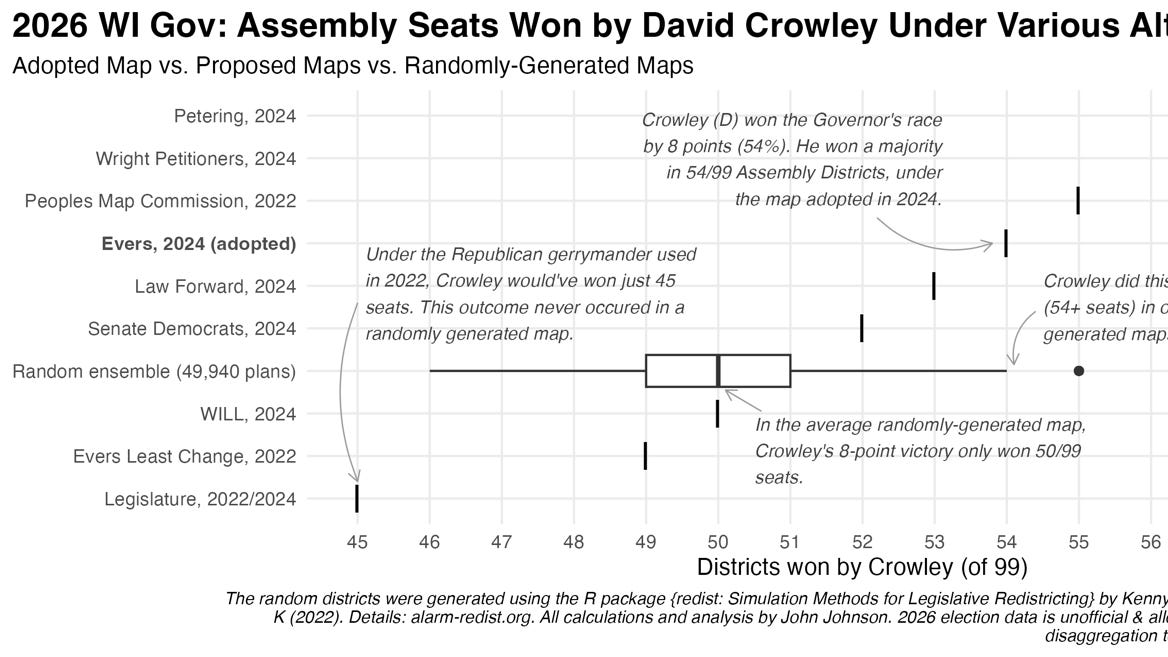
David Crowley’s 8-point victory in the 2026 Wisconsin governor’s race would have given Democrats a majority in just 45 of 99 Assembly seats under the Republican-drawn gerrymander used in 2022, according to a new analysis from the Marquette Law School faculty blog.
The 2022 map, enacted by a Republican-endorsed state Supreme Court majority after Governor Tony Evers vetoed it, locked in a GOP legislative stranglehold that yielded only seven seat flips across 396 general elections from 2014 to 2020. A court-ordered replacement map, passed by Republican legislators in 2024, produced far more responsive results: Crowley won a majority of the vote in 54 districts under the new lines, while Donald Trump won 50 districts with 50.4% of the two-party presidential vote in 2024.
Evers’s “least change” proposal would have yielded 49 Crowley seats — still a minority. The People’s Map Commission (PMC) plan, drawn by a nonpartisan body Evers created, would have produced 55 Crowley seats but with a median district tilting nearly four points Republican.
Simulated maps show geographic tilt
To measure the effect of political geography alone, the author generated nearly 50,000 computer-simulated Assembly maps prioritizing compactness and minimizing municipal and county splits. The modal outcome gave Crowley 51 seats (24.7% of simulations); the median was 50 seats (21.6%). The actual result — 54 Crowley seats under the 2024 map — occurred in only 2.7% of simulated plans. The worst simulated map gave Crowley 46 seats; the 2022 Republican map’s result of 45 never appeared in any simulation.
“The 50th district in the currently adopted map (Evers, 2024) actually tilts slightly Republican,” the analysis says. “It is about 1 point more Republican than the state as a whole.” That map contains 12 competitive districts, defined as a Partisan Voter Index of eight points or less. The PMC map has 19 competitive seats but a median district of nearly +4 Republican.
Competing definitions of fairness
The findings highlight unresolved questions about what constitutes a “fair” map. Iowa’s nonpartisan process ignores partisan data, which in Wisconsin would still produce a Republican lean — though far smaller than the 2022 gerrymander. Michigan’s constitution requires maps to reliably deliver a majority of seats to the party winning a majority of votes. Other reformers prioritize maximizing competitive districts.
Two proposals submitted in the Wisconsin litigation — from Law Forward and the Wright Petitioners — both give the median district a roughly +3 Democratic lean but create nine and 22 competitive seats respectively. “Advocates of nonpartisan redistricting seek to remove the act of drawing and enacting legislative maps from the partisan branches of government,” the author writes. “This is, in my view, a laudable goal, but establishing the ground rules for any nonpartisan redistricting body first requires resolving these fundamentally political questions about what makes a map fair.”
Worth a look

DeSantis Pushes for Special Session for Amendment 3 Before Leaving Office
Florida Gov. Ron DeSantis renewed his push Monday for a special legislative session to implement Amendment 3 before...

Nevada Sports Net Names 2026 All-North Football Teams
Nevada Sports Net has released its 2026 All-North high school football teams, honoring the top performers across all...

Advocacy Groups Demand Reform After Eighth Rhode Island Prison Death This Year
Advocacy groups say Fernando Lopez died on November 18 while held in restrictive confinement at the Rhode Island...

Augusta Regional Airport Reopens Long-Term Lot, Adding 50 Spaces Before Thanksgiving
Augusta Regional Airport reopened its rehabilitated Long-Term Vehicle Parking Lot A on Monday, adding roughly 50 spaces ahead...