“I was in shock,” college student Violet Anniskett told the New York Times after discovering a lone, living walrus calf positioned between two adult carcasses on a remote beach in northwestern Alaska.
The discovery occurred on September 11 while Anniskett was conducting research as part of an internship. She was surveying the coastline alongside Tony Fischbach, a wildlife biologist with the U.S. Geological Survey, to collect Pacific walrus carcasses for testing algal toxins. Instead of finding only deceased specimens, the pair found a roughly five-month-old male calf.
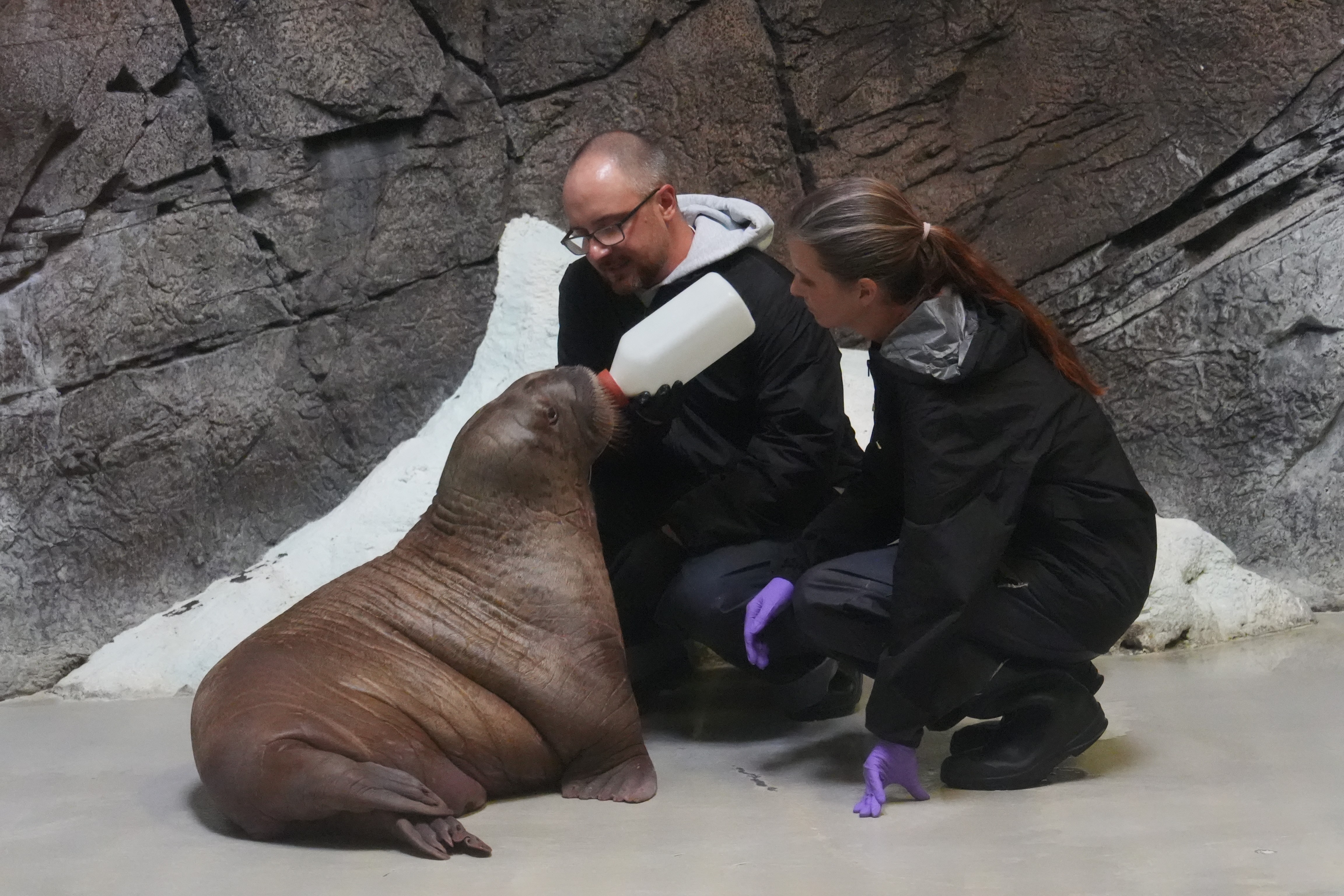
The calf, named Annautaq, has now transitioned to a permanent life at SeaWorld Orlando following a complex rescue and rehabilitation process. While the mission saved his life, federal authorities determined he could never return to the wild because he has become too habituated to human contact.
Saving the calf required immediate coordination with the U.S. Fish and Wildlife Service and the local Inupiaq community. For Anniskett, a member of the Inupiaq people, the decision to intervene was a matter of cultural importance. She told Alaska Public Media that since her community harvests animals for subsistence living, it was vital to seek community consensus before proceeding with the rescue through the SeaLife Center.
Once the researchers obtained permission to move him, stormy weather prevented transport for several days. During this window, the duo had to protect Annautaq from immediate threats, including active polar bears and a flock of scavenging gulls.
To provide shelter, Anniskett and Fischbach moved the calf into an abandoned building. Without access to specialized formula, they sustained him using a mixture of honey and water. The researchers stayed with him for nearly four days to provide the social contact a calf of his age requires. Annautaq frequently sought physical closeness, often attempting to sleep against the researchers to avoid the loneliness of his situation.
Annautaq arrived at the Alaska SeaLife Center on September 14. Although he was dehydrated and required treatment for superficial wounds with antibiotics, he was considered to be in good condition.
Walruses maintain one of the strongest mother-child bonds among pinnipeds, a relationship that typically lasts between one and two years.
Because of this intense social requirement, caretakers at the SeaLife Center had to act as surrogate mothers, providing around-the-clock physical contact, feeding support, and social interaction. This level of human intervention is precisely what prevented his eventual release into the Alaskan ecosystem.
The U.S. Fish and Wildlife Service ultimately decided that Annautaq could not be released into the wild.
Now weighing approximately 250 pounds, Annautaq receives up to six bottle feedings every day. He recently completed his quarantine period and has begun the process of integrating into a herd. His first social milestone involved meeting Uki, a two-year-old walrus who was also rescued from Alaska, with the two animals interacting through a protective barrier.
Related reading

Former Minister Opens Filipino-Inspired Cafe to Build Community
“It’s better to take a risk and do something than to stay home and do nothing,” Rev. Danilo...

Idaho Man Sentenced to 18 Years for Plotting ISIS-Inspired Church Attacks
An Idaho man faces 18 years for ISIS-inspired church attack plot Alexander Scott Mercurio, a 21-year-old from Coeur...
Wilmington Honors 128th Anniversary of 1898 Coup and Massacre
“The wreath is more than an arrangement of flowers; it is a symbol of remembrance, a symbol of...

North Dakota State Bison Travel to Hawaii to Face Rainbow Warriors on Saturday Night
The North Dakota State Bison are headed to the islands for their first-ever trip to Hawaii this week...