
Albuquerque Public Schools demonstrated its expanded safety infrastructure Wednesday at Cibola High School, showcasing visitor management software and wearable panic badges the district says cover 142 schools across 1,200 square miles.
The presentation marked a walkthrough of the CENTEGIX Visitor Management system alongside the CrisisAlert badges APS began deploying in early 2024. Deputy Superintendent Antonio Gonzales told reporters the goal is to preserve a welcoming atmosphere while tightening the procedural side of campus access.
During the 2025–26 school year, staff triggered more than 4,100 alerts — an average of 23 per day — according to figures APS shared. The district said 96 percent of those activations were routine requests for staff assistance. More than 3,200 involved student behavior or students leaving supervised areas, while over 200 were for medical situations. Only one alert involved a firearm, at the West Mesa campus.
“It is an immediate response that quite frankly is seconds as opposed to minutes,”
Carmella Salazar, assistant principal at Cibola High School, described the desktop takeover that occurs when a badge is pressed: responders see the employee’s precise location instantly. “We can respond within 30 seconds to a minute, depending on where someone is,” Salazar told KOAT. “Sometimes all ten of us show up. Sometimes it’s three of us.”
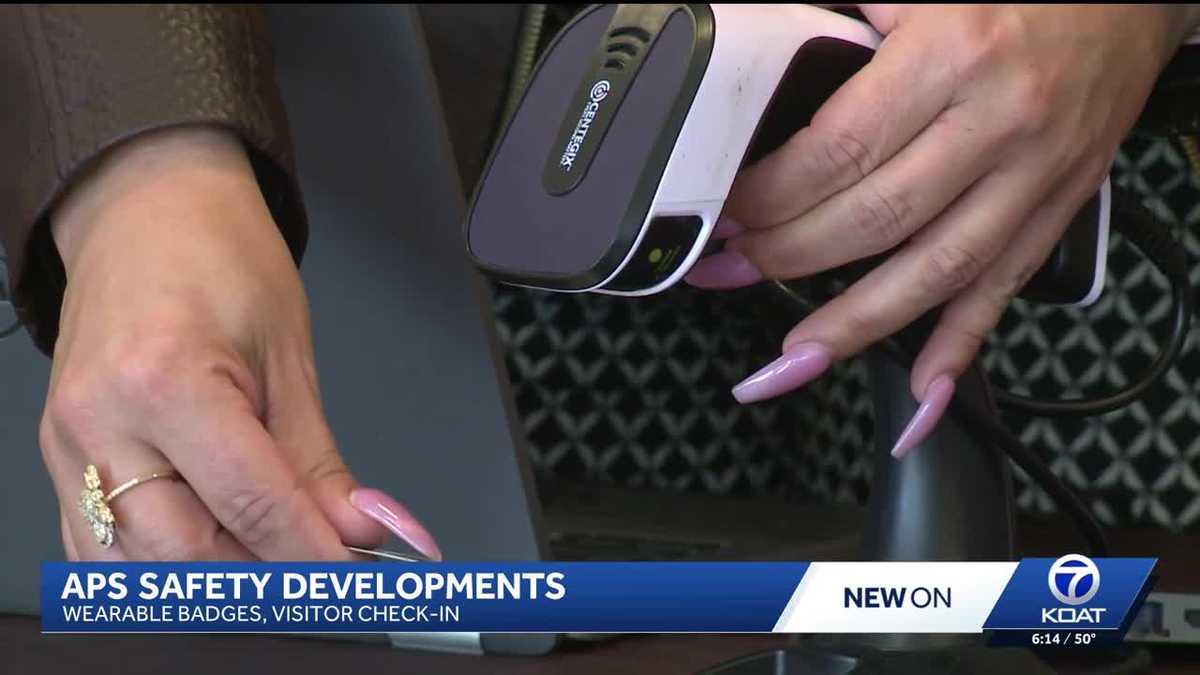
The new visitor management layer requires every guest to present an ID, which is scanned and cross-referenced against the sex offender registry. Approved visitors receive a sticker displaying their name, purpose, and location.
KOAT noted that Santa Fe Public Schools has run similar registry checks since 2018, and Rio Rancho Public Schools has used a comparable system for several years; APS previously required ID but did not run it through any database.
“It gives our front office teams greater visibility into who is visiting our campuses while making the process more efficient for families and for guests,” Gonzales said.
KOAT reported the district has invested $2.8 million in the wearable technology, with an ongoing annual cost of roughly $1.1 million. The badges operate using Bluetooth technology, meaning they function inside buildings, on athletic fields, and at off-site venues such as Milne Stadium without relying on Wi-Fi. A three-press sequence summons immediate help; eight presses initiate a lockdown.
CENTEGIX CEO Brent Cobb framed the deployment as broader than active-shooter preparation. “School safety is about more than preparing for extreme events,” Cobb said in the GlobeNewswire release. “It’s about making sure staff have the support they need in the everyday moments.”
APS leaders characterized the technology as one layer of a larger strategy. The next step, Gonzales said, is continued coordination with emergency response personnel and refinement of response protocols across the district’s sprawling footprint.
Worth a look

Taylor Swift Returns to CMA Awards After 13 Years; Ella Langley Leads Nominations
Taylor Swift returned to the Country Music Association Awards for the first time in 13 years Wednesday night,...

Retired South Dakota Judge Marshall P. Young Dies at 90
The South Dakota Unified Judicial System announced Monday that retired Judge Marshall P. Young died Nov. 4 in...

Columbia Professor, Wife Sue Ex-Student for $10M Over ‘Fatal Attraction’ Harassment; She Countersues for Sexual Assault
A former Columbia Business School professor and his wife filed a $10 million lawsuit Tuesday in Westchester County...

Dauphin County Commissioners Approve 2027 Budget Without Tax Increase
Dauphin County commissioners approved a $220 million budget for 2027 on Wednesday, closing a projected $28 million deficit...