
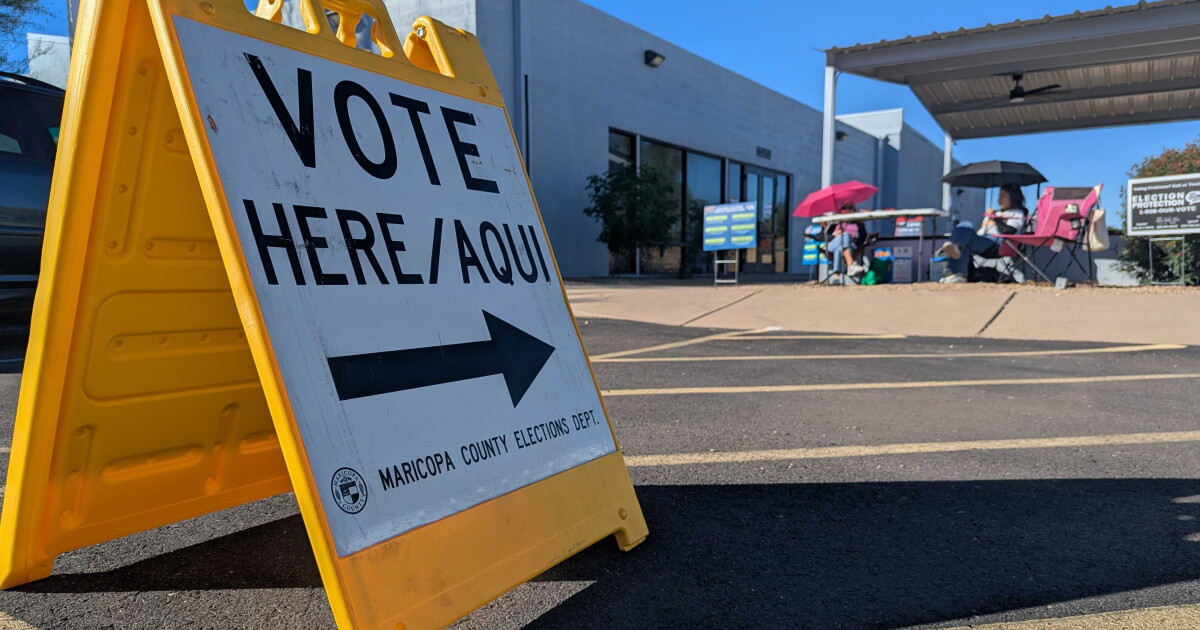
Arizona certified its 2026 midterm results Monday, closing a canvass that proceeded without the disruptions or protests that marked prior cycles.
The statewide certification followed last week’s county-level canvasses, which opened a five-day window for candidates to file lawsuits challenging the results. It remains unclear whether any candidate plans to do so, Arizona Mirror reported.
Maricopa County Recorder Justin Heap did not attend his county’s certification, instead holding a separate press conference. Heap, who voted for election-denial bills as a state legislator, has clashed with the Maricopa County Board of Supervisors in court over hirings and firings and promoted a federal database that has repeatedly misidentified U.S. citizens as non-citizens, Arizona Mirror reported.
“They’re going to have to find a new grift,” Secretary of State Adrian Fontes told reporters after the canvass, referring to election conspiracy theories that have circulated for six years.
Statewide turnout reached 59.6%, down from 78% in the last cycle but up from 44.7% in the 2022 midterms, according to secretary of state data cited by Arizona Mirror and AzLuminaria. The state’s ballot-tracking system saw a 135% increase in use this cycle, Fontes said.

In Pima County, supervisors voted 4-0 to certify on Nov. 19, with District 1 Supervisor Rex Scott absent. Turnout there reached approximately 63%, surpassing both the 2022 midterm (47.3%) and the 2024 presidential election (nearly 61%), AzLuminaria reported. Officials counted 413,270 total ballots: 331,955 early ballots with zero rejections, 17,304 early ballots verified in person with ID, 61,827 vote-center ballots, and 39 conditional provisional ballots.
“This is an election that took months of effort and it went off flawlessly,” District 5 Supervisor Andrés Cano said at the Nov. 19 meeting.
Attorney General Kris Mayes said the midterm “went off without any violence or other issues. Thank God almost nothing happened.” She reaffirmed her commitment to the “fake electors” case against 11 Arizona Republicans who submitted fraudulent electoral votes after the 2020 election.
The Arizona Supreme Court declined to hear her appeal after lower courts ruled the grand-jury indictment was improper because prosecutors did not provide jurors a copy of the 1887 Electoral Count Act. “It’s a resource-heavy case,” Mayes said.
Fontes said he plans to work with the new Democratic legislative majority — the first since 1966 — to protect vote-by-mail and secure funding his office was previously denied.
Thank God almost nothing happened,” noting that fears about U.S. Immigration and Customs Enforcement officers appearing at polling places had been a major topic before the election. The Arizona Mirror reported that potential non-citizen voters flagged by the administration were largely found to be U.S. citizens incorrectly swept up by a flawed federal database.
District 5 Supervisor Andrés Cano said the election “took months of effort and it went off flawlessly,” offering the board’s gratitude to election workers, AzLuminaria reported.
As a state representative from the 10th district (2023–2025), Heap voted for election-denial bills and belonged to the Arizona Freedom Caucus.
Since becoming recorder in January 2025, he has clashed with the Board of Supervisors, filing a lawsuit in June 2025 — backed by America First Legal — to regain control over election IT, staffing and building access; a judge ruled in his favor in April 2026, though supervisors voted to appeal. Heap also promoted a federal database that repeatedly misidentified U.S. citizens as non-citizens, according to Arizona Mirror.
“This is one of my favorite days,” Arizona Supreme Court Chief Justice Ann Timmer said. “The peaceful transition of power is a hallmark of the United States’ elections and something to be admired.”
Keep reading

Amtrak Cascades Launches New Airo Trainsets on Seattle-Portland Route
Amtrak Cascades debuted its new Airo trainsets on the Seattle-to-Portland corridor on September 30, 2026, with train 503...

Portland Signs MOU With FIFA as 2031 Women’s World Cup Host Candidate
“Portland is the global epicenter of women’s sports. Our fans showed that in previously hosted women's world cup...
15-Year-old Girl Stabbed Outside Port Richmond High School
A 15-year-old girl was stabbed in the torso outside Port Richmond High School on Monday at 8:55 a.m.,...

Svi Mykhailiuk Scores Career-High 39 Points in Jazz Loss to Mavericks
Former Kansas guard Svi Mykhailiuk scored a career-high 39 points and hit 10 three-pointers off the bench Sunday...