
“Inaction is no longer an option,” said Maj. Gen. Eric Shirley, who leads the operation, CBS News reported.
The U.S. Army plans to detonate about 5 tons of degraded lead azide in 68 barrels at the Iowa Army Ammunition Plant in Middletown at 9 a.m. Central Time on Wednesday, the day before Thanksgiving, pending weather conditions, CBS News reported.
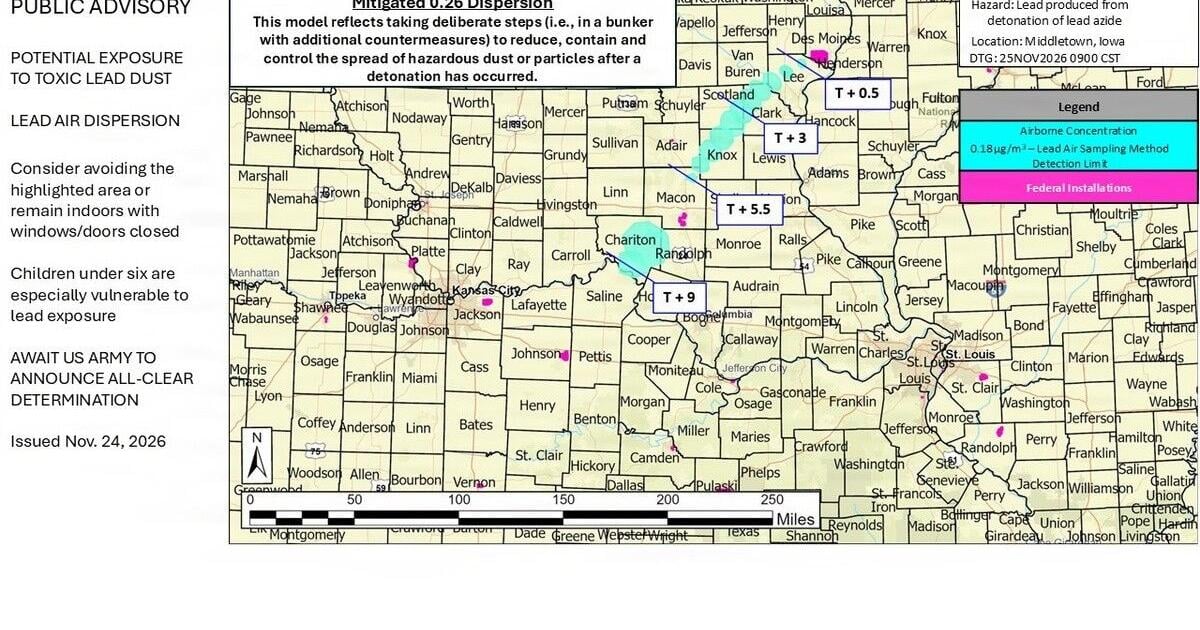
The plant sits slightly more than 25 miles north of the Missouri border, and updated Army maps show a plume of toxic dust drifting southwest toward northeast Missouri over an eight-hour window, ABC17NEWS and CBS News reported. A federal appeals court cleared the way Monday after delays prompted by lawsuits from environmental groups and concerns from elected officials in Illinois and Iowa, CBS News reported.
Why the Army says the blast is necessary
The lead azide has been stored for more than 20 years in earthen-covered containers submerged in a bath of ethanol and water to keep it stable, CBS News reported.
Army officials say moving the barrels now risks setting them off, and experts say the stockpile will grow more volatile as temperatures cool because less liquid makes the solution more prone to freezing, which raises the risk of a chain reaction, CBS News reported. The last controlled detonation of lead azide occurred in 1977, CBS News reported.
Plume maps show two fallout zones over Iowa and Missouri
Army plume modeling outlines two ground fallout zones based on EPA standards for lead dust on surfaces, ABC17NEWS reported. A blue-shaded area extending over 10 miles southwest of the facility covers central Lee County, Iowa, where lead dust levels could reach 100 micrograms per square foot — the EPA limit for dust on windows, ABC17NEWS reported.
A green-shaded area extends over 20 additional miles, indicating locations where lead levels could reach 5 micrograms per square foot, the EPA threshold for floors, reaching slightly into northern Clark and Scotland counties in Missouri, ABC17NEWS reported.
A separate map tracks airborne lead concentrations, which differ from the ground dust plume and could reach 0.18 micrograms per cubic meter, ABC17NEWS reported. Modeling shows airborne lead could be measurable as far south as Macon, Missouri, roughly eight hours after detonation, ABC17NEWS reported.
Officials said these airborne levels only pose health hazards under consistent, daily exposure, and because the blast is short-lived, the event will not harm the environment or residents of Missouri, ABC17NEWS reported. Illinois officials said Monday that NOAA’s latest model showed no Illinois counties would be affected, CBS News reported.
Army adds barriers and warns residents to shelter indoors
The Army has added blast barriers around the bunkers, plans to apply ballistic gels and foams to absorb dust, and will douse the materials with thousands of gallons of water, CBS News reported. An emergency alert sent to cellphones Tuesday morning said some people within 5 miles southwest of the plant may be evacuated and told people up to 20 miles away to stay indoors with windows closed, CBS News reported.
The Army advises residents to avoid outdoor air, keep windows and doors closed, set HVAC systems to recirculate, and wet-clean surfaces that may be contacted by infants or children after the blast, Iowa Public Radio reported. Dust is expected to linger for “no more than one hour,” depending on wind speed, with a potential for localized window damage, Iowa Public Radio reported.
Lead neurotoxin risks highest for children in affected areas
Lead is a neurotoxin that poses the greatest risk to children, potentially causing learning disabilities or developmental challenges if exposure occurs at critical stages, Iowa Public Radio reported. Peter Thorne, a professor of occupational and environmental health at the University of Iowa, said most lead exposure doesn’t lead to cancer, though the EPA classifies lead as a probable human carcinogen based on animal studies at very high doses, Iowa Public Radio reported. He suggested some families may want follow-up blood lead tests for children in a few months, though that expense would fall on them, Iowa Public Radio reported.
The USDA estimates 250 farms could be impacted, and Iowa cattle farmer Steve Lucie said, “If we don’t have a healthy herd, we don’t have a healthy paycheck,” expressing concern about soil and livestock health, CBS News reported.
Missouri Gov. Mike Kehoe said state agencies are setting up additional monitoring of air and water quality, CBS News reported. The Army said soil, air and water near the site are being tested before and after the detonation, Iowa Public Radio reported.
“We're very concerned about what that's going to do to the health of our soil and our livestock,” Steve Lucie, Iowa cattle farmer, said.
Forecast maps change with weather and update hourly
The maps are forecasts and will change with the weather; a change in wind speed or direction, or the presence of clouds, can affect the viability of the detonation and the resulting path of lead dust, ABC17NEWS reported. Under the EPA’s permit, the Army must update its plume forecasts six hours before the detonation and hourly after that until it is finished, CBS News reported.
The Army Sustainment Command said it will release the latest version of the maps six hours in advance and every hour thereafter until the detonation, then issue a final estimate of the affected area, Iowa Public Radio reported.
The Army’s forecasts do not establish that harmful exposure will occur at every location inside a projected plume, and sampling will be needed to show where lead settles on farmland, playgrounds and other surfaces, CBS News reported.
Related reading

Man Charged With Forcing Oral Sex on Woman in University of Minnesota Dorm, Admits “I Should Have Stopped”
A 19-year-old Minneapolis man faces a felony charge of fifth-degree criminal sexual conduct after a woman told police...

Columbia County Officials Consider One-Year Data Center Moratorium Tuesday
Columbia County officials will consider a one-year moratorium on new data center projects Tuesday to prevent developers from...

Boise State Falls Out of CFP Rankings After Loss to San Diego State; No Group of Six Teams Ranked
Boise State dropped out of the College Football Playoff rankings on Tuesday after a 22-20 home loss to...

BermudAir to Operate Four Routes From New Orleans in 2027
The Bermuda-based carrier will operate twice-weekly service on Wednesdays and Saturdays to Providenciales, Turks and Caicos (PLS); San...