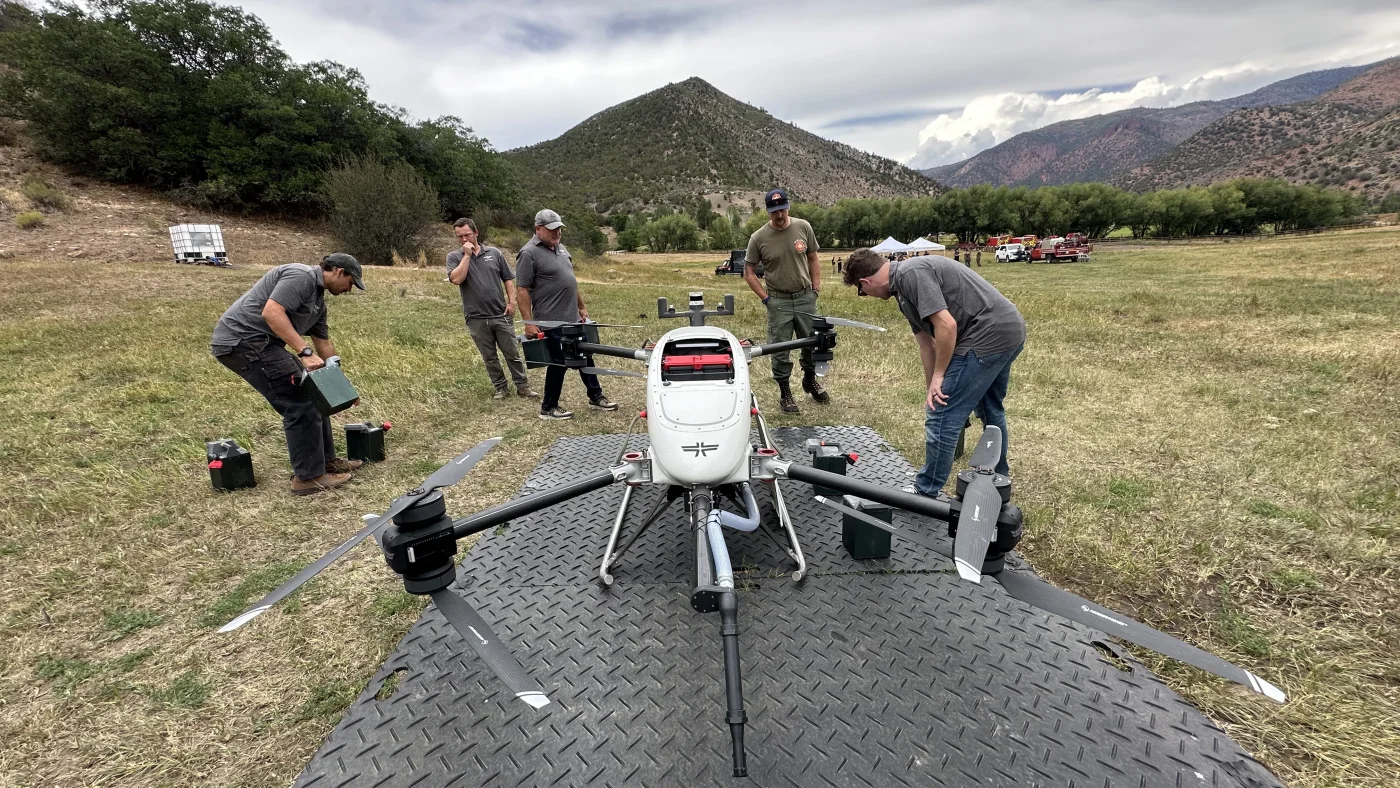
Fire crews in Aspen, Colorado are training to pilot new artificial intelligence-enabled firefighting drones developed by California-based company Seneca, NPR reported.
The aircraft look like giant bugs, measuring about 10 by 12 feet wide with propellers attached to four large arms. They are roughly the size of a small U-Haul trailer.
Once staff complete training, the Aspen Fire Protection District will become the first fire department in the world to operate the drones independently. Previous tests occurred only on prescribed burns in California with support from Seneca’s staff.
The drones are designed to operate in swarms. Five of them can carry between 500 and 1,000 gallons of finished fire foam, functioning much like a small fire engine.
Aspen Fire plans to use the machines to tackle hard-to-reach blazes like remote lightning strikes before they grow. Dense forests and limited evacuation routes surround the city, creating high wildfire stakes.
“If we could get it quick, keep them small and attack them while they’re smoldering instead of waiting for the wind to pick them up, I feel like that’s the most ideal use case,” said Andy Fisher, deputy chief of Aspen Fire. Fisher also noted the ease of operation, saying, “We were just joking that my 12-year-old could fly these things.”

According to Seneca founder Stuart Landesberg, the drones use an AI-supported sensor suite to calculate distance and wind speed while hovering over a fire. They can then release water or retardant at a specific angle and velocity.
Landesberg compared the navigation system to a flying Waymo. The drones have a range of 5 to ten miles, which doubles when they are empty.
Aspen Fire will pay roughly $2.5 million over five years for the program, with private donors funding the cost. Other fire departments nationwide are watching to gauge the experimental technology’s effectiveness.
Joe Stutler, a firefighter with nearly 60 years of experience who is unaffiliated with the department or Seneca, expressed interest in the technology’s potential to fight fires overnight when manned aircraft are typically grounded.
“You look at how many wildland firefighters that have died this year — some aviation accidents,” Stutler said. “We say, ‘Gosh, we really want a retardant or water drop here.’ … We transfer risk to those people that are flying those helicopters and those air tankers.”
However, Stutler remains skeptical because Seneca has only tested the drones on prescribed burns rather than active wildfires. “I haven’t seen any results,” he said. “It’s one thing to make a claim. It’s something else to back it up with data.”
The Federal Aviation Administration granted Aspen Fire a waiver in late October to fly the drones up to 200 feet in Pitkin County, provided operators maintain visual contact at all times.
Keep reading

Jordan Poole and Draymond Green Open to Potential Warriors Reunion
Jordan Poole made it clear after a game on Monday night that he would welcome a return to...

Karina LeBlanc Reflects on the Growth of Women’s Sports in Portland
In a column published on LinkedIn, Karina LeBlanc reflected on Epicenter Week and the growth of women's sports...

Franklin Circuit Court Grand Jury Indicts Ten Individuals on Felonies
Franklin Circuit Court grand jury indictments handed down on Tuesday charge ten individuals with felonies, the State-Journal reported....

Executive Team Transitions Announced – The University of Kansas Health System
Executive leadership changes are coming to The University of Kansas Health System, primarily affecting the St. Francis and...