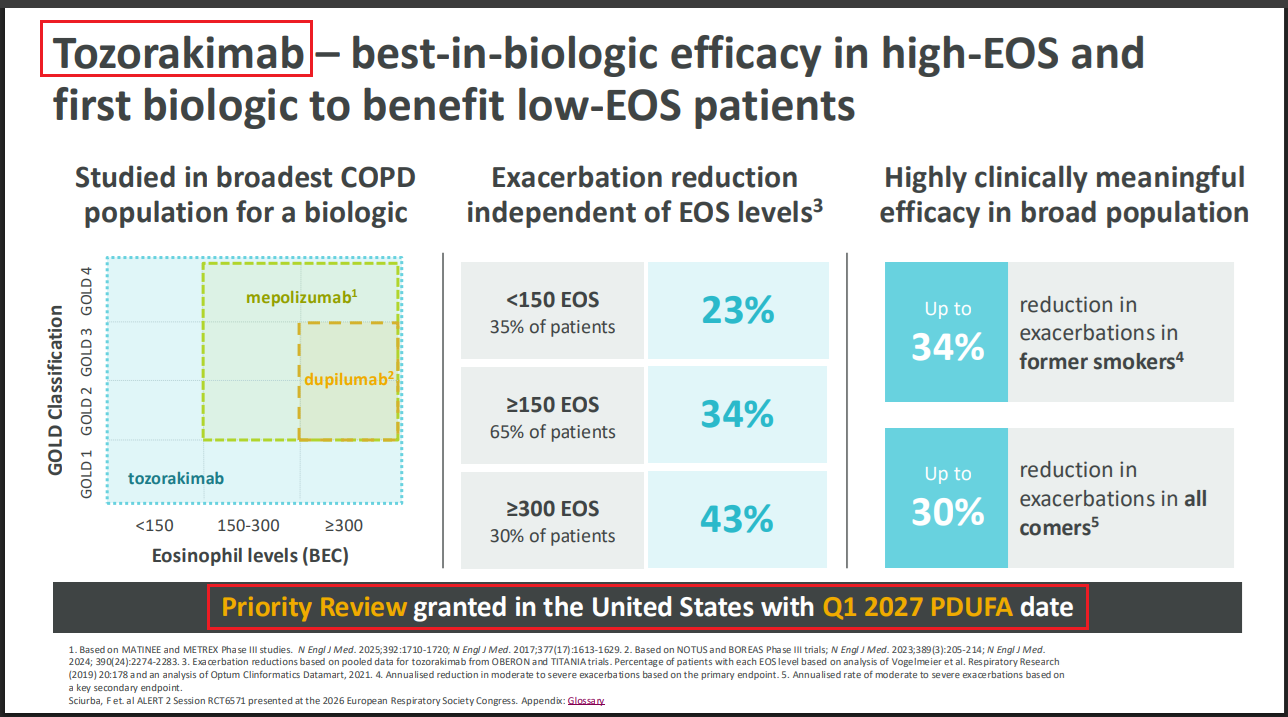
AstraZeneca's tozorakimab cut COPD flare-ups by 30 percent across a broad range of patients in two Phase 3 trials this year.
New biologic drugs are finally giving doctors something to offer patients with chronic obstructive pulmonary disease after decades of therapeutic stagnation, with one treatment expected to win approval next year that cut flare-ups by 30 percent across a broad range of patients regardless of inflammation type.
For 20 years, pulmonologists like Dr. MeiLan Han, chief of pulmonary and critical care at the University of Michigan Health, could only tell patients “the answer was no, no, no” when asked about new treatments.
“That's a paradigm shift in our thinking,” Dr. MeiLan Han, chief of pulmonary and critical care at the University of Michigan Health, said.
“We're now beginning to realize that C.O.P.D. for some people actually begins in childhood,” Dr. MeiLan Han, chief of pulmonary and critical care at the University of Michigan Health, said.

Now dupilumab, approved in 2024, and mepolizumab, approved in 2025, reduce exacerbations in patients with a specific inflammatory profile. But they don’t work for everyone.
Two Phase 3 trials this year showed tozorakimab, made by AstraZeneca, reduced exacerbations by 30 percent across a broad range of COPD patients, not just those with a particular type of inflammation. The drug is expected to be approved in 2027.
“One exacerbation is one too many,” said Dr. Francesca Polverino, a professor of medicine at Baylor College of Medicine in Houston and spokeswoman for the American Lung Association.
Each flare-up accelerates disease progression and raises the risk of heart attacks and death. “You can have a stepladder-like decrease in lung function, which is permanent,” said Dr. Surya Bhatt, a professor of medicine at the University of Alabama at Birmingham.
Valerie Chang, a retired attorney who founded the Hawaii COPD Coalition and has lived with the disease for 26 years, took dupilumab for a year before switching to mepolizumab. After picking up an infection at a wedding in October, she experienced her first exacerbation in two years. “That’s a win,” she said.
Underdiagnosis remains widespread. Stigma tied to smoking keeps people from seeking care, and access to spirometry — the breathing test that confirms the diagnosis — is limited. The majority of cases are estimated to be undiagnosed.
Symptoms include shortness of breath during routine activities like making the bed or cooking, and a persistent phlegmy cough.
Standard treatment includes smoking cessation support, immunizations, pulmonary rehabilitation, long-acting inhaled bronchodilators, and inhaled steroids. Some physicians also prescribe azithromycin or other anti-inflammatories.
COPD is the third leading cause of death worldwide, and its burden is expected to grow as the population ages.
Related reading

Doc Giffin, Arnold Palmer’s Confidant and Assistant, Dies
Giffin served Palmer from 1966 until the golfer’s death in September 2016. He previously worked as press secretary...

Naderi Retaken Penalty Sends Rangers Top After Dramatic Falkirk Win
Ryan Naderi converted a retaken penalty in the 99th minute to give Rangers a 2-1 victory over Falkirk...

2026-27 FCS Football Playoffs: Bracket, Schedule, and National Championship Details
The 2026 FCS football playoffs feature a 24-team bracket, with the tournament commencing Saturday, Nov. 28 and culminating...

Magic at Wizards: TV Channels, Streaming Options, Free Trials, Betting Odds
The Orlando Magic (7-10) visit the Washington Wizards (7-12) Saturday at Capital One Arena for their third meeting...