
In a new conversation published by the Association of Writers & Writing Programs, poet Heather Frankland and writer Kara Douglass Thom detail how a mentorship pairing built on shared geography reshaped a manuscript and reframed the sting of rejection.
The exchange, which ran on awpwriter.org, follows Season 23 of the AWP Writer to Writer Mentorship Program. Thom, a Minnesota-based writer who grew up in the Southwest, was matched with Frankland, a New Mexico poet originally from the Midwest. Their mirrored trajectories — Thom living in the Midwest, Frankland in the desert — created an immediate shorthand that accelerated the work.
Thom entered the program struggling to curate thirteen years of poems into a chapbook braiding her own midlife experience with the middle years of Georgia O’Keeffe. Frankland, who holds an MFA and a master’s in public health, recognized the subject matter quickly.
“In my opinion, menopause is most certainly a matter of public health,” Thom said. Frankland’s feedback ranged from line-level edits to structural strategy, helping Thom see the manuscript as a cohesive collection rather than a pile of individual poems.
The breakthrough arrived during their first session. Frankland offered an analogy: treat a poetry manuscript like a music album. “In an album, we see how the songs go together. Generally, the slow songs aren’t all together, nor are the fast songs,” Frankland said.
She described the need for tempo shifts and “palate cleansers” — lighter poems that let heavy material resonate without exhausting the reader. “Whales dive deep, but no matter how deep they dive, they have to come up for air,” she said. “That is the same way for an audience.”
For Thom, the comparison was clarifying. “I felt like a math student who finally understood how to solve a vexing equation,” she said. “Where before selecting the order of poems was my best guess, now I had a pattern to play with.”
The conversation also turned to the business side of publishing. Frankland introduced the “rejection jar” — a physical container where a writer deposits a token for every manuscript sent out.
The idea, credited to a guest post by Zoe Fay-Stindt on Trish Hopkinson’s site, reframes rejection as evidence of effort. “It honors the energy you spent sending your work out in the world,” Frankland said. “It shows that the real rejection is when you don’t try.”
Thom embraced the practice but pushed back on the language of submission. “I try to avoid using the word ‘submit’ or ‘submission,'” she said. “Despite its proliferation in the writing world, we hardly consider how demeaning it sounds; how it can put the writer in a one-down position.”
She prefers “share,” “apply for,” or “send for consideration.” On the word rejection itself, she is unbothered. “The more rejections, the more I’m creating; the more I’m pursuing my art, living and leaning into it,” Frankland said.
Both writers stressed that community sustains the solitary act of writing. Frankland has founded or joined writers’ groups in nearly every place she has lived, including a cohort from Marge Piercy’s 2022 Summer Intensive Poetry Workshop that still meets over Zoom.
As poet laureate of her town and county from 2024 to 2026, she built local programming. “You can’t be a great writer if you aren’t reading,” she said. “You gather inspiration from others, but more so, you show up for them as well.”
Thom said Frankland’s modeling has pushed her toward deeper engagement — attending readings, launching books, meeting peers for coffee. “I’m especially grateful to AWP for the opportunity to build my poetry community with Heather in the Writer to Writer Mentorship Program,” Thom said.
Since the mentorship, both writers have advanced new projects. Thom’s first middle-grade novel, “Sweet, Tart,” was published by Candlewick Press in February 2026. The book weaves poems by Ross Gay, Ada Limón, Connie Wanek, and Witter Bynner into the narrative.
She is now drafting another middle-grade manuscript while continuing to arrange her chapbook, poems printed and taped to her office wall. “I keep plucking poems off, putting poems back on, rearranging,” she said. “It’s not quite there yet but moving toward critical mass.”
Frankland published a chapbook, “The Wanderer,” earlier this year as part of “Cacti Fur Collective Volume I” from Grandma Moses Press, a split volume with three other New Mexico poets. She is sending out “Blood Mangos,” a manuscript inspired by her Peace Corps service in Peru and Panama that was a shortlist finalist for the 2025 Steel Toe Book Awards.
A second book, “Seasons of the Crone,” awaits summer revision. “It does feel refreshing to work on this different project, to see how this book can be gathered and grown,” she said.
Keep reading
Pacers Guard Braden Smith Set to Make G League Debut With Noblesville Boom
Braden Smith, the Westfield native who became the NCAA’s all-time assists leader at Purdue, will make his G...
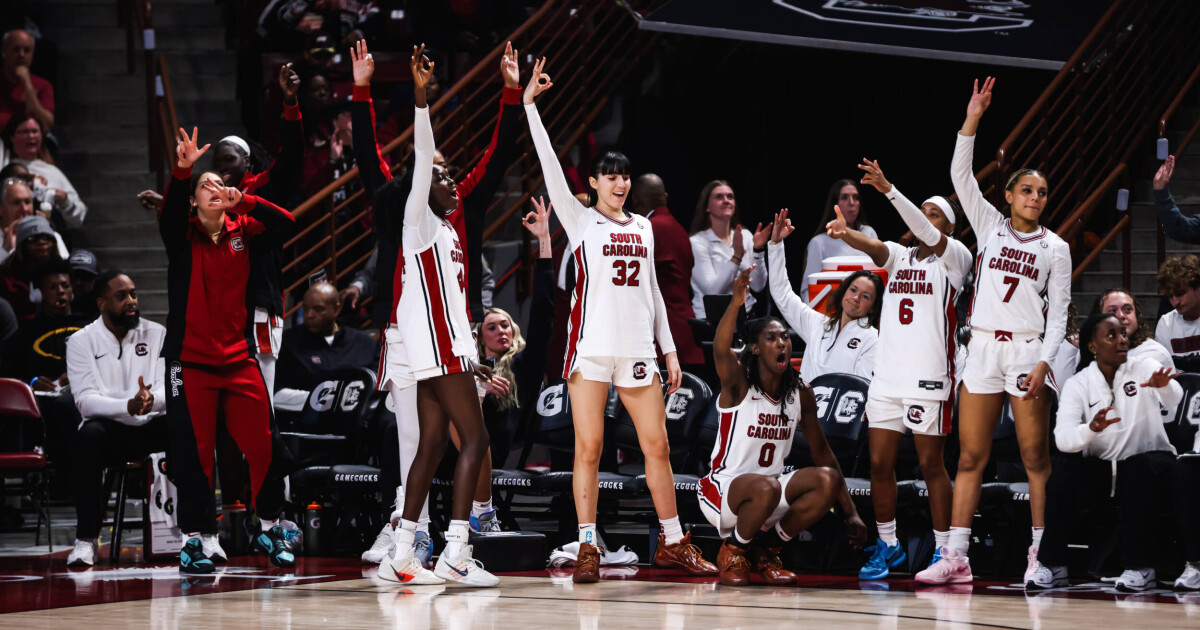
No. 1 South Carolina Routs Florida Gulf Coast 116-58 in Home Opener
Joyce Edwards scored 20 points and No. 1 South Carolina routed Florida Gulf Coast 116-58 Tuesday night in...

Stephen Edward Herzog, 71, Providence ‘Bud Man’ and Accomplished Golfer, Dies
Stephen Edward Herzog, a lifelong Providence resident known across Rhode Island for a quarter-century delivering beer as "Steve...

Salem Listing Hits Market at $429,900
Salem, Utah, just got a fresh listing at 1561 N 305 E #17, a townhome priced at $171...