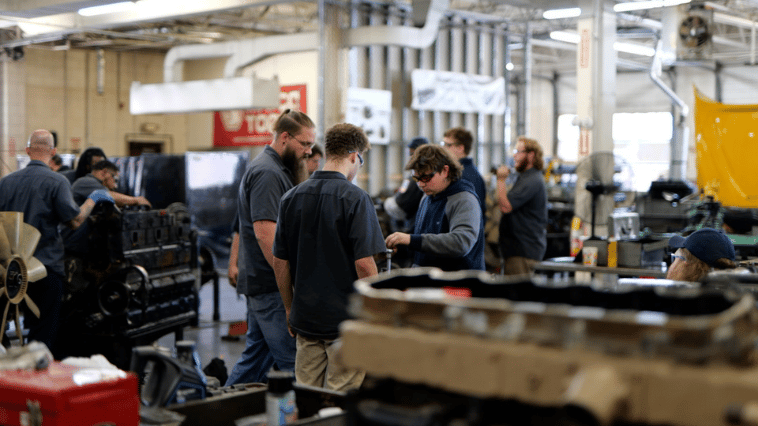
Baltimore students can enter diesel mechanic training in about nine months, not the two years many expect, North American Trade Schools reported.
- The day program runs for 39 weeks; the evening program runs for 58 weeks at NATS.
- No Maryland state license is required to work as a diesel technician.
- Graduates qualify for Freightliner, Detroit Diesel, Mercedes-Benz, and Cummins certifications.
- The U.S. Bureau of Labor Statistics projects 24,400 annual job openings through 2035.
Program runs 39 weeks days or 58 weeks evenings
The Diesel Technology program at North American Trade Schools takes 39 weeks of day classes or 58 weeks of evening classes. Day classes run full-time on weekdays while evening classes run part-time for students who work during the day. Both schedules start several times a year.
What students learn
Training covers engines and fuel systems, air and hydraulic brakes with ABS, automatic and manual transmissions, rear differentials, suspension and steering including air ride, and electrical and computer systems. Students practice on real engines and equipment in the NATS diesel shop.
Modern trucks use onboard computers to run the engine and brakes, so many repairs start with a computer scan. Technicians also add emission control systems to older engines to meet pollution rules.

Industry certifications
After finishing the program, graduates are eligible to earn certifications from Freightliner, Detroit Diesel, Mercedes-Benz, and Cummins, including Cummins Insite diagnostic software used by many shops. Getting ASE certified is voluntary and involves passing an exam plus accumulating hands-on work experience; the NATS program gives students a head start on qualifying. Most ASE certifications require about two years of experience, and formal training can count toward part of that time.
Maryland requires no license for diesel technicians
No state license is required to work as a diesel technician in Maryland. Graduates can apply for entry-level jobs immediately. Employers include trucking companies, bus fleets, repair shops, railways, and heavy equipment companies.
Major undertakings such as rebuilding the key bridge are generating fresh demand for diesel techs to keep construction fleets and heavy equipment running. The U.S. Bureau of Labor Statistics projects about 24,400 job openings for diesel technicians and mechanics each year from 2025 to 2035.
Cost and financial aid
Cost depends on the program chosen and how long a student takes to finish; staying on schedule helps keep the cost down. Most students do not pay entirely out of pocket. Federal grants, student loans, and payment plans can help cover tuition for those who qualify. NATS is accredited by the Accrediting Commission of Career Schools and Colleges, which affects eligibility for federal financial aid.
Ask about shop time accreditation and full cost
Prospective students should ask how much shop time is included, whether day and evening classes are offered, if the school is accredited, what job placement services exist, and the full program cost including tools and fees.
NATS provides a separate Diesel Technology with CDL program for students who also want a Class A CDL. Eligible veterans may use VA education benefits. The NATS campus is at 5760 Wabash Avenue in Baltimore; prospective students can book a campus visit to tour the diesel shop.
Related reading

King Tides and Storm Surge Batter Washington Coast Ahead of Thanksgiving
Coastal flooding struck Western Washington ahead of Thanksgiving as king tides and storm surge combined to overwhelm shorelines...

Malin Akerman Details Connecticut Home’s DJ Room, Move From L.A.
"I have a room with a disco ball, DJ mixing deck and a laser and smoke machine. I...
Columbia to Deploy Crews for First Winter Storm; Silvey Street to Close, Parking Limits Set
Columbia Public Works will deploy a 16-person crew at 7 p.m. Wednesday to pretreat roads ahead of the...

Flanker SLC Advises Early Planning for Company Holiday Parties to Secure Venue, Budget, and Culture Benefits
Flanker Kitchen + Sporting Club in Salt Lake City advises companies to begin planning holiday parties months ahead...