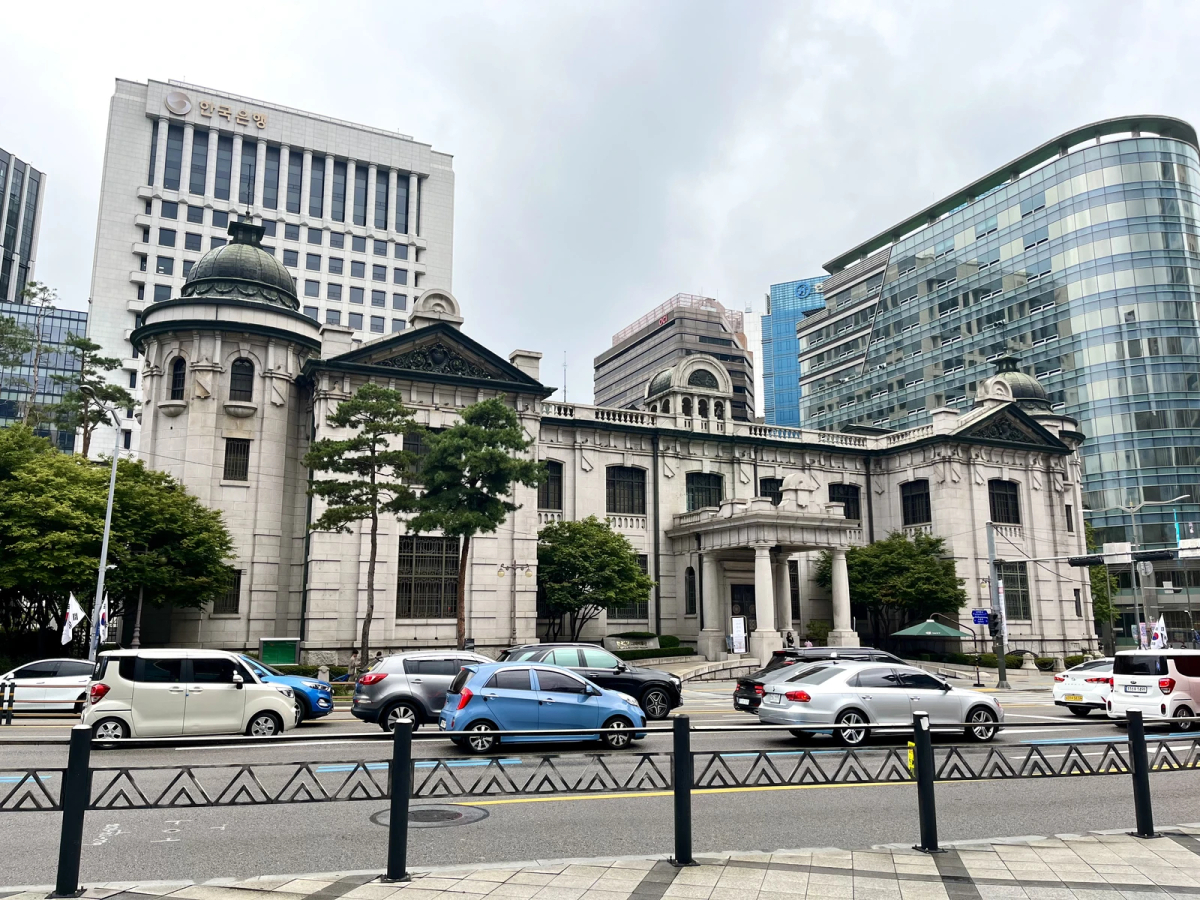
South Korea’s central bank raised its benchmark rate by a quarter point to 3.25% on Thursday, its highest level since November 2024, AP News reported.
The Bank of Korea lifted its 2026 growth forecast to 3.9% from 3.3% and its 2027 projection to 4.1% from 2.9%, citing an AI-driven semiconductor export boom, according to CNBC. Governor Shin Hyun-song told reporters that domestic chipmakers’ operating profits could reach 700 trillion won this year — more than one-fifth of projected national income. “That 700 trillion won will not disappear into a black hole,” Shin said, explaining the earnings would flow back through corporate taxes, dividends and investment, The Korea Times reported.
Consumer prices rose 2.8% in October, above the bank’s 2% target, and core inflation ran at 2.7%.
Household debt hit a record 2,030 trillion won ($1.51 trillion) in the third quarter, nearing the size of annual GDP. Shin said consumer prices are expected to remain above the bank’s target until sometime in 2028.
The rate decision was not unanimous.
Two of the seven monetary policy committee members voted to hold at 3%, AP News reported. The bank also removed the word “pace” from its forward guidance, showing a slightly less hawkish stance toward future hikes, Yonhap News Agency reported.
| Year | Previous forecast | Revised forecast |
|---|---|---|
| 2026 | 3.3% | 3.9% |
| 2027 | 2.9% | 4.1% |
In its economic outlook report published the same day, the Bank of Korea released a baseline forecast of 4.1% for next year and 3.0% for 2028.
“The projections of high growth rates for next year and beyond also reflect the significantly increasing weight of the IT sector as a growth engine for the Korean economy,” BOK Governor Shin Hyun-song said.
Following the benchmark interest rate increase, major financial institutions experienced intraday declines, with KB Financial Group and Hana Financial Group trading down 2.16% and 2.15% respectively due to limited profitability from falling market interest rates.
According to The Korea Herald, Bank of Korea Gov. Shin Hyun-song took office on Tuesday for a four-year term running until April 20, 2030, following his appointment by President Lee Jae Myung.
Previously serving as head of the Monetary and Economic Department at the Bank for International Settlements since 2014, Shin is a renowned macroeconomist with academic experience at Oxford University, the London School of Economics, and Princeton University, alongside advisory roles at the International Monetary Fund, Bank of England, and Federal Reserve Bank of New York.
Upon taking the helm, Shin outlined priorities including flexible monetary policy, structural economic reforms, and financial stability to navigate supply shocks from the Middle East conflict.

Private consumption contracted 0.2% in the third quarter, its first quarterly decline in nearly four years, The Korea Times reported. The central bank lowered its forecast for private consumption growth this year to 1.8% from 2.1.
Capital Economics senior Asia economist Gareth Leather told CNBC the tightening cycle may be nearing its end, citing a strengthening won and the likelihood that the bank will favor macroprudential measures over further rate hikes to address rising property prices.
“Inflation is expected to remain above the target level for a considerable time, as higher cost pressures continue to feed through to prices and demand-side pressures gradually build amid stronger economic growth,” Shin said.
Worth a look

Kansas City Air Charter Services Offer Flexible Travel, Jettly Connects Clients
Private aviation travelers across the Kansas City metropolitan area utilize air charter services for flexible and efficient travel...

Texas Democrats Sweep Supreme Court Races, Gain Influence on 5-4 Court
Texas Democrats swept every statewide office this year, securing four seats on the Texas Supreme Court in an...

Cris Carter Rips Ohio State Program, Ryan Day Ahead of Michigan Game
The annual college football matchup known as The Game arrives on Saturday with the Ohio State Buckeyes hosting...
Phil Hanley to Perform at Hyena’s Comedy Night Club Albuquerque March 12, 2027
Comedian Phil Hanley will perform at Hyena's Comedy Night Club - Albuquerque on March 12, 2027. Ticketing platforms...