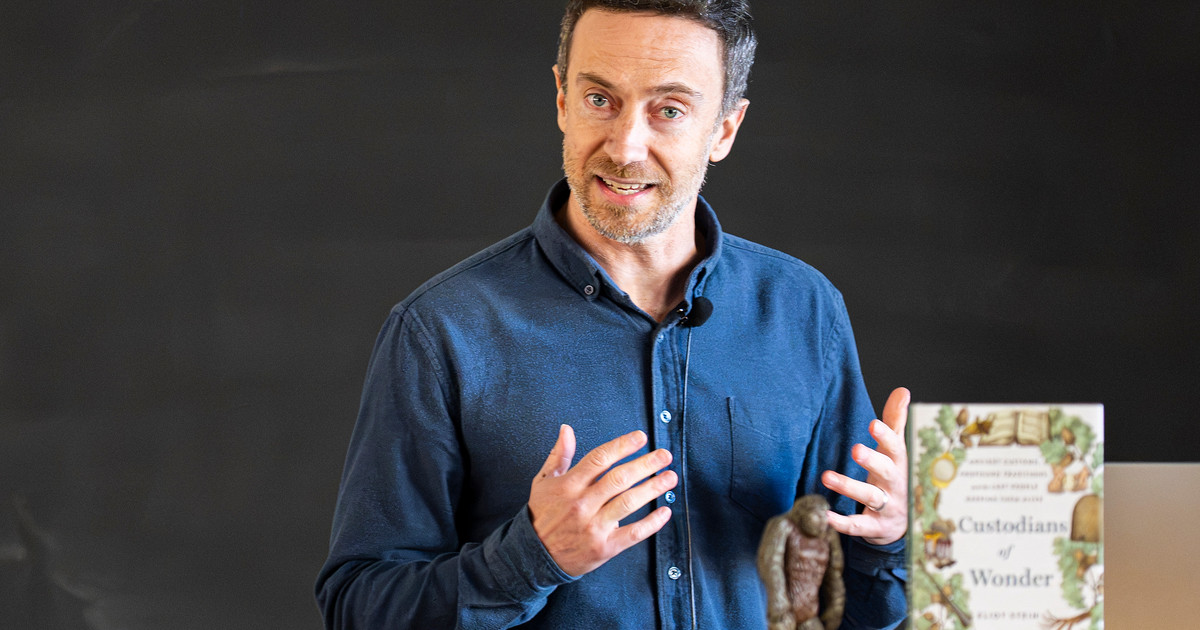
BBC Travel journalist Eliot Stein visited the University of Wisconsin–Madison on November 19 to deliver the keynote address for the 2026-27 Go Big Read program, which selected his book “Custodians of Wonder” for the campus-wide reading initiative.
The book profiles ten individuals preserving cultural traditions threatened by global homogenization, including Paola Abraini, a 73-year-old Sardinian woman who makes su filindeu, described as the “threads of God” and the rarest pasta in the world. Stein told students in an Introduction to Folklore class that the pasta represents “the idea of Sardinia itself — a reminder to the people who live there of who they are, where they came from and what they believe in.”
“It’s about why we humans do the things that might take a lot of calories and a lot of energy and might be gorgeous, or irrational, or completely impractical — but mean something to us,” Stein said during his classroom visit.
Interim Chancellor Eric Wilcots introduced Stein at the evening keynote in Varsity Hall, calling the selection “a perfect Go Big Read selection for the moment” because “at a time of change and uncertainty, it invites us to be inspired by people who are driven to preserve traditions in the face of change.” The university distributed close to 12,000 copies of the book to students and libraries, and incorporated it into more than 20 courses this fall.
Stein, a senior journalist and editor at the BBC, described how he built trust with his subjects — people he characterized as “humble” and “somewhat anonymous” who are “not celebrities.” He relied on local translators and approached each interview with “kindness, empathy, sincere curiosity and a willingness to deeply listen.”
“It really comes down to the Golden Rule,” Stein said. “What I’m looking for as a journalist is honesty and vulnerability and candor. So I am honest with my subjects. I’m vulnerable with my subjects. I’m candid with my subjects — because that’s what I want them to give me in return.”
Stein also revealed a personal connection to Wisconsin. As a BBC editor, he had dispatched a reporter to Madison several years ago to cover the discovery of 16 dugout canoes in Lake Mendota, one dating back 5,200 years. “This place was a thriving cosmopolitan place 400 years before the pyramids were ever constructed, 4,000 years before Europeans ever stepped foot on this continent,” Stein told the keynote audience. “And it’s truly mind-boggling.”
The visit marked Stein’s first trip to Wisconsin. His own path to global journalism began with a study abroad experience in Sardinia, which he called “the absolute best thing that I ever did in college. It opened my eyes. It changed my life. It set me on the path where I am right now.”
When asked for advice on studying abroad, Stein was direct: “Number one: Do it. Number two: Do it. Number three: Do it.”
He urged students to choose destinations as different as possible from their backgrounds. “Thrust yourself outside your comfort zone — that’s how you’re going to learn. That’s how you’re going to grow.”
Stein acknowledged a “sense of sadness in this book about these things that are fading away” but emphasized wonder at their persistence. “How amazing is it that these things are still here? It’s almost 2027, and you’ve got a guy crunching through a forest in Germany delivering handwritten love letters to a tree. There’s a guy climbing 12 stories to the top of a church to look for fires. You don’t need these things, but they’re beautiful and they somehow still exist against all odds. That’s amazing… The world’s an incredible place. You just have to go out and find it.”
Keep reading
Arkansas Drops Charges Against Little Rock Man After Police Shot His Dog
The state entered a nolle prosequi against Thomas Schmidt, 35, on Nov. 19, formally declining to pursue charges...

Woman Shot in Head by Stray Bullet in Albany; 3 Suspects Arrested
Officers heard gunfire at 11:34 a.m. on Sherman Street; a simultaneous 911 call reported shots near Elk Street...

Wyoming AG Kautz Asks High Court to Rebuff Ruling Striking Down Three 2025 Abortion Laws
Wyoming Attorney General Keith Kautz asked the state Supreme Court to overturn a district judge's June ruling that...

Whitmer Honors Hollister at Memorial as City Hall Opens to Public
Gov. Gretchen Whitmer and local leaders honored former Lansing Mayor David Hollister at a public memorial Monday, the...