Beaufort County Council rejects Pine Island rezoning
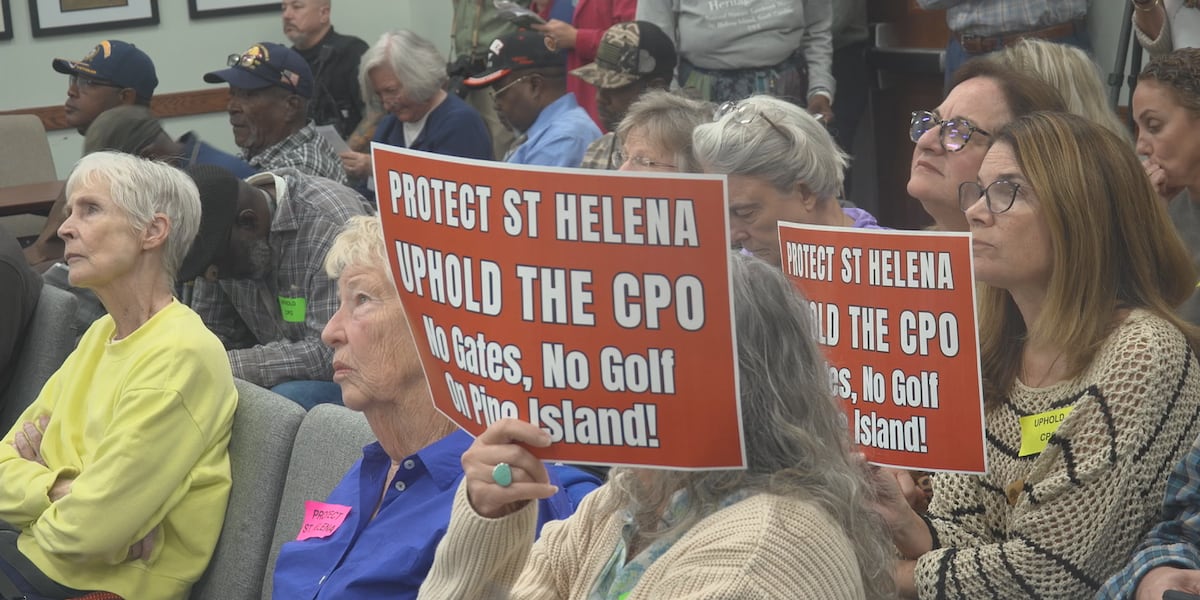
Beaufort County Council denied a request Monday to rezone a 502-acre St. Helena Island property, blocking a proposal to build a golf resort on the land known as Pine Island.
The decision follows a marathon session on Nov. 9 that pitted developers against local residents fighting to maintain the area’s existing protections.
The council’s vote effectively upholds the St. Helena Cultural Protection Overlay, a regulatory boundary that prohibits the construction of golf courses, resorts, and gated communities within its limits. According to reporting from The Island News, the council rejected the ordinance during its first reading and public hearing, voting 7-3 to deny the application.
This latest attempt marks the fourth time the property owners have sought similar changes since 2022. A previous request was withdrawn in late 2022, another was denied by an 8-2 vote in 2023, and a third was withdrawn minutes before a scheduled vote in September 2025, The Island News reported.
A settlement offer on the table
During the Monday meeting, developer Elvio Tropeano introduced a settlement offer intended to resolve a lawsuit the property owners filed against the county regarding past zoning denials. The offer, which was discussed in an executive session before being brought into the public view, was contingent upon the council approving the current rezoning request.
The proposed settlement included several significant concessions from the developers, Pine Island Property Holdings LLC and Pine Island GC LLC. As reported by WTOC, the terms included:
- A $3.5 million donation to the Beaufort-Jasper Housing Trust for workforce housing initiatives.
- Payment of $343,619 in county legal fees related to the Pine Island matter.
- A reduction in the planned number of docks to 14.
- The installation of advanced wastewater treatment facilities to service the development.
Tropeano urged the council to view the proposal as a “mutually beneficial resolution” and a chance for “transformational change.” However, the council ultimately voted 7-3 to reject the settlement offer entirely.
Attorney Kevin Dukes argued that the application faced “particular bias,” according to WTOC. Despite a motion by Council member Logan Cunningham to delay the vote to further examine the settlement details, the motion failed 6-4, and the rezoning request was subsequently denied.
Residents voice opposition to protect Gullah heritage
The public hearing, which lasted until at least 11 p.m., featured testimony from approximately 30 residents. While the council limited speakers to five minutes—a change from the unlimited time allowed during a 2025 hearing—the opposition remained vocal.
Residents expressed a deep connection to the land and the protections established to preserve the Gullah heritage of St. Helena Island. One resident, speaking to WTOC, addressed the council regarding the Gullah community’s perspective, stating, “We, the Gullah people living on St. Helena Island, are highly educated people, and we are tired of being insulted. We don’t have peanut brains; we see exactly what you are doing.”
Other community members argued that the Cultural Protection Overlay represents a long-standing promise to local families. Anne Clark, an Okatie resident, told The Island News that the rules were not mere obstacles, but protections written by families who have held the land for generations.
Jessie White, a senior attorney with the South Carolina Environmental Law Project, characterized the council’s decision as a manifestation of “true community power.” She noted that the community continues to defend the overlay because they view the area as something special and worth protecting.
Legal battles ahead
The council’s decision to deny the application and reject the settlement offer sets the stage for continued litigation. County Attorney Brian Hulbert noted that because the council chose to take affirmative action in its denial, the county should expect to enter into further legal proceedings.
The property owners’ long-term goals have been documented in previous legal filings. In an April 2026 court filing, attorney Ellis Lesemann wrote that the plaintiffs’ objective has remained an “18-hole golf course-centered development with limited residential density.”
The legal tension is not limited to local council chambers. Arguments regarding another Pine Island lawsuit are scheduled to be heard early next month in the Fourth Circuit Court of Appeals in Richmond, Virginia.
Because the rezoning request was denied, the property owners must wait 365 days before they can submit another application for the same zoning change.
Keep reading

Oklahoma Human Services Launches Holiday Hope for Foster Children
Oklahoma Human Services has opened the Holiday Hope portal to collect wish lists for children and youth currently...

Fargo Tenants Seek to Break Leases Due to Safety Concerns
“I have to either pay or stay,” a long-time resident told Valley News Live, expressing the desperation currently...

Central Park Rape Suspect Arrested in Miami Beach Linked to 2 Other Rapes
Miami arrest links suspect to multiple Central Park attacks Dereck Rivera-Deleon was arrested Tuesday while working at a...

Central Park Rape Suspect Arrested Working at Miami Burger King
Miami Beach police arrest Central Park rape suspect Police arrested Dereck Rivera-Deleon in Miami Beach on Tuesday while...