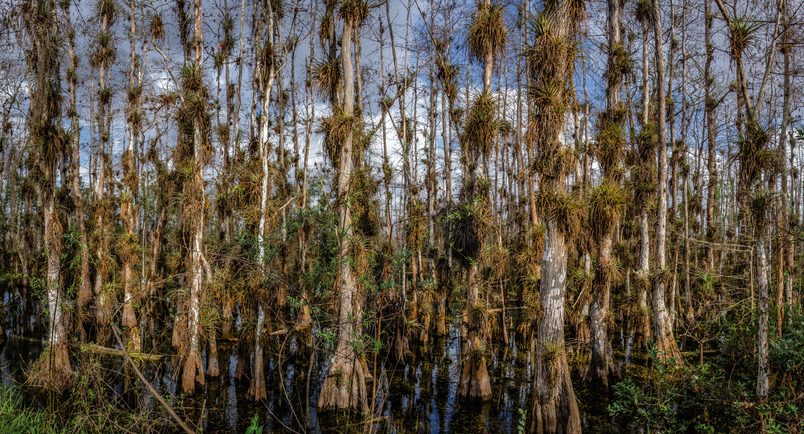
Big Cypress National Preserve spans 729,000 acres of wetlands, an area larger than the entire state of Rhode Island and the European country of Luxembourg.
Established in 1974 as America’s first National Preserve, it is located in South Florida, approximately 45 miles west of Miami, and is vital to the health of neighbouring preserves, coastal ecosystems, and Everglades National Park.
The preserve features a diverse range of habitats, including hardwood hammocks, pinelands, prairies, cypress swamps, mangrove forests, and tidal marshes, supporting a vast array of flora and fauna. It is home to over 100 endangered and threatened plant and animal species, as well as species not on the threatened list.
The most notable resident is the elusive Florida panther, with Big Cypress providing the largest contiguous acreage of habitat for an estimated 130 to 230 of these animals in the wild.
American alligators, an apex predator in the preserve, create alligator holes that serve as critical wet and dry habitats for other animals. Other wildlife includes river otters, which are semiaquatic mammals weighing between 5 and 14 kg and feeding on fish, clams, and turtles, and Florida manatees that venture inland into the preserve during the winter.
The preserve’s cypress forests are dominated by bald cypress trees, known for their “knees”—pneumatophore roots that transport air to submerged roots. In 2016, Big Cypress was designated a dark-sky park, supporting nocturnal animals like 50 species of fireflies and bats.
Unlike a National Park, a National Preserve allows for some activities such as oil extraction, hunting, and trapping in certain circumstances. When established by law in 1974, Big Cypress National Preserve permitted petroleum exploration, which had begun earlier in 1943 when Humble Oil Company discovered Florida’s first producing oil well in the northwest portion of what is now the preserve.
Additionally, the designation ensured the Miccosukee, Seminole, and Traditional people retained permanent rights to occupy and use the land traditionally, including hunting with off-road vehicles.

Certain Native American tribes, such as the Miccosukee and Seminole tribes, still call the preserve and its surrounding area home and have specific rights to use the area’s resources. Unlike a National Park, a National Preserve allows for some activities such as oil extraction, hunting, and trapping in certain circumstances.
Worth a look
Prosper Portland Director ‘Out of Office and Not Working’ Amid Union Allegations, Board Review
Prosper Portland executive director Cornell Wesley is "out of the office and not working" as the agency's board...
Brentford’s Andrews to Reach 50 Games as Pochettino Faces First Old Trafford Test
Brentford head coach Keith Andrews will reach 50 Premier League games in charge when his side faces Manchester...

Purdue Faces Oklahoma in Florida Seeking First MTE Win Since 2020
Purdue faces Oklahoma on Thursday in Florida, seeking its first multi-team event win since a 2020 loss to...

Omaha City Council to Hold Public Hearing on Two Major Redevelopment Projects
The Omaha City Council will hold a public hearing on December 15, 2026, for two major redevelopment proposals....