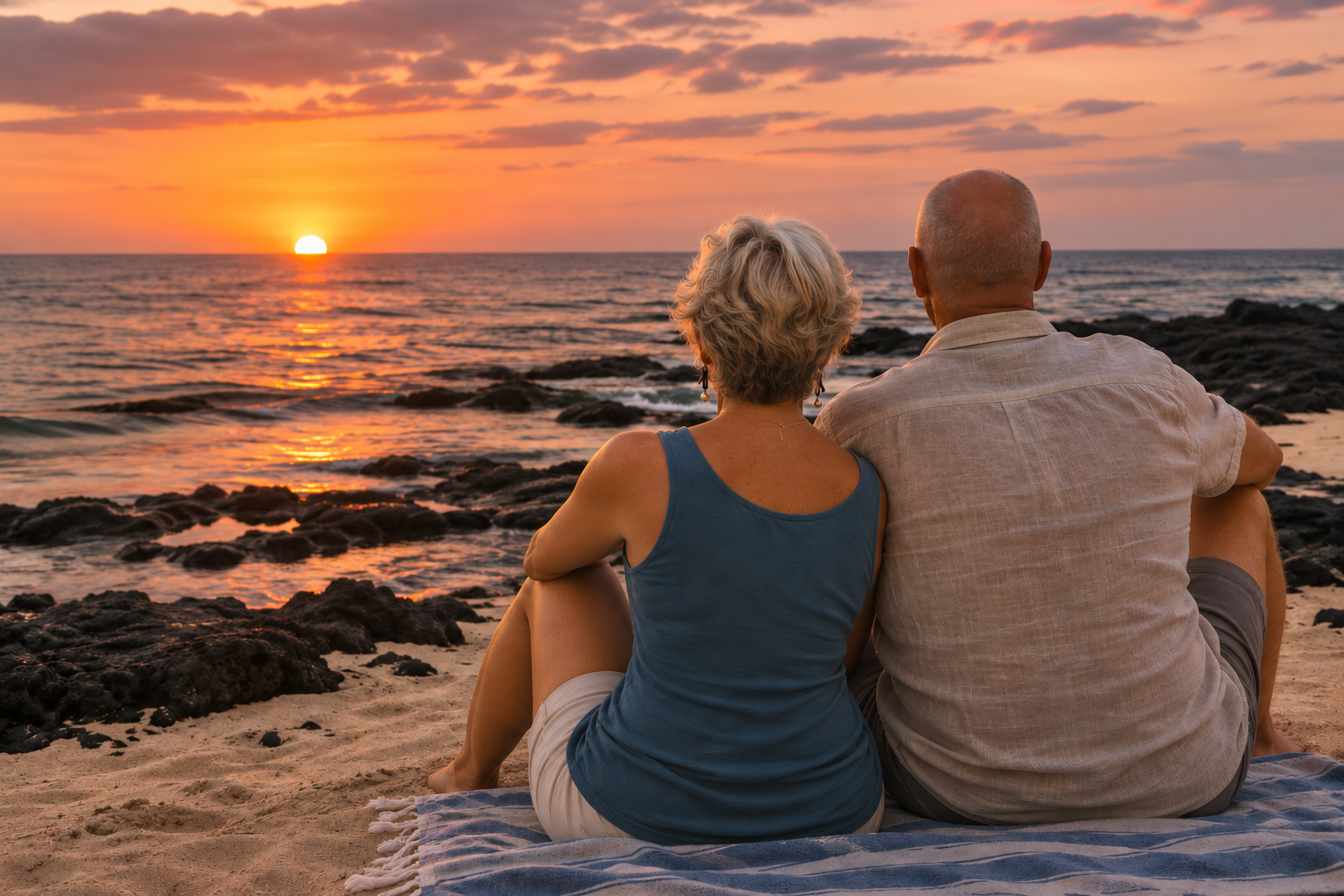
A Big Island resident detailed the process of designing a dream home in Puako built around daily ocean access, indoor-outdoor entertaining, and an established community network.
After moving to Waikoloa Village in 2003, the author spent years exploring the island before choosing Puako as a permanent home. “Now, every evening, my husband Johnny and I walk across to the sand in Puako to watch the sunset. You would think that after doing it so many times, we’d get used to it. We still pinch ourselves. We live here!” the author wrote.
The home’s design centered on three priorities. First, immediate proximity to the water: “I Wanted to Be Close Enough to Ride My Bike to the Beach,” the author said. “Ocean is my potion,” as the song goes, and I live by that almost every day.
I still body surf, snorkel, swim, or watch the sunset whenever I can. Bodyboarding is my favorite pastime, and here in Puako it’s practically at my doorstep. I love that I can get on my bike in the morning, ride to the beach, and get a little vitamin Sea.”
Second, a functional lanai for daily use. “Johnny and I wanted a lanai and some yard space. We like having friends over, we enjoy the pool, and if we can sit outside and visit for another hour after a meal, all the better,” the author wrote.
The layout was planned around social flow: “When we were designing the house, it helped to picture it with the people we love already there. Where would everybody sit? Could whoever was getting dinner together still be part of the conversation? I don’t want to miss the good stories because I’m inside looking for a serving spoon!”
Third, a built-in community. “Lots of my friends and some of my family live in Puako. Johnny and I are social people, so that was a big part of the decision for us,” the author explained. “I like being able to say, ‘Come over for sunset,’ and know it’s an easy invitation for somebody to accept, even at the last minute. There’s another side to it, too. I wanted to live among people who pay attention to one another. It means something when a neighbor knows you well enough to notice you could use a hand, and feels comfortable asking when they could use one themselves.”
Puako’s character emerges from centuries of ocean-centered life, from a pre-contact fishing and salt-producing settlement to a 19th-century sugar plantation whose wharf pilings remain visible near today’s boat launch ramp. The 2006 Kiholo Bay earthquake epicenter sat just 6 miles offshore, a reminder of the dynamic coastal geology that shapes daily experience.
With 41.56% of its 17.6-square-mile CDP area as water and a population of 772 in 2010, the community clusters along the shoreline where modest original cottages mix with substantial homes, and small boats still moor in the bay or launch daily from the state ramp.
The design also included a separate downstairs quarters for visiting family and friends. “This was one part of our dream home I was very clear about. We wanted family and friends to come and stay awhile, and I wanted them to have their own quarters downstairs,” the author wrote. “Think about how a visit actually goes. Somebody is ready for coffee at six. Somebody else has been looking forward to sleeping in for weeks. I may already be out on my bike.”
Related reading

Cornell Men’s Hockey Faces Maine in Seventh Frozen Apple Game at Madison Square Garden
Cornell men’s hockey faces Maine on Saturday at Madison Square Garden in the seventh Frozen Apple game, with...
The New York Times crossword puzzle published on Saturday featured the clue “Albuquerque Isotopes
The New York Times crossword puzzle published on Saturday featured the clue "Albuquerque Isotopes, e.g." with the answer...
Sheryl Underwood Joins Legends of Laughter Tour at North Charleston Performing Arts Center March 27, 2027
Sheryl Underwood will perform as part of the Legends of Laughter tour at the North Charleston Performing Arts...

Best Black Friday Sneaker Deals on Hoka, On, Nike and More
Retailers opened Black Friday with steep discounts on running, walking and lifestyle sneakers, led by the Hoka Bondi...