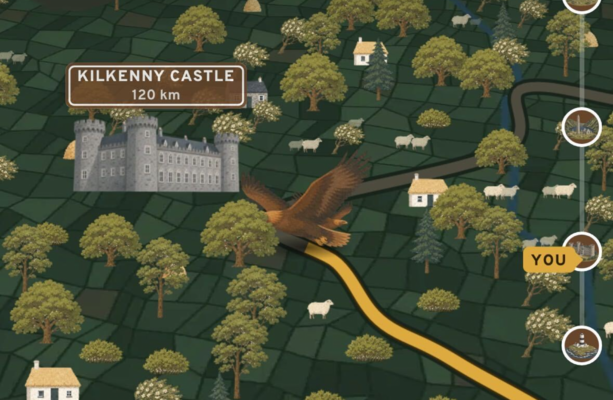
Hundreds of thousands of people play Boreen daily, a trivia game that has become a national phenomenon since its launch last month.
The game, designed by Oisín McKnight, presents players with seven questions each day, asking them to name something that fits certain criteria, such as “name something you’d see at an Irish wedding.” Players earn points based on how unique their answers are, with more common responses earning fewer points. The game then compares a player’s score against all other users, with a score of 450 placing a user in the 90th percentile on one day but only the 50th percentile on another, due to varying difficulty each day.
The game’s design features indigenous Irish animals, with a unique answer allowing a player to travel 100km as a golden eagle. A less common answer might see them travel 75km as a red squirrel. The sight of these animals on screens has taken on a special meaning this week, following EU-level proposals to gut nature and biodiversity protections. An amendment by the EPP voting bloc, of which Fine Gael is a member, would permit the killing of protected species like bats and otters during construction projects, The Journal reported.
Before long, it might be the only Irish golden eagles people see are in the game, it noted.
This week, the game’s design resonated with cultural events, including the turmoil in the HSE, where the board sacked CEO Anne O’Connor less than a year into her tenure for undisclosed reasons, while the government remained undecided on its stance. The game’s questions are sometimes crowdsourced, with players submitting their own. A question about naming a controversial HSE CEO might yield different scores; “Anne O’Connor” might only get a “robin” (10 points) due to recency bias, while “Tony O’Brien” might earn a “hedgehog” (25 points), The Journal suggested.
Boreen’s popularity harks back to Wordle, which emerged in October 2021 as the country exited Covid restrictions.
The immediate success of Boreen begs the question: what are people trying to escape now? Obvious answers like the housing crisis or healthcare waiting lists earn few points. A more specific answer, such as “a record number of people accessing emergency accommodation,” might fare better.
What is certain, The Journal concluded, is that Ireland is a population “desperately in need of a little bit of levity at the moment,” and Boreen has provided it.
Keep reading
Tracy Marander enters hospice care as donations surpass $101,000 for her medical expenses
Tracy Marander enters hospice care as donations surpass $101,000 for her medical expenses. Marander dated Cobain between 1987...

Róisín Ingle Reached Ballyshannon in Two and a Half Hours From Dublin
The Irish Times published an account of a recent road trip to County Donegal, where traveller Róisín Ingle...

The Hunting Wives Season 2 Finale: Two-Year Time Jump Shows Sophie, Bloody Margo Call
The Season 2 finale of The Hunting Wives on Netflix features a jaw-dropping two-year time jump where an...

Dervla Kirwan: Bad Behaviour Was Tolerated – We Called It ‘Handsy’ or ‘Love Bomby’
In an interview with the Irish Independent, actress Dervla Kirwan reflects on the shift in how the entertainment...