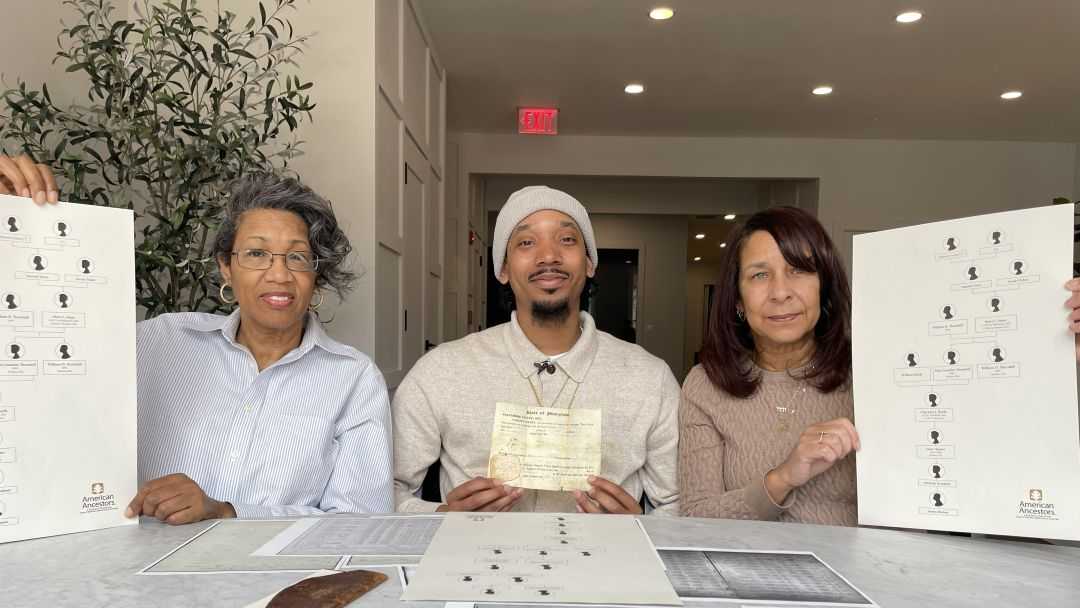
Aaron Haynes held the 1834 freedom paper inside the library at American Ancestors on Newbury Street, the document his mother had handed him during a COVID-19 lockdown cleanout.
“And I opened it up and looked at it and was very confused as to what this might be,” Haynes told WCVB. “And she said, ‘That’s your ancestor’s freedom papers.’ And I said, ‘Hold on!’”
The parchment named Samuel Jones, describing his complexion, height and a scar on his left hand. Conservator Todd Pattison examined the seal date of 1817 and the document’s 1834 production.
Danielle Rose of the 10 Million Names Project, housed at American Ancestors, called it “a real treasure” for African American genealogy before the Civil War. “The more documents that you can find for African Americans, especially before the end of the Civil War,” Rose said. “It’s a real treasure.”
Researchers trace the line to Samuel Jones
Lindsay Fulton, chief research officer at American Ancestors, and Rose worked with census and marriage records to link Haynes to Jones. The 1900 census showed a household with Mary Thornhill, William Thornhill and Samuel Jones. Matching names, dates and location confirmed Jones as Haynes’ many-times great-grandfather. “He lived a very long life, and surrounded by family,” Fulton said. “Because he was with his family up until the end.”
Leslie Godfrey, Haynes’ aunt, grew emotional seeing the names in ink. “It makes me feel like our family is being reunited again in a way that it hadn’t been before,” she said.
Her sister, Kimberly Kendrick, said the discovery fulfilled a promise to their late Aunt Janet, who had shared family stories. “She’s not here, and I know that this was very, very important to her,” Godfrey said. “This is sort of like a fulfillment almost.”
Fulton noted the historical proximity. “We’re not that far away from even the period of enslavement, like a lot of people living today knew someone who knew someone who was enslaved,” she said. “So yes, it compresses time, I think, immensely.”
The woman who carried the papers north
The team traced the papers’ journey to Boston through Mary Jones, later Mary L. Forman after her third marriage. Born in Baltimore, she brought the document with her. At Mount Hope Cemetery, Fulton led the family to her headstone beside her husband Arthur.
“This is Mary L. Jones. Born in Baltimore. Lived most of her life in Boston,” Fulton said. “And this is definitely the person that brought the Freedom Papers up to Boston. So we have Mary to thank.”
Godfrey and Kendrick recognized the stone from childhood visits. “We didn’t even understand the significance of it,” Kendrick said. Godfrey recalled meeting “Nana Forman” once as an infant. “Oh wow, Nana!” Godfrey said. “God bless you!”
Haynes placed flowers at the grave. “Being reunited with somebody even though she’s not physically here anymore,” he said. “Getting that feeling that she’s been here. And at some point in time was another reason to give me that push to come find her again.”
Questions remain — whether Jones is a fourth or fifth great-grandfather, and the location of his Maryland burial plot. “Just gives me that gratefulness of just knowing that the core that I thought I had is just expanding,” Haynes said. “And just also excited because now I’m just bringing more family into my life and I don’t think anybody doesn’t want that.”
American Ancestors, the operating name of the New England Historic Genealogical Society founded in 1845, serves as the nation’s oldest and largest genealogical society with over 250,000 members and more than 90 staff and volunteers. Headquartered at 99–101 Newbury Street since 1964, the organization houses the Brim-DeForest Library, which holds 200,000 bound volumes, 5,000+ linear feet of original manuscripts, and 100,000 rolls of microfilm.
Through its chief research officer Lindsay Fulton and the 10 Million Names Project led by Danielle Rose, American Ancestors provides expert research services that connect families to pre–Civil War records using census data, marriage records, and manuscript collections. Its website, AmericanAncestors.org, hosts nearly 3,000 searchable databases covering over 113 million people, making it a central hub for genealogical scholarship and African American family history recovery.
“If it wasn’t for her, we wouldn’t be here,” Godfrey said. “We wouldn’t be here. We found her.”
Keep reading

Fairfax County Police Report Widespread Road Closures, Downed Trees, Signal Outages Across District Stations
Fairfax County police responded to widespread road closures, downed trees and traffic signal outages on Thanksgiving Day after...

State Works to Remove Grounded Atlantis Vessel Kapena From Fort DeRussy Beach
The Hawaii Department of Land and Natural Resources announced Thursday it is working to remove the 65-foot passenger...
Arizona Sees Mild Thanksgiving Weekend With 70s in Phoenix, Gusty Mountain Winds
Arizona will see mild, above-normal temperatures through the holiday weekend, with Phoenix highs in the upper 70s, while...

Broncos Activate Badie, Elevate Schrader for Black Friday Trip to Pittsburgh
The Denver Broncos entered Thursday with one running back on the 53-man roster and finished it with three,...