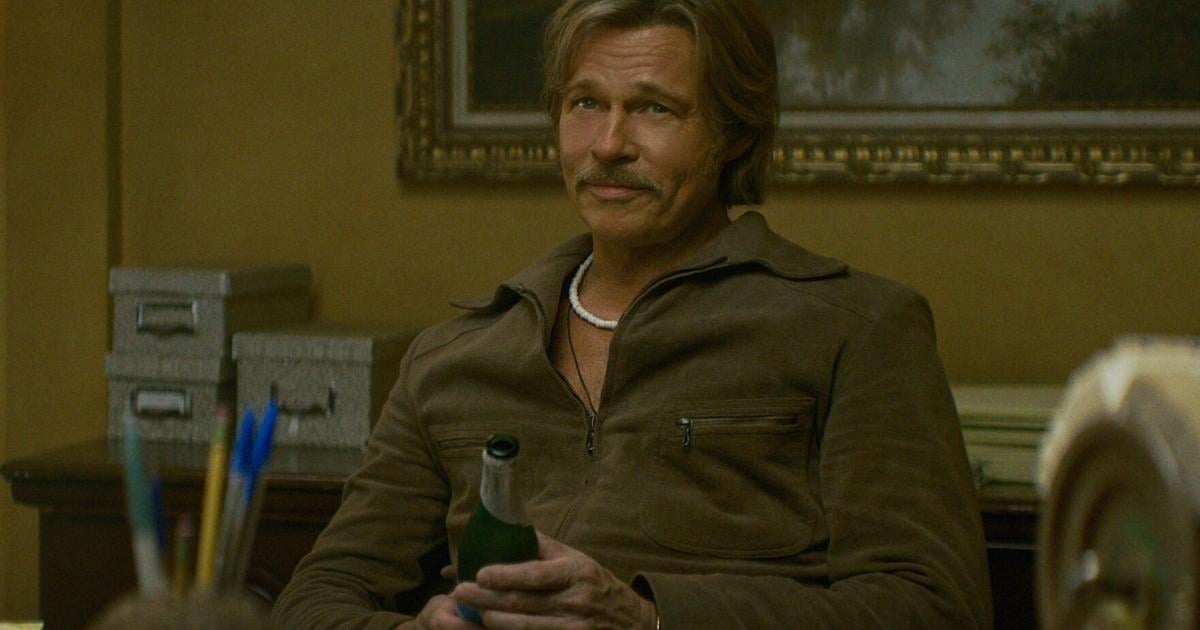
Brad Pitt returns as Cliff Booth in “The Further Mis-Adventures,” a Netflix film directed by David Fincher from a Quentin Tarantino script that opens in limited IMAX release Wednesday.
The collaboration pairs Tarantino’s digressive, dialogue-heavy sensibility with Fincher’s precise, technically meticulous direction — a combination The Globe and Mail’s Barry Hertz likened to “smooshing sweet, indulgent chocolate (that’d be Q.T.) with salty, dense peanut butter (D.F.)” and found “dynamic and pleasingly tongue-twisting.” The film runs two hours and 20 minutes and arrives on Netflix streaming December 23, IndieWire reported. The Ringer’s Adam Nayman noted the screenplay is “devised to do its job as circuitously, as idiosyncratically, and as ornamentally as possible,” while The New Yorker’s Richard Brody wrote that Fincher captures Cliff’s verve “with joyful wonder — if not with the palpable physicality that Tarantino brought to the job.” Cliff Booth, now in his 50s, lives with his father (Peter Weller) and hasn’t worked a stunt job “in God knows how long,” the Los Angeles Times reported. Leonardo DiCaprio’s Rick Dalton has relocated to Australia. Elizabeth Debicki joins the cast as Karen Crosby, a former freelance movie reviewer, and Scott Caan plays TV star Charlie Peters. Vulture’s Bilge Ebiri described the film as “so unbothered and indulgent that there’s really no option but to surrender to it,” adding that it “embraces the idea that Cliff is less a person than a collection of sometimes contradictory, occasionally toxic ideals of masculinity.”
The production has drawn criticism over the reported use of generative AI. Bloomberg reported in May that Fincher used Ben Affleck’s AI filmmaking company, InterPositive, on the film. Vulture noted “multiple listed ‘generative artists'” in the credits. Deadline quoted Fincher telling the Los Angeles Times: “I’m not a Luddite, so I don’t fear the unknown. Is everyone satisfied that we have figured this art form out enough that what we really need to do is go back to celluloid?” Kotaku cited indie filmmaker Patrick Tomasso calling the AI use “blatant and egregious,” while Next Best Picture described it as “nothing but an eyesore.”
The Guardian situated the film within a wave of Los Angeles nostalgia projects — including “Licorice Pizza” (2021), “Babylon” (2022), and “MaXXXine” (2024) — arriving as the industry contends with runaway production and a reported loss of 42,000 jobs over the past two years.
“If Los Angeles was a person, it might just be a laid-back fiftysomething trouper with cool sunglasses and an even better haircut,” the Guardian wrote. “The Further Mis-Adventures” is rated R for strong violence, pervasive language, sexual content, nudity, and drug use.”
Critics question Fincher's AI use in film credits
The Ringer reported that claims from early screening attendees about generative AI use have not been formally addressed by Fincher, noting his “not a Luddite” quotes came from a Los Angeles Times interview printed before the online furor.
The publication added that the film features sequences that feel suspicious, as if staged or stranded. Next Best Picture’s review referred to Fincher’s use of generative AI in key moments as “nothing but an eyesore.”
Vulture noted multiple listed “generative artists” in the credits.
I walked out of Cliff Booth completely gutted. What could have been a really great sequel is overshadowed by some of the most blatant and egregious AI use I’ve ever seen in a studio film. Shocked it’s not in everyone’s reviews – More thoughts with receipts when it’s streaming. https://t.co/uofIO7oUEs
Fincher told the Los Angeles Times he does not fear the unknown and questioned whether everyone is satisfied that the art form has been figured out enough to return to celluloid. Deadline quoted those remarks. The Ringer observed the film may be slightly more fun to talk and think about than to watch, though its 140 minutes pass quickly.
Film positioned within Los Angeles nostalgia wave
The Further Mis-Adventures opens in limited IMAX release Wednesday before streaming on Netflix December 23, IndieWire reported.
Netflix acquired Ben Affleck’s AI filmmaking company InterPositive in March 2026, bringing its 16-person team of engineers, researchers and creatives in-house while Affleck serves as a senior adviser. The L.A.-based start-up, founded in 2022, built tools that model a production’s dailies to assist with postproduction tasks such as mixing, color, relighting and visual effects rather than generating footage from text prompts.
Bloomberg reported in May that Fincher used InterPositive on the film, and Vulture noted multiple credited “generative artists.” The technology is designed to keep creative decisions with artists while expanding control over the filmmaking process, an approach Affleck described as preserving the judgment that “only people can have.”

Gus tells Cliff that in Hollywood two things matter — shelf life and shelf space — but neither matters to Cliff Booth or to the company distributing his mis-adventures, a passage near the end of the film noted. The Ringer described the movie as a throwaway with deceptively careful aim, with a refrain of “It don’t mean shit to me” recurring across layers of fiction and reality.
More on Cliff Booth
"It don't mean shit to me." On David Fincher's THE FURTHER MIS-ADVENTURES OF CLIFF BOOTH, for @ringer https://t.co/58O2VL4RCx
‘THE FURTHER MIS-ADVENTURES OF CLIFF BOOTH’ is now exclusively playing in IMAX. • Will only be playing in IMAX for the next two weeks. • Won’t come to Netflix until December 23. Read our review: https://t.co/xp89fo4b7V pic.twitter.com/c425cxq4Tq
A roundtable with Brad Pitt, David Fincher, and Quentin Tarantino about ‘THE FURTHER MIS-ADVENTURES OF CLIFF BOOTH’ is coming to Netflix on November 30. pic.twitter.com/maXZZ16iVI
Fincher & Tarantino’s The Further Mis-Adventures of #CliffBooth is a pure riot. It’s a cinephile’s dream to have two ‘90s auteurs combine their storytelling strengths in one glorious, uproarious feature. + Debicki gets to be tall AND Aussie! My review: https://t.co/t4NM4mGsCz
Brad Pitt’s return as Cliff Booth is drawing early raves, with critics calling the sequel a “wild, hilarious hangout movie.” Directed by David Fincher and written by Quentin Tarantino, the film moves Booth into the role of a Hollywood fixer and opens in theaters Nov. 25. Read… pic.twitter.com/jbjSsEoHFl
Brad Pitt and Ines de Ramon arrive at the Los Angeles premiere of "The Further Mis-Adventures of Cliff Booth." pic.twitter.com/1A7X2WeG5C
Brad Pitt is stepping back into the role that won him an Oscar in his new movie "The Further Mis-Adventures of Cliff Booth" — is he going for no. 2? 🏆 pic.twitter.com/yWjxeJqdFu
Related reading

Leighton Meester, Adam Brody Spotted at Bunratty Castle Banquet for ‘a Night at Claridge’s’ Filming’
Hollywood actors Leighton Meester and Adam Brody have been spotted attending a medieval banquet at Bunratty Castle &...

Hailey Bieber Celebrates 30th Birthday With Justin Bieber and the Jenners in the Bahamas
Hailey Bieber turned 30 on Sunday, Nov. 22, and marked the milestone with a Bahamas getaway alongside husband...

Sanofi Agrees to Acquire Insmed for $41 Billion
Sanofi agreed on November 24 to acquire Insmed for $175 per share in cash, valuing the U.S. biopharma...

Gordon Ramsay Named New Top Gear Host for 2028 BBC Revival
Celebrity chef Gordon Ramsay will lead the new Top Gear presenting team when the BBC motoring show returns...