
Federal Medicaid changes that took effect October 1 have already stripped coverage from nearly 2,000 Rhode Island noncitizens, and a January 1 work-reporting mandate threatens tens of thousands more — unless the state accepts a six-month federal reprieve announced November 13.
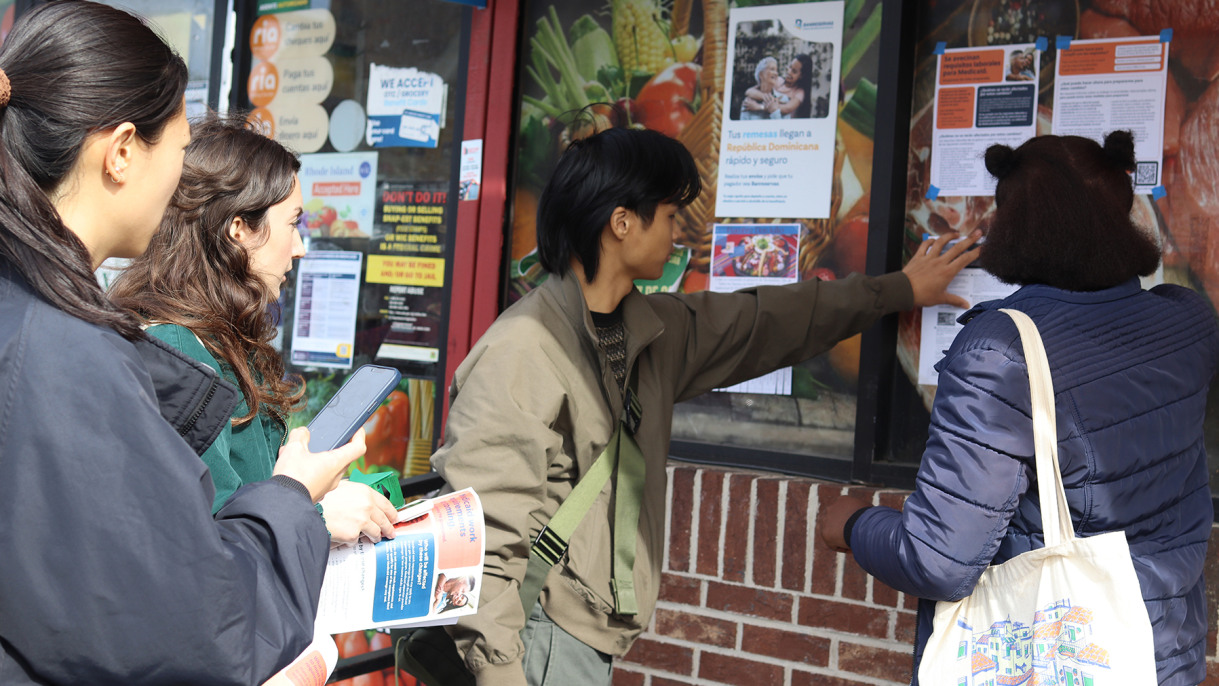
Into that gap step nine Brown University public-health graduate students. Since mid-October they have canvassed roughly 75 Providence businesses, posted more than 850 flyers in nine languages, and helped over 120 people directly at drop-in sites, Rhode Island Current reported. The fellowship, a joint effort of Brown’s People, Place, and Health Collective and the state Medicaid program, was announced October 14.
“We’re not selling anything. We’re just trying to keep folks informed,” fellow Aidan Choi told Rhode Island Current during a Wednesday sweep of Westminster Street storefronts.
At Frog & Toad, co-owner Erin Schofield cleared space on a community bulletin board for a timeline flyer Choi called “a little dense.” At Colombia Auto Service, the owner moved a windshield-wiper display so fellow Alexa Pupillo could tape a Spanish-language version to the window.
“The process of even applying to Medicaid, even before changes, is very complex. … This delay period is nice for us to be able to help people understand it better.”
— Aidan Choi, Medicaid fellow, Brown University
What changed October 1
The October restrictions — rooted in the sweeping federal tax and spending law President Donald Trump signed in July 2025 — tightened eligibility for refugees, asylees, and several other immigration categories. State officials initially estimated fewer than 3,500 noncitizens would be affected; the final count was under 2,000, Kerri White, spokesperson for the Rhode Island Executive Office of Health and Human Services, said in an email Thursday.
At Dorcas International, a refugee-focused nonprofit where Pupillo holds drop-in hours, she has helped people explore marketplace plans. “But frankly, all the premiums are too expensive, so the next best option after that is trying to refer them to free care,” she told Rhode Island Current. Free clinics “are already preparing for even longer wait times.”
January 1 brings work rules for Medicaid expansion adults
The next wave targets the Medicaid expansion population: adults 19–64 who must document 80 hours a month of work, volunteering, schooling, or meet an income threshold, with exemptions for the medically frail. Some will also face twice-yearly renewals instead of annual ones. About 66,000 adults are enrolled through expansion, White said, though many may already meet criteria or qualify for exemptions.
Rhode Island is weighing the Centers for Medicare & Medicaid Services’ November 13 offer of a hold-harmless period through June 30, 2027, during which compliance would be assessed but coverage not terminated. The state is also evaluating a possible good-faith waiver extension tied to a recent court decision on the medical-frailty exemption, White said.

“We know that policy shifts at the federal level can create confusion, misunderstanding and sometimes even fear. But we also know that when information is delivered clearly, consistently and through trusted channels, people are far better equipped to make decisions that protect their health coverage.”
— Kristin Sousa, Rhode Island Medicaid Program Director
A model other states aren’t using
Nebraska, which began phasing in work requirements in May, saw 533 coverage losses in July and August alone, according to a September KFF analysis. Ninety-two percent of those losses stemmed from paperwork failures — people who would have renewed but did not verify work information — not affirmative noncompliance.
States such as Montana and New Mexico have tried statewide informational tours, a July KFF report noted. But Abdullah Shihipar, research associate at Brown’s People, Place, and Health Collective, said he was unaware of any other state enlisting students for Medicaid outreach the way Rhode Island has.
The fellows — paid $23 an hour for ten hours a week — were chosen from 45 applicants, many with prior experience serving unhoused populations, immigrants, and people in recovery, Shihipar told the Boston Globe.
From classroom to curb
Choi, who previously organized on tenant and immigrant rights, said the fellowship shows how policymaking affects daily life. “If we want to be focused on improving people’s lives, we need to understand how they’re receiving and thinking about these public services,” he told Rhode Island Current.
Pupillo added that public health is “often an unseen service” until practitioners hit the streets. “When you’re talking to people who are unaware of the Medicaid changes or confused by them, it reminds you the importance of having public health people out there actually helping people directly.”
The team’s weekly rhythm: two canvassing shifts across Providence neighborhoods, plus drop-in hours at Dorcas International, Refugee Dream Center, Amos House, Project Weber/RENEW, CODAC Behavioral Healthcare, Clínica Esperanza, Brown University Health locations, and the mobile “Shower to Empower” program in Woonsocket and Providence, the Boston Globe reported.
State decision on federal extension pending
The state has not yet announced whether it will adopt the six-month federal extension. If it does, the fellows gain breathing room; if it does not, January 1 arrives with work-reporting rules in full force. Either way, Choi said, “people will have to adapt to this new system” — and the students plan to stay on the sidewalks, flyers in hand, through the two-year fellowship.
Worth a look

Minot State Visits Montana State Billings for Fifth Game in Eight Days
Minot State heads to Billings on Friday for a 7 p.m. tip-off against Montana State Billings, the Beavers'...

Wisconsin Women’s Soccer Matches Program Record With Fourth Straight NCAA Tournament Bid
The Wisconsin Badgers women's soccer team has matched a program record with its fourth consecutive NCAA Tournament appearance,...

Veteran Journalist Bill Sweetman Drives to Area 51 Back Gate
Veteran aviation journalist Bill Sweetman recounts in a column for Forbes that he drove to the back gate...
Hawaii Women’s Volleyball Defeats UTEP 3-1 on Senior Night Behind Ratkai’s Fourth-Set Run
Hawaii women's volleyball defeated UTEP 3-1 (25-19, 25-21, 23-25, 25-19) on Thursday at SimpliFi Arena, with the Rainbow...