
Cheyenne data centers consumed just 93 million gallons of water in 2025, about 2% of the city’s total water sales, far below initial projections and common benchmarks like agriculture or golf courses.
Frank Strong, engineering and water resource division manager for Cheyenne’s Board of Public Utilities, told Cowboy State Daily the city sold about 3.5 billion gallons of water in 2025. The 93 million gallons used by data centers was “significantly less” than developers had originally proposed, a gap Strong attributed to newer chips that run at higher temperatures and require less water-based cooling.
Cooling advances cut consumption
Ryan Luther, at Enverus Intelligence Research, said the firm modeled water use across cooling scenarios and consumer benchmarks. The analysis counted water consumed at power plants generating electricity for the facilities, which accounted for about 90% of the total attributed to AI use.

In early evaporative cooling systems, $25 a month of AI use corresponded to roughly 21 gallons of water. Modern closed-loop systems — which recirculate coolant like a vehicle radiator — reduced that to about a quarter of a gallon for the same compute spend, Luther told Cowboy State Daily.
“There’s been a huge improvement on the efficiency,” he said. “They still need a lot of cooling, but it’s a different type of cooling.”
“Our reputation lives and dies on our ability to do science-based research,” Luther said. “We have clients on both sides of everything, so we’re not trying to pick a side here.”
Comparisons to everyday use
Cheyenne Mayor Patrick Collins provided additional context to the Wyoming Legislature’s Select Water Committee. He said the city’s data centers use approximately 200 acre-feet annually — less than 1% of Cheyenne’s available supply. A single quarter-section of alfalfa irrigation consumes about 412 acre-feet, more than double the current data center total.
The city uses 2,629 acre-feet yearly to water lawns, while Laramie County School District 1 uses 264 acre-feet, 204 of that for irrigation. “Greenhouse Data — today, it’s called Lunavi — opened their first data center (in Cheyenne) in 2009,” Collins said. “NCAR and Microsoft followed in 2012, and we’ve had constant or continuous data center construction ever since.”
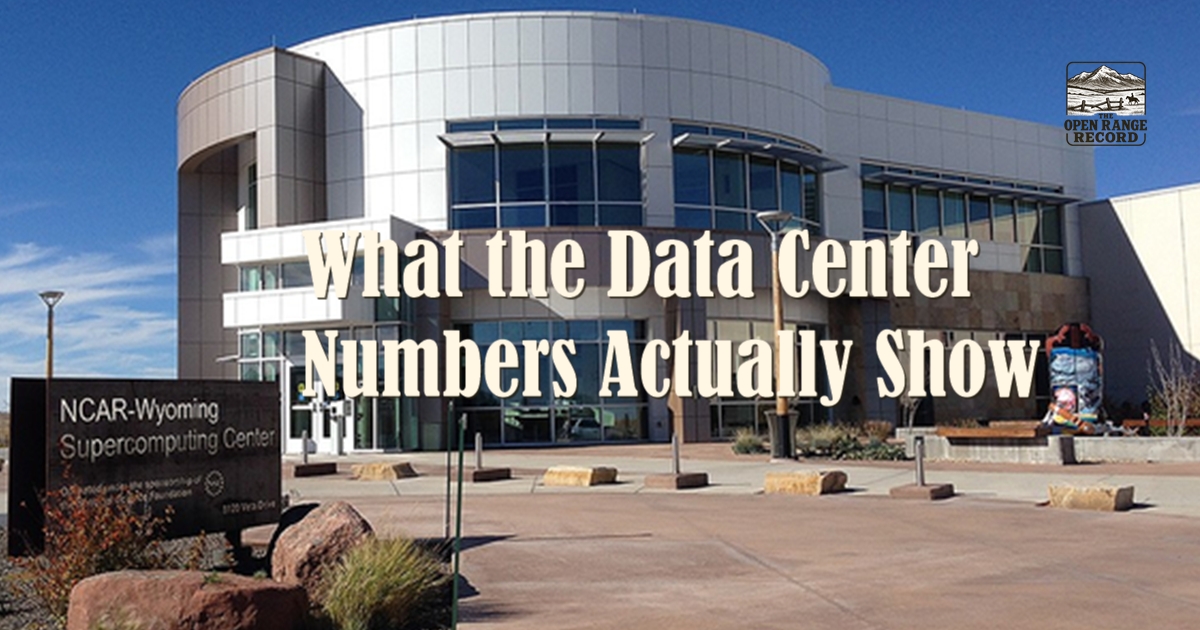
Data centers use city water
He said the city has since seen constant construction, resulting in a number of small data centers plus three campuses with 13 operating buildings, while three more campuses and seven data center halls are under construction.
Collins said the Board of Public Utilities modeled a scenario with more than 70 data centers and estimated combined annual use at about 400 acre-feet, roughly 3% of the city’s current water usage. He also noted that two developers with projects under construction told him their closed-loop cooling systems would each use around two acre-feet per year, equivalent to the consumption of eight single-family Cheyenne homes.
Researchers compare AI water use to everyday benchmarks
Enverus Intelligence Research modeled water consumption per $25 of spending across cooling scenarios and found that AI inference uses far less water than many common activities. Director Ryan Luther told Cowboy State Daily the analysis is not a pitch for developers and that the firm’s reputation depends on science-based research with clients on all sides of the issue.
Microsoft cites Wyoming climate advantage for cooling efficiency
Microsoft reported its Wyoming facilities used 0.23 liters of water per kilowatt-hour of computing in 2022, below the national average of approximately 0.36 liters recorded by Lawrence Berkeley National Laboratory in 2023. At Microsoft’s rate, a megawatt running continuously for a year would consume roughly 530,000 gallons, about what a full-service restaurant uses in three months.
Enverus Intelligence Research, through its director of energy transition research Ryan Luther, modeled water consumption for data centers by measuring water use per $25 of monthly AI inference spending across cooling scenarios in a November 2026 report. The methodology attributes roughly 90% of total water consumption to upstream power generation rather than on-site cooling, making the electricity source a primary determinant of the overall footprint.
Power demand dwarfs water concern
A proposed 2.7-gigawatt power plant south of Cheyenne could generate 23.7 billion kilowatt-hours annually — nearly 40% more than the 17.2 billion kilowatt-hours Wyoming utilities sold statewide in 2024. Collins noted Wyoming’s climate provides a natural advantage: Microsoft says its Cheyenne facilities are designed to operate without cooling water when outside temperatures are below approximately 85 degrees, a threshold the city averaged just 188 hours a year above. Northern Virginia averaged 409 hours; Phoenix averaged 3,093.
Luther acknowledged that some communities have reason to be concerned. But he told Cowboy State Daily that data centers “do have noise, but they’re not very loud compared to a power plant,” and developers are typically willing to invest in sound barriers and green space.
“A lot of the communities want the data center to invest in green spaces around them, or sound barrier walls, which I think almost all developers are more than happy to do.”
Related reading

Man Charged With Forcing Oral Sex on Woman in University of Minnesota Dorm, Admits “I Should Have Stopped”
A 19-year-old Minneapolis man faces a felony charge of fifth-degree criminal sexual conduct after a woman told police...
Columbia County Officials Consider One-Year Data Center Moratorium Tuesday
Columbia County officials will consider a one-year moratorium on new data center projects Tuesday to prevent developers from...

Boise State Falls Out of CFP Rankings After Loss to San Diego State; No Group of Six Teams Ranked
Boise State dropped out of the College Football Playoff rankings on Tuesday after a 22-20 home loss to...
BermudAir to Operate Four Routes From New Orleans in 2027
The Bermuda-based carrier will operate twice-weekly service on Wednesdays and Saturdays to Providenciales, Turks and Caicos (PLS); San...