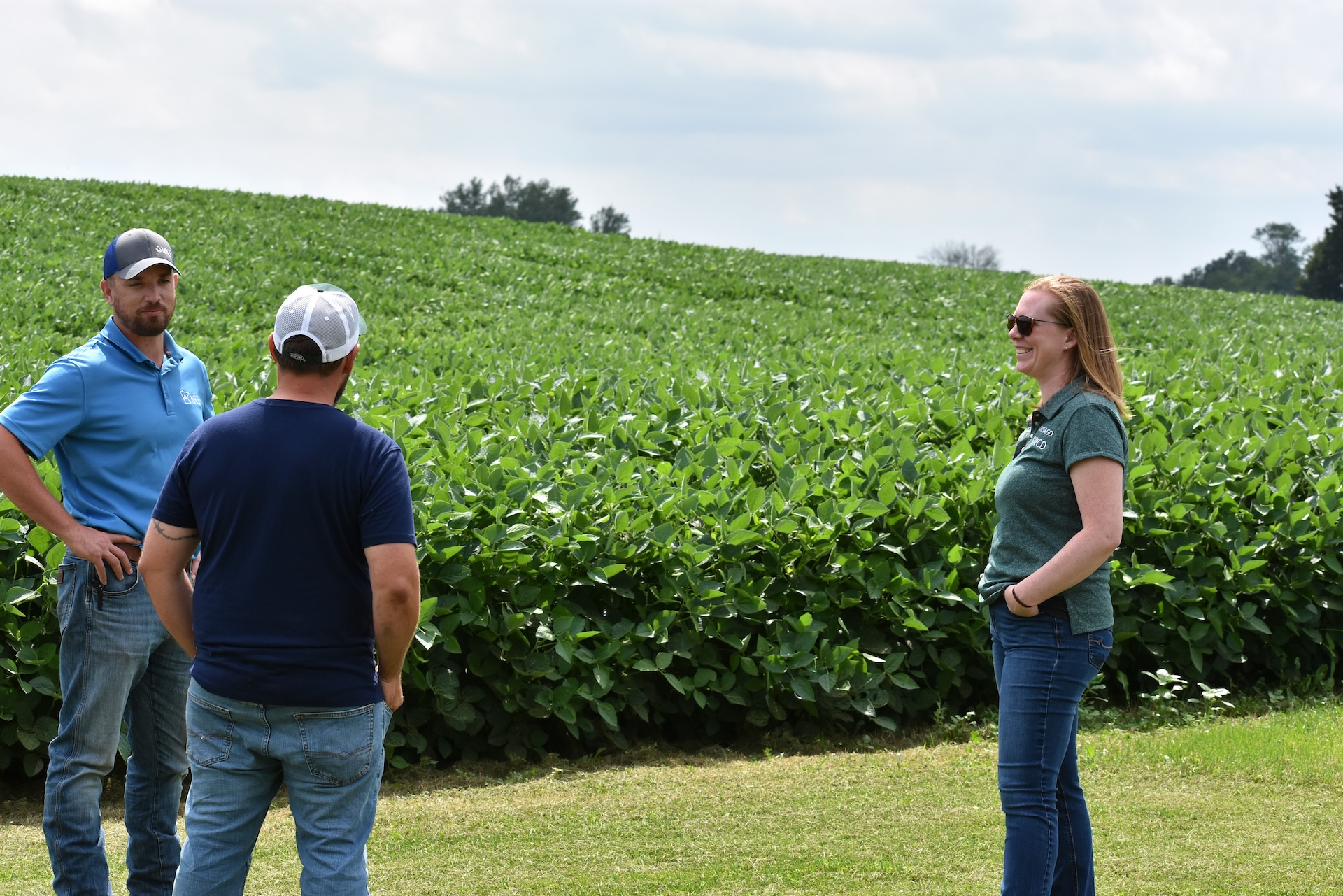
Sixth-generation Chisago County farmer Sonny Strelow is keeping topsoil on his Chisago County hills and out of the Gulf of Mexico.
The conservation work on Strelow’s land — some of the steepest in the Goose Creek watershed — is part of a federal-state push that has funneled $289,795 in Environmental Quality Incentives Program money and $417,020 in Minnesota Clean Water Fund grants into the watershed since 2021.
Together, the funds have built 43 water and sediment control basins, converted 90 acres to perennial hay and pasture, and put cover crops on 370 acres, according to NRCS and Chisago Soil and Water Conservation District figures.
“For the next generation and beyond, I would like to see this place be able to continue farming,” Strelow said. “We’ve got to look past when we’re gone (to) what happens after.”
“Anything that we can do in this watershed has a trickle-down effect impacting the water quality downstream, and we want to do everything that we can to reduce the pollutants that we send downstream.”
said Jacquelynn Olson, conservation specialist with the Chisago SWCD.
The 140-square-mile Goose Creek watershed drains to the Mississippi by way of the St. Croix River, making it a priority for the 12-state Mississippi River Basin Initiative launched in 2009. Heavy agricultural density meant nitrogen and phosphorus were reaching Goose Lake, Rush Lake and Rush Creek, said Brian Steffen, NRCS District Conservationist Team Lead.
“If they had to fund the whole project, that’s a huge out-of-pocket expense. They’d probably continue just bringing that soil back up and just leveling off the field instead of fixing the problem,” Steffen said of the sediment basins. “Every little practice helps. It’s not the big ones. It’s not the small ones. It’s everything combined and in between.”
Strelow installed four basins in a rented field under a 2023 contract, reclaiming at least two acres that were previously too steep to farm. A 2024 contract added a grassed basin at the home site. He also no-tilled 52 acres in 2024 and another 26 in 2025, planting soybeans into spring wheat.
“It worked really good. I was surprised, and even more surprising were the soybeans that followed the wheat the third year. They were better than the (first year of the 3-year contract) by 5 or 6 bushels an acre at least,” Strelow said in fall 2026. “I had no washouts in that field. It was as smooth as the year I planted it.”
He expanded cover crops on his own, seeding rye into wheat stubble and planting soybeans into waist-high rye that was terminated the same day. That soybean crop yielded 40 to 45 bushels an acre in 2025. The 2026 harvest finished in mid-October; drought cut yields, but Strelow said no-till preserved spring moisture.
“I would hate to have seen how terrible they would have looked had I tilled that field,” he said. “We were 100% conventional tillage. If you can figure out a way to cut some costs, it does matter. So if you can keep your yield close — it doesn’t have to be perfect — but you’re already eliminating a pass and you’re eliminating fuel costs.”
Now Strelow is shifting from row crops to grazing. With MRBI and Clean Water Fund help, he converted nearly 25 acres of hilly row crops to hay in 2024, committing to permanent cover for 10 years.
“When we can convert a row-crop field into perennial cover, that has a huge impact on reducing soil erosion in the long term.”
Olson said.
The Goose Creek MRBI involved 34 landowners and 39 contracts, supporting work totaling more than $708,000. A $1,000 contribution from the Rush Lake Improvement Association and a $250 landowner contribution brought the total to $708,065, the Minnesota Board of Water and Soil Resources reported.
The family farm is marking its 150th year.

Gonzaga WBB Heads to North Shore Showcase: Fortier One Win From Record, Zags Face Cal, Hawaii
Gonzaga women's basketball heads to Hawaii this week for the North Shore Showcase carrying a 3-3 record and...

New Mexico Seeks $1M to Start AI Wildfire Cameras for High-Risk Areas
New Mexico lawmakers heard Thursday that the state’s network of AI-powered wildfire cameras covers just 59 spots, leaving...

No. 2 Utah at TCU: Utes Need Win to Clinch Big 12 Title Berth
No. 2 Utah travels to Fort Worth on Saturday for a 7 p.m. MST kickoff against TCU at...

Pittman Steps Down as Maryland Democratic Chair; Moore to Nominate Dukes
Steuart Pittman announced Friday he will not seek another term as chair of the Maryland Democratic Party, capping...