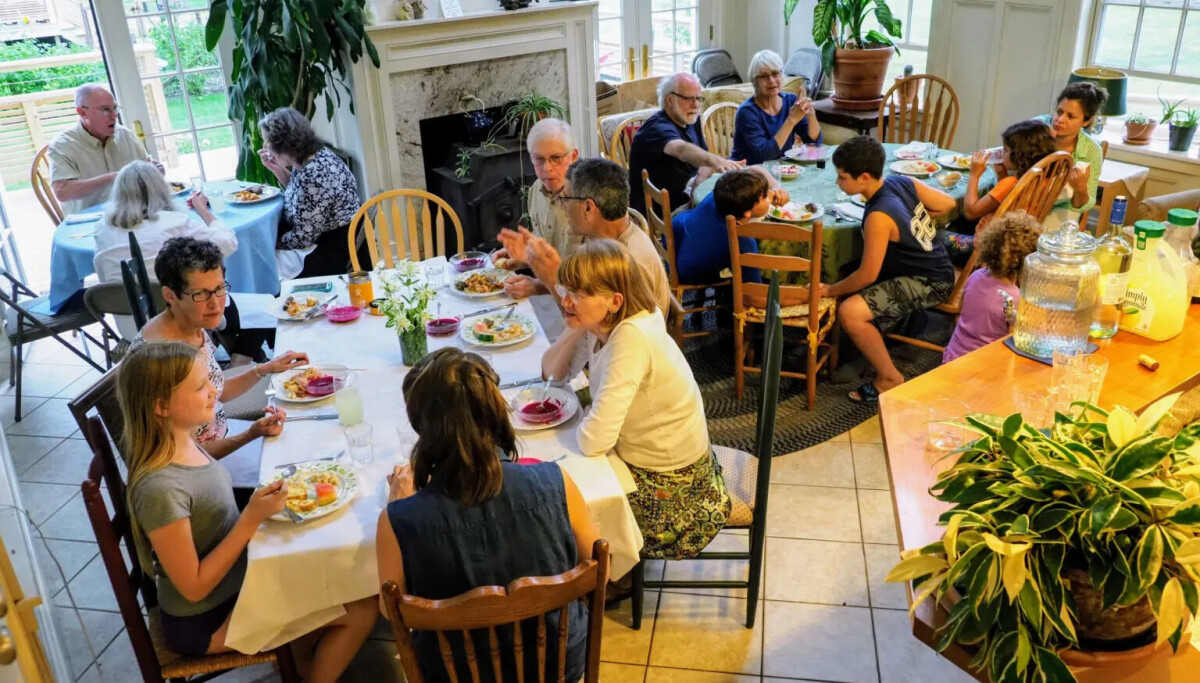
On a recent Monday in October, Sharyl Green picked a tomato from a common garden at Burlington Cohousing East Village.
It wasn’t hers. Her neighbor, away on vacation, had told the community to help themselves. Green is one of 56 neighbors who share a kitchen, green space, and dinner every other night.
“It’s a dynamic way to live. So that includes all the ‘Oh my goodnesses’ and the pleasant surprises,” Green said.
Burlington Cohousing East Village is one of 12 cohousing communities in Vermont, up from just one in 1995, according to the National Cohousing Alliance. The state now ranks seventh in the nation for the number of such communities, outpacing many larger states.
Cohousing helps curb loneliness while promoting sustainable living, said Jim Mendell, vice president of the National Cohousing Alliance Board. Mendell lives at Bristol Village Cohousing, a 14-unit development 45 minutes south of Burlington.
“It is a way of dealing with a lot of problems in the world today,” said Mendell.
The model began in Denmark in the 1960s to combat loneliness and isolation. Residents own their individual properties but collectively own shared spaces. Many communities use a decentralized decision-making structure called sociocracy. At East Village, the community is organized into six committees, including land, building, and home. Bristol Village Cohousing operates similarly.
“Everyone has a job. Every month we have work time, so we all get together and do projects together. Sometimes it’s painting a building, doing some weeding, gardening or fixing things that are broken,” Mendell said.
Beyond shared meals, communities use common spaces for events. At East Village, residents recently gathered to hear Progressive/Democratic candidate Amanda Janoo’s campaign for governor.
“You couldn’t do this without our common community space,” Green said.
Shared spaces at both East Village and Bristol Village are powered by solar energy. The model also encourages sustainability through shared equipment like lawnmowers, cars, and children’s toys.
“I’ve got some toys that my kids have outgrown. ‘Can anyone use them?’ That’s what cohousing can provide,” said Liz Ryan Cole, a former member of the National Cohousing Alliance who lives in Pinnacle Cohousing in Lyme, N.H.
Cole says cohousing is defined by “intentionality.”
Communities decide how to use their property, which might include a yoga room or a farm space. Many save money by sharing guest rooms, piano rooms, or game rooms.
Still, cohousing is not always affordable. One of the biggest criticisms is its cost, Cole said. Properties can be expensive to design and build to meet zoning standards.
Some homes at East Village Cohousing are designated as affordable housing and are listed and sold by Champlain Housing Trust. The National Cohousing Alliance is actively working to find ways to make the model more accessible.
“One of our big questions is how to keep it more affordable,” Mendell said.
Cohousing’s model can be expensive and can’t cure loneliness alone, but Cole said it can be a transformative way of life.
“It’s not a utopian community,” Cole said, “but it is a cooperative one.”
Worth a look

Indiana Poultry Producers Donate 142,900 Pounds Meat to Food Banks
Indiana poultry producers donated 142,900 pounds of chicken and duck meat to state food banks and community organizations...

Aspyn Keller Helps West Fargo Sheyenne Win North Dakota Division AA Volleyball State Title
West Fargo Sheyenne's eighth-grade outside hitter Aspyn Keller, who stands 6-feet tall, made a significant impact off the...

Boise Students Pack Thanksgiving Meals for Needy Families Through St Vincent de Paul
“We’re giving back, and we’re teaching them that giving back is very rewarding,” said paraprofessional Vivien Dickens. Participants...

FC Cincinnati Stuns No. 1 Seed Nashville SC, Takes 1-0 Series Lead
FC Cincinnati stunned top-seeded Nashville SC, 1-0, at GEODIS Park on Sunday to seize a 1-0 lead in...