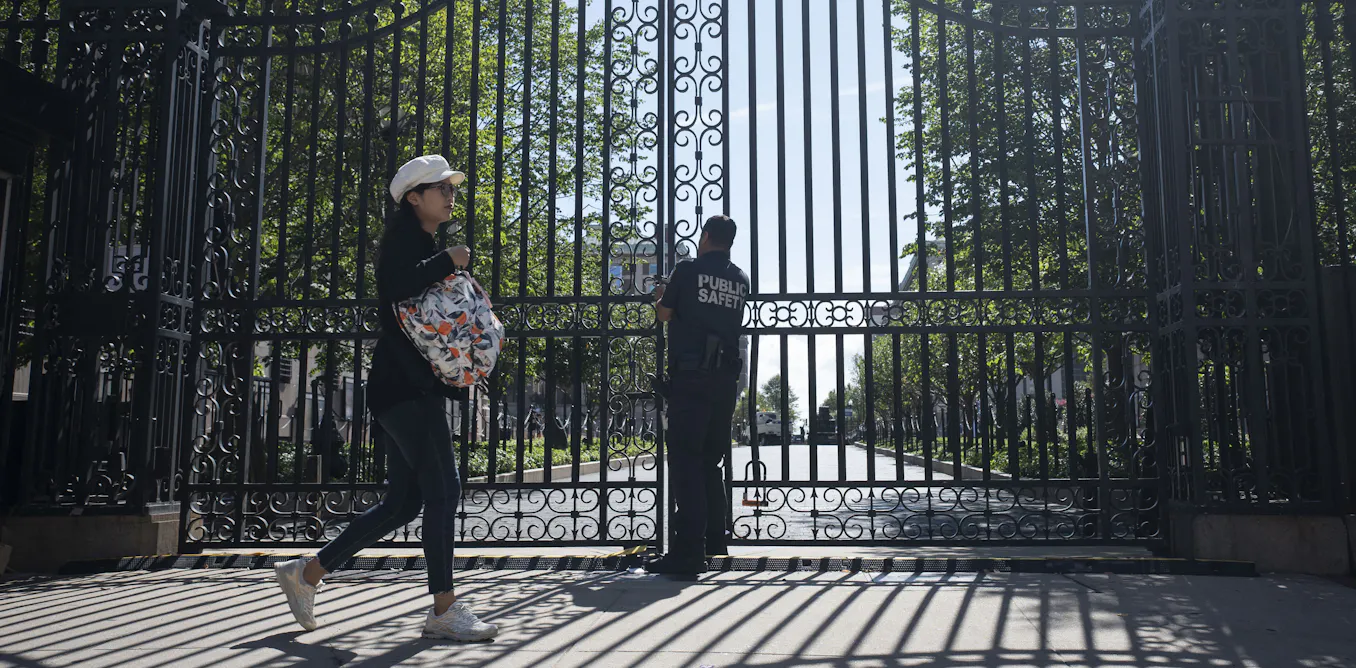
Columbia University has kept its Morningside Heights campus closed to the public since April 2024, a restriction that began after pro-Palestinian protests and police arrests.
The university first shut its gates in April 2024 following waves of demonstrations and arrests. New York City politicians at the time said the disruptions were fueled by “outside agitators.” Today, only students, faculty, staff and alumni with a school ID can enter the quad.
Neighbors sued in January 2025, arguing the closure created a “six-block barrier between Broadway and Amsterdam Avenue from West 120th to West 114th Street” and violated the Americans with Disabilities Act and the Rehabilitation Act.
A New York Supreme Court judge in Manhattan dismissed the suit on Nov. 10, 2026, writing that “even if Columbia previously granted unrestricted public access to College Walk, as it remained their private property, nothing prevented them from restricting access at any time.” The plaintiffs have appealed.
From at least the 1950s until 2024, Columbia maintained an open campus policy. In 1953, New York City approved closing the campus’s central West 116th Street stretch to cars with the understanding that pedestrians would still be able to walk across, Neighbors used the campus as a scenic shortcut, and nearby nursery schools brought children to play on the green.
Columbia has said safety concerns required the gate closure and that the campus is private property.
The plaintiffs quickly appealed the decision, according to both outlets.
News reported. Before 2024, the university allowed neighbors to cross the campus as a scenic shortcut and nearby nursery schools used the green for children to explore and play, both sources said.
“The ivory tower” captures one vision of a university — disengaged from immediate community concerns, benefiting society indirectly through research, innovation and jobs. But as the Columbia case shows, universities also face pressure to demonstrate civic responsibility.
“Columbia is successful when Morningside Heights is successful and when the relationship between the neighborhood and the university is good,” newly elected New York State Assemblyman Eli Northrop said.
Worth a look

Oklahoma’s Ryan Fodje Cleared for Missouri Game; Kenny Ozowalu Upgraded to Probable
Oklahoma offensive lineman Ryan Fodje has been cleared to play Saturday against Missouri after being removed from Thursday's...

Democrats Win Six New State Trifectas, Target Minimum Wage and Abortion Rights
Democrats secured full control of six state governments in the November midterm elections, adding Wisconsin, Pennsylvania, Arizona, Michigan,...

Over 3,667 Acres of Illinois Farmland Across 23 Counties Head to December 2026 Auction
More than 3,667 acres of Illinois farmland across 23 counties will be auctioned in December 2026, with individual...
New Jersey Restaurants: Omakase, Pizzeria, Tavern, Freddy’s Location Open
New restaurants opened across New Jersey in recent weeks, adding an elevated tavern in Bedminster, a chef-led omakase...