
Carbon bubbling out of Hawaii’s volcanoes may have traveled the longest possible route to Earth’s surface: from the outer solar system, into the planet’s metallic core, and back up through a mantle plume.
A study published in the Proceedings of the National Academy of Sciences reports that volcanic rocks from Kīlauea and the Tantalus Rift contain an unusual carbon isotope signature that researchers interpret as evidence of core-derived carbon leaking into the mantle and rising to the surface.
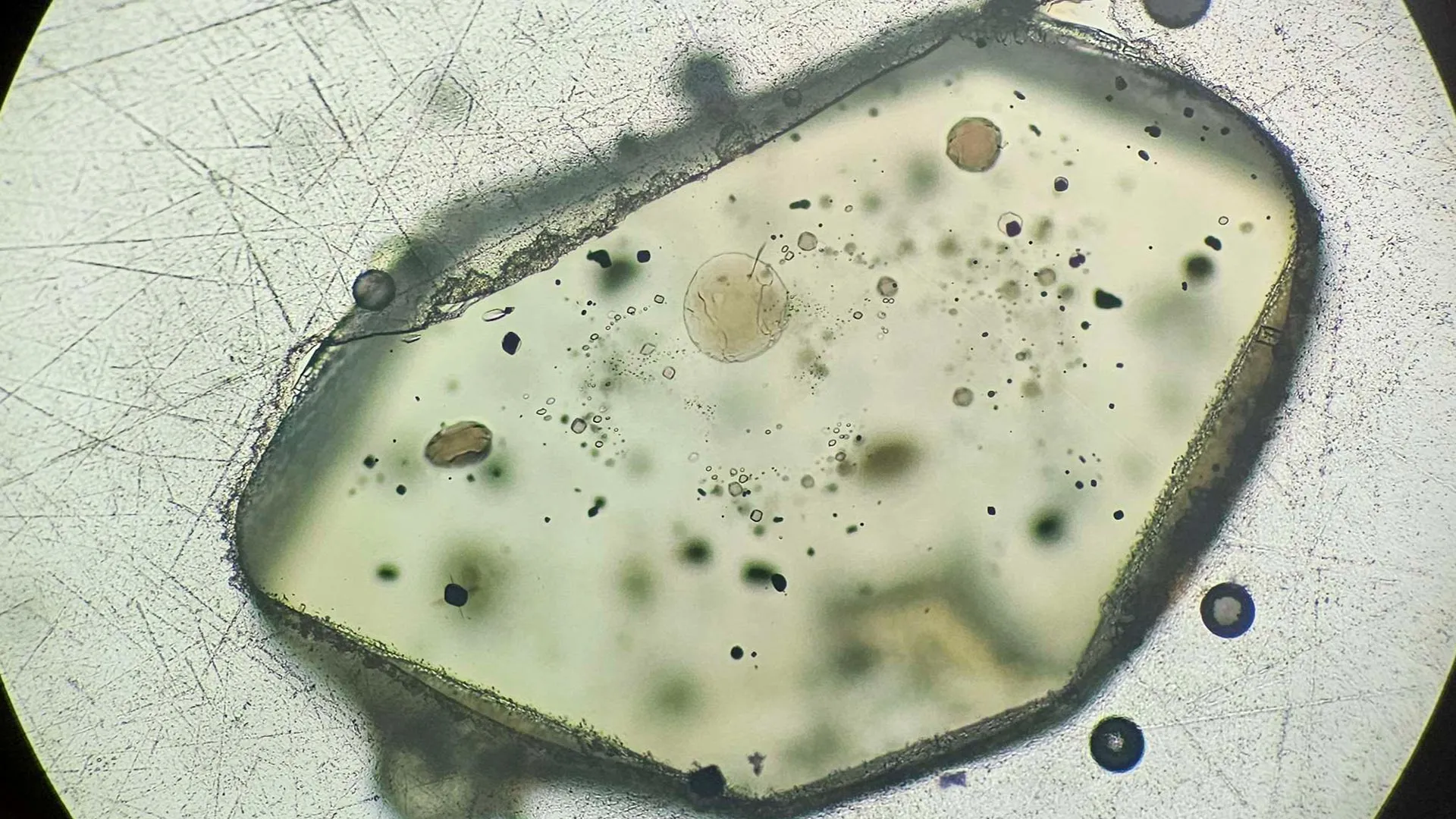
Earth holds roughly two billion tons of carbon, most of it locked in the core — a reservoir beyond the reach of direct sampling. To probe it, a team led by Yves Moussallam, an associate professor in Columbia University’s Department of Earth and Environmental Sciences at Lamont-Doherty Earth Observatory, analyzed microscopic melt inclusions trapped inside olivine crystals from Hawaiian eruptions, including the 1959 Kīlauea Iki event.
“These melts are fossils of the magma”, Moussallam said. Because the inclusions sealed before gases could escape, they preserve the isotopic composition of carbon dissolved in the original magma.
The team measured carbon-13 relative to carbon-12. Samples from the Tantalus Rift, associated with the plume’s outer margins, showed a typical mantle value of about −7‰. But samples linked to the plume’s central axis — thought to originate near the core-mantle boundary — yielded a distinctly heavier signature of about −1‰.
“We interpret this as carbon leaking from the core”, said Damanveer Grewal, a cosmochemist at Yale University and co-author of the study. The enrichment in carbon-13 matches what scientists would expect if carbon had partitioned into the metallic core during Earth’s formation and later migrated back into the overlying mantle.
Scientists Trace Carbon Journey From Outer Solar System to Core
Researchers propose that carbon now detected in Hawaiian lavas arrived aboard meteorites during a specific stage of planetary accretion and became sequestered in the metallic core, according to the study published in the Proceedings of the National Academy of Sciences.
ScienceDaily reports that scientists are still working to answer the fundamental question of where Earth’s carbon originally came from, and the new findings suggest an extraterrestrial origin followed by deep planetary storage.
The transport pathway spans roughly 3,000 kilometers through the mantle via rising plumes.
Earth's Layered Structure Defines the Leak Pathway
Most of Earth’s carbon — roughly two billion tons — is believed stored in the core, ZME Science notes, making it the planet’s largest carbon reservoir yet beyond the reach of direct sampling.
Recent studies suggest certain elements can escape from the outer core into the overlying mantle, where enormous rising columns of hot rock called mantle plumes may transport them toward the surface.
These plumes begin near the core-mantle boundary, partially melt as they ascend, and produce magma that erupts through volcanoes such as those in Hawaii. The ZME Science article explains that if material from the core crosses into the mantle, these plumes could effectively carry it upward.
Columbia University’s press release details how associate professor Yves Moussallam, in the Department of Earth and Environmental Sciences at Lamont-Doherty Earth Observatory (November 2026), led the team analyzing undegassed melt inclusions from Hawaiian olivine crystals. Their method measured carbon isotopes in samples from the 1959 Kīlauea Iki eruption and the Tantalus Rift to distinguish plume-center magma from plume-edge sources.
“We think that we found evidence of carbon from Earth’s core leaking into the core-mantle boundaries and traveling all the way to the surface”, Moussallam said.
The findings suggest that carbon delivered by meteorites during a specific stage of planetary accretion became sequestered in the core, and that mantle plumes can transport it upward across 3,000 kilometers of rock. If confirmed, the Hawaiian lavas offer an unprecedented window into the chemistry of a region humans have never directly sampled.
Worth a look
Police Link Substance Release at Don Toliver Manchester Concert to Robbery Attempts
British police said on Friday that the release of an unknown substance during a Don Toliver concert at...

USD Instructor Kelly Knutson Named SHAPE SD 2026-27 College Teacher of the Year
Kelly Knutson, a physical education specialist and instructor at the University of South Dakota, was named the Society...

Nikola Topić Leans on Serbian NBA Brotherhood Through Injury Struggles
"I told him I'm just amazed how strong of a person he is," Nikola Jović told The Oklahoman...

Pregnant Inmate Escapes Custody in Prison Transport Vehicle During Whataburger Stop
A pregnant inmate climbed from the back seat into the driver’s seat of a state transport vehicle and...