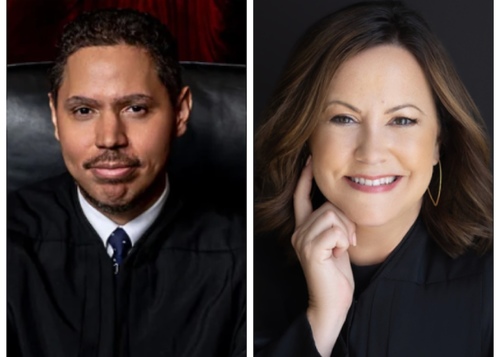
Dark money spending helped Democratic-nominated Michigan Supreme Court justices win reelection, maintaining a six-to-one majority on the state’s highest court. The justices won by larger margins than other top Democrats.
Outside groups spent nearly $2.5 million to boost the Democratic nominees through mid-October, while Republican nominees received just $3,100 in disclosed outside spending, Deadline Detroit reported. The final totals are likely higher, as committees have yet to disclose all their fundraising and spending through the election. Post-election filings are due in early December.
Justices Megan Cavanagh and Noah Hood, incumbents who appeared on the ballot with the potent “Justice of the Supreme Court” label, each received more than double the votes of their Republican challengers.

The bulk of the Democratic support came from dark money nonprofits. The Michigan Civic Action Fund gave $1.75 million, and Justice Project Action provided $1.38 million to the Justice For All super PAC, which supports Democratic judicial nominees, bridgemi.com reported. Billionaire Michael Bloomberg also gave $375,000 to the super PAC, and three labor unions donated a combined $210,000.
The influx of undisclosed funds has raised alarms among experts. “This flood of secret money leaves voters without important information about the interests trying to shape state courts, and it can obscure potential conflicts of interest for judges and litigants alike,” Alicia Bannon of the nonpartisan Brennan Center for Justice wrote in a 2018 report.

The Michigan Supreme Court has significant power, deciding on the constitutionality of state laws and whether ballot measures should go before voters.
The court has made several precedent-setting decisions on criminal law recently, including ruling that the state’s sex offender registry law is unconstitutional when applied retroactively, a decision that has already removed more than 20,000 people from the list. The court also adopted a rule this year limiting law enforcement’s ability to make civil arrests in courtrooms.
The Michigan Civic Action Fund won’t have to disclose its 2026 spending until November 2027. The most recent reported year for the organization was 2024, when it disclosed revenue of $14.6 million and expenditures of $15.6 million. Amy Chapman, a representative for the fund, did not reply to an inquiry for comment on this story.
Worth a look

LeBron Scores 21 in Fifth Straight 20-Point Game as Pacers Fall to Sixers
LeBron James scored 21 points in a game against the Indiana Pacers, leading the Philadelphia 76ers to a...

India Flags Inflation Risks From Wedding Demand, El Niño, Hormuz; Growth Holds
India's Finance Ministry warned on Saturday that retail inflation, already above the central bank's tolerance limit, faces fresh...
Four States Enact Laws to Limit Medical Malpractice Damages
Since 2025, at least four states have enacted laws capping damages or shortening filing deadlines in medical malpractice...

Va. Gov. Spanberger Explains Why She Didn’t Call for State of Emergency Earlier
“Knowing what this storm was going to be, we didn’t have a need for mobilization and, most importantly,...