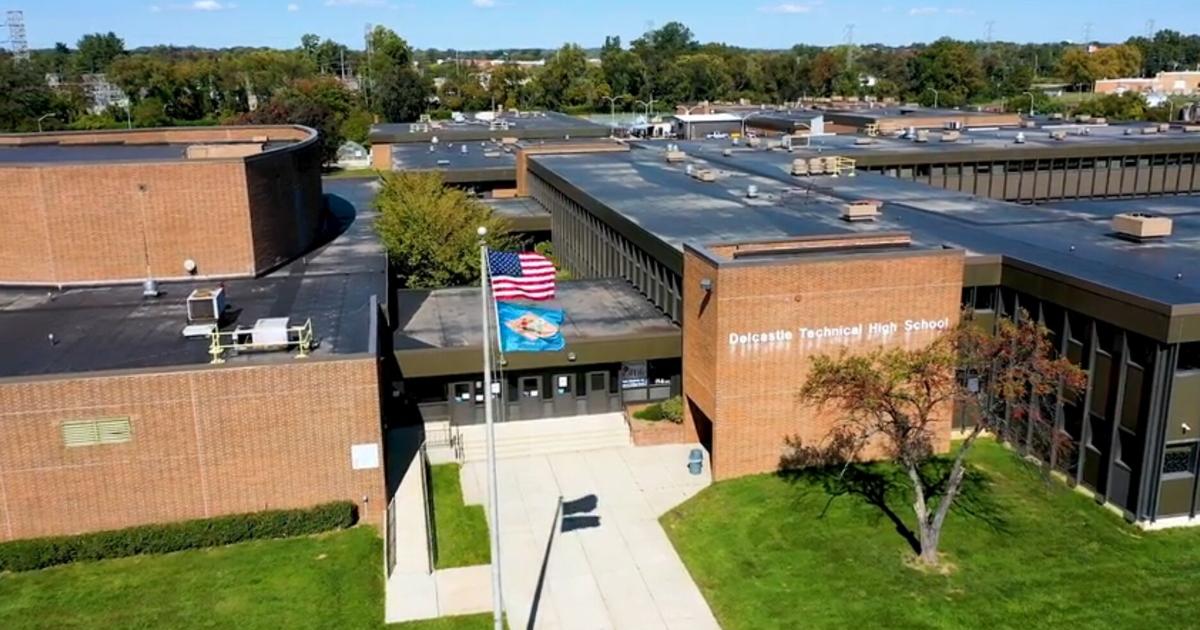
Delaware’s vocational-technical district is staring down a $315 million bill to replace a high school that opened when Lyndon Johnson was president, WDEL reported.
The New Castle County Vocational Technical School District secured a Certificate of Necessity for a new Delcastle Technical High School, a move that would retire a 250,000-square-foot building from 1967 that now holds 1,634 students — 149 above the state’s rated capacity.
Superintendent Dr. Joseph Jones laid out the stakes in the district’s request to the Department of Education: the proposed facility would consolidate programs now split between campuses, including a Medical Careers Pathway currently bused to the Marshallton Education Building during the school day.
“The proposed new Delcastle Technical High School will replace the aging facility with a modern school designed to support current and future educational and workforce development needs,” Jones wrote in the filing. “The project will provide contemporary academic and (Career & Technical Education) instructional environments; improve accessibility, safety, security, and energy performance; and address aging infrastructure and campus facilities.”
The financing structure shows a key difference in how Delaware funds its vo-tech system. Unlike traditional districts, NCCVT does not put capital referendums to a public vote. The local share — $110,259,700 — comes directly from county taxpayers without a referendum, while the state covers the remainder.
Construction would follow the Hodgson model: build on the existing athletic fields, keep the current school running, then replace the old footprint with a new stadium and turf fields as early as 2031.

State funds new Charlton School fully
Downstate, the Caesar Rodney School District received approval for two major asks and a third that signals where the district believes its future lies.
The state greenlit $114 million for a new John S. Charlton School on land behind Frear Elementary and Postlethwait Middle School, a facility serving 300 students in the Delaware Autism Program and Early Intervention Program for all of Kent County. Because it is a special-education request, the state picks up the full tab; district taxpayers need only approve the work itself.
The district also won permission to spend $2.1 million for the Sorghum Mill Road site and $7.9 million for an additional 163 acres nearby — land that could host a second 1,600-student high school. Caesar Rodney High finished last year with 2,284 students against a 1,864 capacity, with projections hitting 2,861 by 2030. The district asked the state to fund that second high school now. The answer was no.

Brandywine’s $218 million lifeline hinges on a referendum
The Brandywine School District walks away with $218 million in approved projects, but every dollar is contingent on a successful capital referendum. The centerpiece is $92 million for Mount Pleasant High School, built in 1956, targeting ADA compliance across music, arts, and library spaces. Mount Pleasant Elementary, a 1931 structure, draws $76 million for windows, classroom expansions to meet state standards, and a cafeteria addition.
Athletics claim $40 million: synthetic turf fields at Brandywine, Concord, and Mount Pleasant; field houses with restrooms at stadiums; dugouts for baseball and softball; new tracks at the high schools plus P.S. duPont, Springer, and Talley Middle Schools; and stadium lighting at Mount Pleasant. Concord High’s natural grass field hockey field was condemned by the DIAA because shared use with girls’ lacrosse wears it down each season.
New Castle County Vocational Technical School District traces its roots to 1867, when it opened as Public School No. 16 in a five-room building at 12th and Orange Streets in Wilmington dedicated to educating Black children; two years later it was named for Civil War General Oliver Otis Howard.
Each year one-fourth of all eighth-grade students in New Castle County public schools apply for admission, and those accepted choose from 42 career programs across six clusters.
Cape Henlopen expansion targets largest status
Cape Henlopen High School sits at 1,889 students in a 2,000-seat building. A $67 million two-story classroom addition would add space for roughly 600 students, pushing capacity past William Penn and Caesar Rodney to make it Delaware’s largest high school.
Worth a look

Green Mountain Chapter of Air & Space Forces Association Pauses Operations After Decades of Service
Eighty years of advocacy ended not with a vote, but with a quiet luncheon on November 12 at...

Pierre Martel, Former MPC Chair and Hall of Famer, Dies at 71
The Canadian mortgage industry is mourning the sudden death of Pierre Martel, a former chair of Mortgage Professionals...

No. 18 NC State Knocks Off No. 6 Ohio State 19-17
No. 18 NC State knocked off No. 6 Ohio State 19–17 Friday night at Reynolds Coliseum in Raleigh,...

Trump Administration Admits in Court Filing It Deported U.S. Citizen, Reversing Months of Denials
The Trump administration admitted in a federal court filing Friday that it deported a U.S. citizen, reversing months...