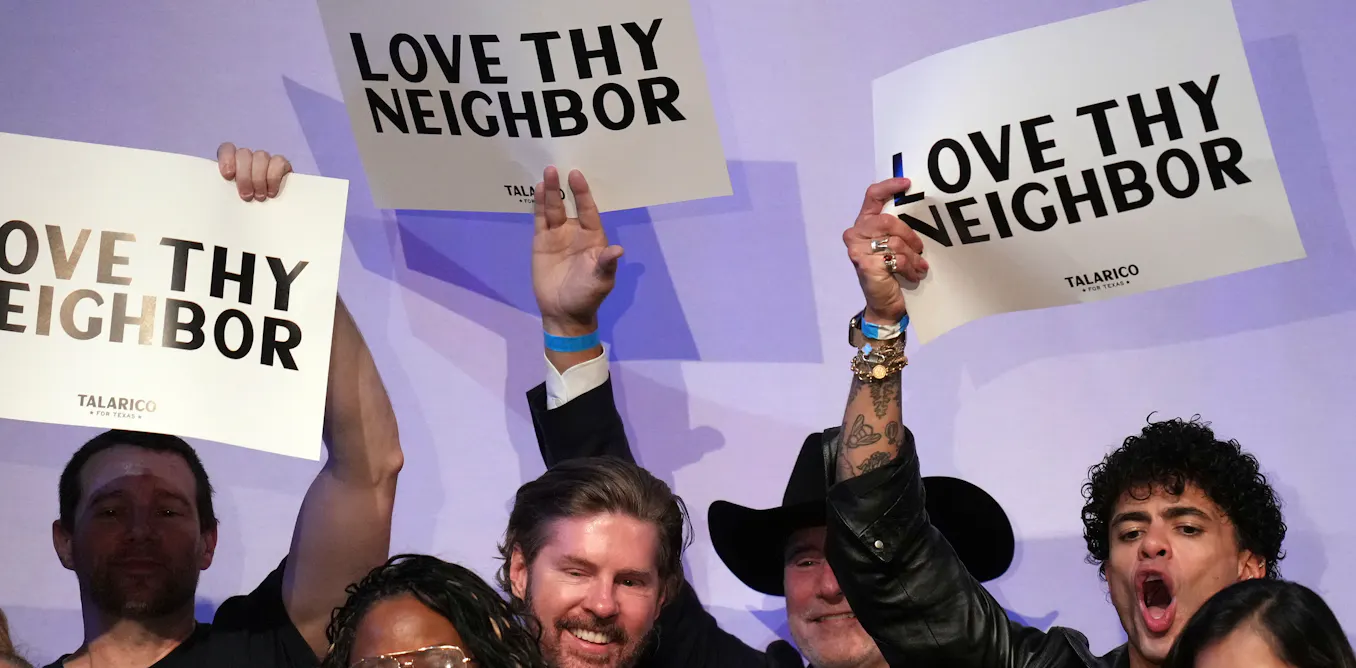
Democrats flipped Senate seats in Texas and Kansas this month, breaking decades of Republican control with candidates who centered Christianity in their campaigns.
- James Talarico, a Presbyterian seminary student and state legislator, defeated Ken Paxton in Texas.
- Adam Hamilton, founding pastor of the 24,000-member Church of the Resurrection, won in Kansas — the state’s first Democratic senator since 1932.
- Four other mainline Protestant clergy flipped U.S. House seats for Democrats in November.
- White evangelicals still voted 82 percent Republican in the midterms.
Clergy candidates break the pattern
James Talarico, the grandson of a Baptist preacher, pursued a master’s in theological studies while serving in the Texas Legislature. On the trail he contrasted his reading of the New Testament — a Jesus who “was tolerant of sinners, who challenged religious authorities and who advocated for a radical form of equality between the downtrodden and the elite” — with the conservatism of Republican opponent Ken Paxton.
Talarico argued that “the Christian religion should advocate for economic equality and tolerance of marginalized groups.”
The founding pastor of the Church of the Resurrection — the largest United Methodist church in the U.S. with 24,000 members in three states — Adam Hamilton made his congregation LGBTQ-affirming two decades ago.
He told voters his faith drives advocacy for “those experiencing economic difficulties and marginalized groups.” His victory made him the first Democratic senator from Kansas since 1932.
Other mainline Protestant wins
The midterms sent four additional clergy to the U.S. House: Rev. LaKesha Womack, an ordained deacon in the African Methodist Episcopal Zion Church in North Carolina; Rev. Frederick Haynes III, senior pastor of Friendship-West Baptist Church in Dallas; Rev. Lindsay James, a Presbyterian minister in Iowa; and Rev. Sarah Trone Garriott, a minister in the Evangelical Lutheran Church in America in Iowa. All ran as Democrats in districts that had leaned Republican.
White evangelical loyalty holds
Despite the pickups, white evangelical voters backed Republican candidates at 82 percent in the midterms — a level virtually unchanged from the more than 80 percent who supported Donald Trump in 2024. The alliance, forged after Ronald Reagan’s 1980 election, remains the Republican Party’s most durable demographic pillar.
Echoes of the Social Gospel
Historians note the rhetoric mirrors the Social Gospel movement of the 19th and early 20th century. According to Walter Rauschenbusch and other theologians, the New Testament depicts Jesus as a radical egalitarian who sought to place the poor on equal footing with the elite. Franklin D. Roosevelt adopted that language for the New Deal and won four presidential elections.
Rhetoric or realignment?
Whether Talarico and Hamilton are “simply making use of Christian rhetoric to draw attention to issues related to the economy remains to be seen.”
More on James Talarico
SEC Presidents to Discuss LSU Membership Over Eligibility Concerns
The Southeastern Conference will hold a video conference Thursday with the presidents and chancellors of all 15 member...

Law Firm Outlines Factors in Philly Truck Crash Probes
A fatal truck crash in Philadelphia can trigger a wrongful-death investigation that examines driver fatigue alongside road, vehicle...

Only 6 of 55 Major US Cities Have Measurable Snow; Denver 42 Days Past Normal
Only six of 55 major U.S. cities have recorded measurable snow this season through Saturday, with Denver now...

Kentucky TE Mikkel Skinner Rushes 121 Yards, MVP After Baxter Ruled Out
Kentucky tight end Mikkel Skinner rushed for 121 yards and a touchdown on 19 carries Saturday, earning the...