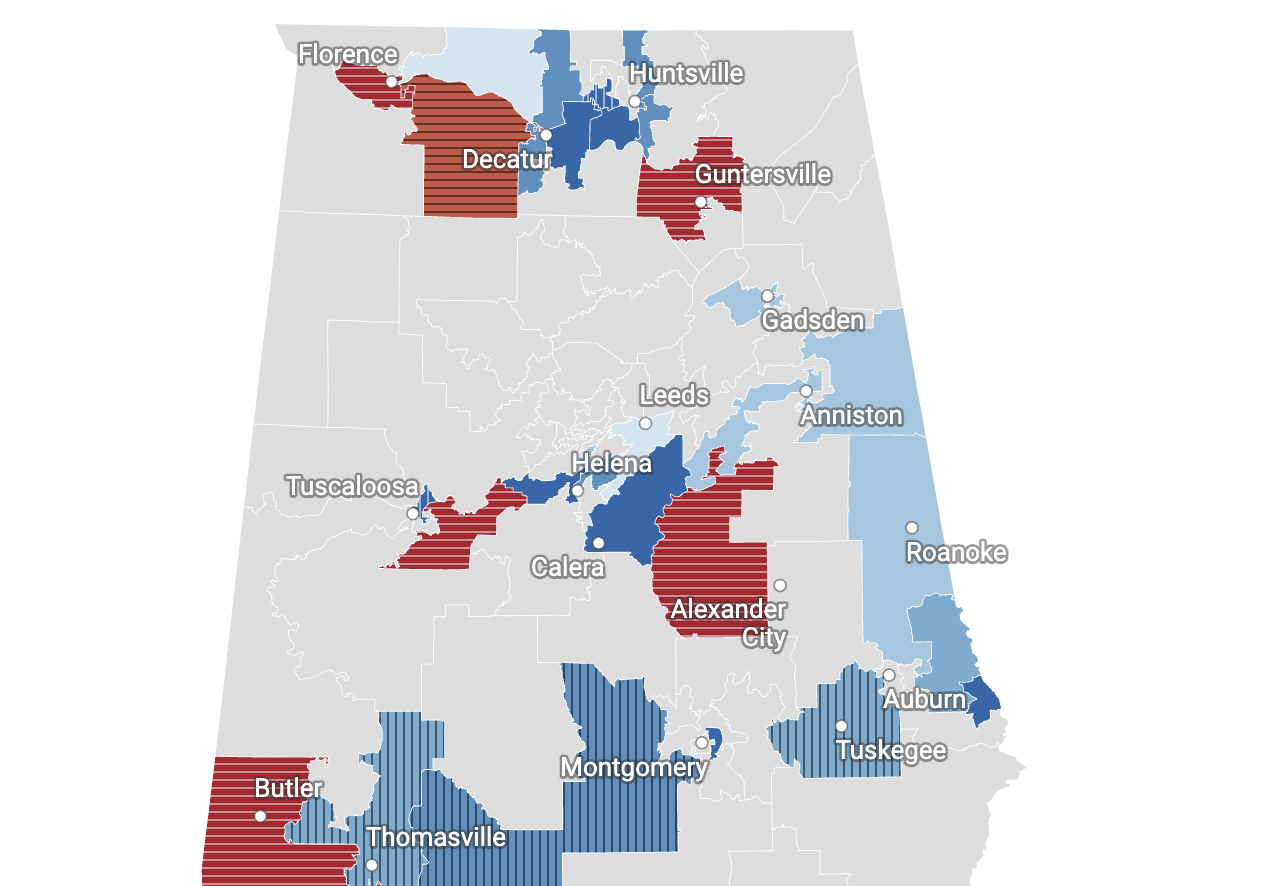
Alabama’s legislative makeup changed in subtle but telling ways this past Tuesday, as Democrats managed to chip away at Republican margins in several key districts.
While the GOP maintains a firm grip on the state legislature, an analysis of the latest unofficial election returns reveals that the political map is not as static as the lopsided totals might suggest.
According to an Alabama Daily News analysis, Democrats successfully flipped four Republican-held seats. Yet, these gains reveal a structural reality of Alabama politics: in the vast majority of legislative districts, voters were never presented with a choice between the two major parties.
In fact, 88 out of 140 House and Senate races featured only a single candidate on the ballot, leaving most voters with no alternative to the incumbent or the party in power.
Suburban Shifts and the Education Gap
The narrowing margins were most visible in suburban corridors where highly educated voters are increasingly drifting toward the Democratic ticket. Professor David Hughes, an expert on Alabama elections, noted that this trend is particularly pronounced in the regions surrounding Birmingham, Huntsville, and Auburn. In these areas, historical Republican strongholds are seeing a measurable cooling of support.
“That’s a story I would be telling,” Hughes said of the suburban shifts.
The data bears this out in specific, measurable ways. Take House District 4, which encompasses parts of the Decatur and Huntsville areas. In 2018, the Republican candidate cruised to a 44-percentage-point victory. By 2026, that lead had eroded to 19 points. While the Republican still secured the seat, a 25-point swing toward the Democratic candidate over an eight-year period represents a major realignment in voter preference.
The Impact of Non-Competitive Races
The scarcity of competition is not merely a quirk of the ballot; it is a defining feature of the state’s political architecture. When voters with similar political leanings are clustered into the same districts, the incentive for the minority party to field a candidate evaporates. This absence of a challenger carries real-world consequences for accountability and civic engagement.
Research suggests that uncontested races directly correlate with lower voter participation. When a candidate faces no opponent, they face no pressure to defend their legislative record or engage with the specific concerns of their constituents. This lack of scrutiny can leave voters feeling disconnected from the process, potentially fueling the frustration that often bubbles up in cycles where the outcome is effectively decided before a single vote is cast.
The reliance on straight-ticket voting further entrenches these patterns. According to unofficial figures released by the Alabama Secretary of State, 70.5% of ballots cast on Tuesday were straight-ticket votes. This mechanism allows voters to select an entire party slate with one mark, which often shields down-ballot candidates from the need to build individual support or articulate specific platforms.
Race Drives Alabama Political Polarization and Redistricting
Alabama’s political divide remains deeply rooted in race, a factor that Hughes notes is inseparable from the state’s current electoral environment. Black voters continue to overwhelmingly support Democratic candidates, while white voters remain predominantly aligned with the Republican Party. These demographic divisions, when mapped onto legislative districts, create the very conditions that make competitive elections a rarity.
Interpreting these shifts requires a cautious eye. The Alabama Daily News analysis compared 2026 returns against 2018 and 2022 data, but the researchers were quick to note that 2022 was a notably weak cycle for Alabama Democrats. Furthermore, comparing current results to 2018 figures must account for the significant redistricting that occurred in the interim, which reshaped the boundaries of many districts and altered their partisan composition.
The Senate map shows a similar, if fragmented, story. Central and eastern Alabama have seen shifts toward the Democratic Party, while parts of northern and eastern Alabama have trended in the opposite direction toward the GOP.
These movements indicate that while the state remains firmly Republican, the underlying currents of voter sentiment are moving in ways that could eventually challenge the status quo if the structural barriers to competition are lowered.
Ultimately, the results of this election cycle show that while Alabama’s legislative map is currently dominated by one party, the suburbs are quietly following national trends. The question for the coming years is not just which party gains ground, but whether the state’s electoral system will evolve to provide voters with the competitive choices necessary to hold their representatives fully accountable.
Keep reading

Boise Man Arrested for Shooting 15-Year-Old After Ding-Dong Ditching
Boise Police Arrest 45-Year-Old Following Juvenile Shooting Boise Police have taken 45-year-old Darin Young into custody following the...

HPD Recalibrates Gang Tracking on Oahu Amid Federal Prosecutions
The Honolulu Police Department is currently recalibrating how it identifies and tracks criminal gangs on Oahu, a shift...

Georgia Takes No. 1 in AP Top 25 After Miami Loss to Notre Dame
Georgia now sits at the top of the college football world. Following a chaotic Saturday that saw the...

Amanda Rai Photography Details Newborn Family Sessions in Dover, NH
The Evolution of the Family Portrait in Dover Capturing a growing family requires more than just a camera;...