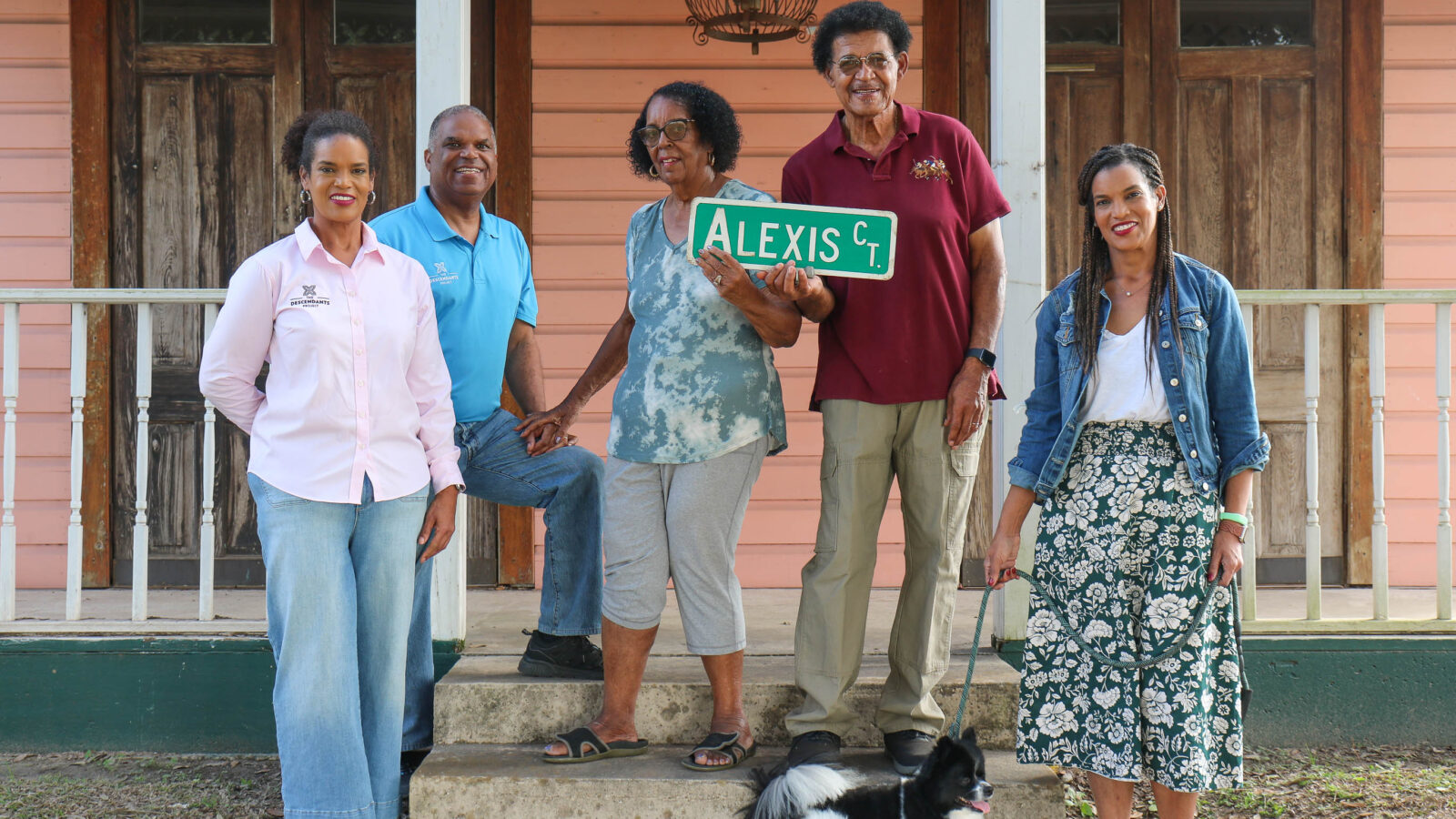
On November 13, more than 40 frontline environmental justice organizers from across the U.S. joined a descendant-led solidarity bus tour through Louisiana’s River Parishes, known to outsiders as “Cancer Alley,” to unveil public art installations that reclaim the region’s history of freedom and resistance.
The tour, co-produced by The Natural History Museum and The Descendants Project, traveled through industrial corridors and historic Black communities, revealing how the histories of extraction and liberation occupy the same ground. The journey included the unveiling of “Mapping Freedom: Signs of Resistance & Reclamation,” a public art installation featuring 10 commemorative street signs and a monumental town welcome sign, allowing descendants to put their histories back on the map.
In many ways, I hate using it,” said Jo Banner, co-founder of The Descendants Project, who led the tour. “This is my home. This is where my mom grew up, and this is where my grandparents grew up.”
The signage commemorates histories that rarely appear on official maps, from the 1811 German Coast Uprising and Maroon communities to Black Union soldiers and jazz pioneers. “These signs show how we would name our community if we had the chance and the choice,” Banner said. “They speak to our freedom, our liberation, and our hope. They make visible histories that have been hidden and affirm our ability to tell our own story.”

Seven of the street signs were mounted on property owned by The Descendants Project, while three were displayed by community members along the tour route.
At the street sign near the Denka Performance Elastomer plant, Tish Taylor of Concerned Citizens of St. John recalled neighbors and the illnesses affecting residents due to chemical emissions. The plant announced in May 2025 it would halt operations after scrutiny over chloroprene emissions, classified by the EPA as a likely carcinogen.
On November 13, The Natural History Museum and The Descendants Project co-produced a solidarity bus tour through Louisiana’s River Parishes. The tour was led by Jo and Joy Banner of The Descendants Project.
The journey was presented as a companion program to the 2026 Community Sentinel Awards.
The signs honor histories rarely found on official maps, from the 1811 German Coast Uprising to jazz pioneer Edward “Kid” Ory. “These signs show how we would name our community if we had the chance and the choice,” Banner said. “They speak to our freedom, our liberation, and our hope.”
The Descendants Project was founded by twin sisters Jo and Dr. Joy Banner, 10th-generation Louisianans, to reverse enduring harms of slavery and environmental racism. In 2024, the organization acquired Woodland Plantation, making the Banner sisters its first Black owners in over two centuries, and is transforming it into a descendant-led museum and cultural center.
As Co-Director, Dr. Banner spearheaded the creation of a Descendant Culture and Education District in the historic Freetown of Wallace, where she leads the design of The Liberation Labyrinth, a garden space dedicated to freedom-seeking and environmental connection.
At Woodland Plantation in LaPlace, three signs honored the 1811 uprising, its organizer Charles Deslondes, and jazz pioneer Edward “Kid” Ory. The Descendants Project acquired Woodland in 2024, making the Banner sisters its first Black owners in over two centuries, and is transforming it into a descendant-led museum and cultural center.
The tour culminated in Wallace with food, live jazz, and a community gathering, where participants exchanged stories and organizing strategies to strengthen struggles for environmental justice and community self-determination.
Worth a look
Kalshi Launches Connecticut Gas Price Prediction Market for Nov. 28, 2026
Kalshi has launched a prediction market for the change in Connecticut's average regular gasoline price on November 28,...
Ohana Lists Tens of Thousands of NYC Sublet Searchers
Ohana lists tens of thousands of searchers and all-time listings for New York City sublets and roommates, the...

Sports Illustrated: Thunder Aim to Reverse Mediocre Season With Favorable Schedule
Thunder Face 3-7 Start Amid Key Injuries The Oklahoma City Thunder are 3-7 in their last 10 games,...

Anchorage’s Gus Schumacher Opens World Cup Season with Olympic Medal
Anchorage skier Gus Schumacher opens the World Cup season Friday in Ruka, Finland, carrying an Olympic silver medal,...