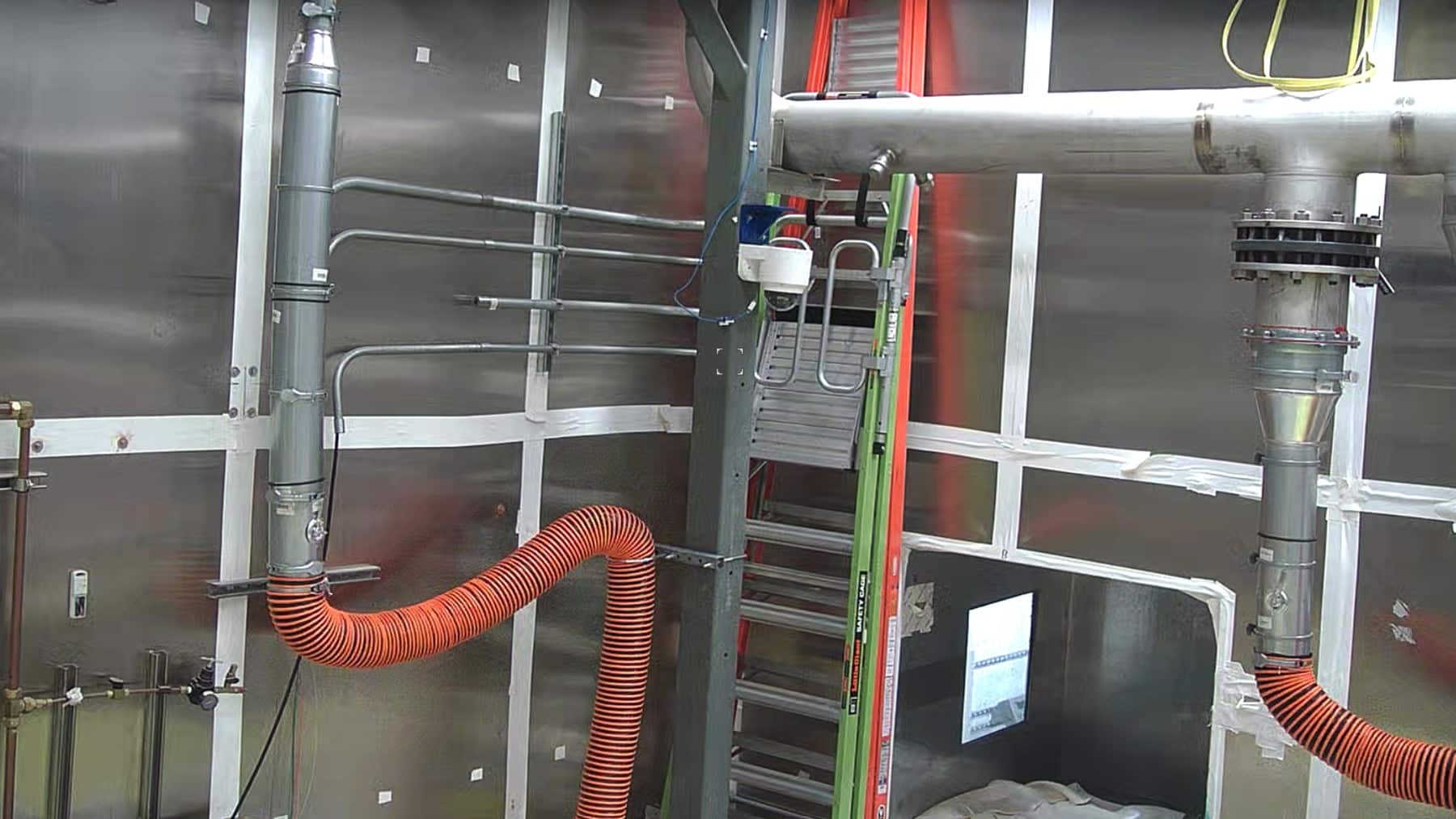
Workers at a Tennessee nuclear cleanup facility have traded a loud, shaky reciprocating saw for a mechanical drum crusher.
The Department of Energy’s Office of Environmental Management announced on November 3 that its Oak Ridge cleanup office and contractor United Cleanup Oak Ridge (UCOR) completed a reconfiguration of one section of the Transuranic Waste Processing Center.
The upgrade tackles a bottleneck in nuclear legacy cleanup. Transuranic waste, commonly known as TRU waste, consists of tools, rags, protective clothing, sludge, and soil contaminated with elements heavier than uranium, primarily plutonium, left over from decades of nuclear defense work.
Before this material can make its permanent journey underground to the Waste Isolation Pilot Plant (WIPP) in New Mexico, facilities like the 38,000-square-foot center in Oak Ridge’s Melton Valley must open, sort, repack, and certify it.
The recent overhaul focused on the cask processing enclosure, or CPE, which is one of four work areas inside the main processing building. Earlier this year, UCOR crews stripped out old gear, including a conveyor, a soil mixer, and an old ventilation system. In their place, they installed a drum crusher, new cameras, and monitoring software.

Ventilation is a priority in these containment zones. Air is constantly pulled through filters to ensure radioactive contamination stays right where it belongs. Meanwhile, the addition of the new crusher replaces a manual process. Previously, operators had to hold a vibrating reciprocating blade against contaminated steel containers.
Investing in the site supports the department’s mission, and its capabilities for getting TRU waste ready for final offsite disposal are unique, according to Michael Griswold, the federal project director for the Oak Ridge center.
Adam Fraser, the center’s facility operations manager, pointed out that the site doesn’t have much space to work with. Turning nonfunctional space into an active processing zone lets crews tackle the reservation’s old waste faster without building new work areas.
This is not the facility’s first drum crusher. The plant’s main operating gallery utilizes a 900-pound drum crusher mounted on top of the contact-handled glovebox. When that unit previously suffered a mechanical failure, workers were forced to suit up and cut open empty drums by hand—a slower, riskier process.
The newly outfitted CPE is designed for a different assignment. It will process large waste boxes generated from deactivation and demolition projects at the Oak Ridge National Laboratory (ORNL) and the Y-12 National Security Complex. A Department of Energy presentation from October describes the CPE as three contained rooms optimized for handling these oversized containers and other containers with lower radiation levels.
Federal officials have not yet released a start date for the new boxes to enter the system, nor have they shared specifications regarding the weight or throughput capacity of the new drum crusher. As teams finish clearing out old infrastructure and testing the monitoring software, the facility stands poised to take on the next wave of waste.
Keep reading

Two Arrested After Fatal Shooting at Winston-Salem State University Homecoming
Homecoming weekend at Winston-Salem State University ended in tragedy that left a 19-year-old dead and another person injured,...

Kathleen Billington Passes Away at Age 93
Kathleen Billington passed away peacefully at her home with family by her side on October 30, 2026, at...

Neil deGrasse Tyson Debunks Space and Earth Conspiracy Theories
Astrophysicist Neil deGrasse Tyson appeared on the "New Heights" podcast hosted by Travis and Jason Kelce, according to...

Ryan Day Expected to Make More Ohio State Coaching Changes After Discher Firing
Ohio State head coach Ryan Day fired special teams coordinator Robby Discher on Monday following a 41-28 home...