
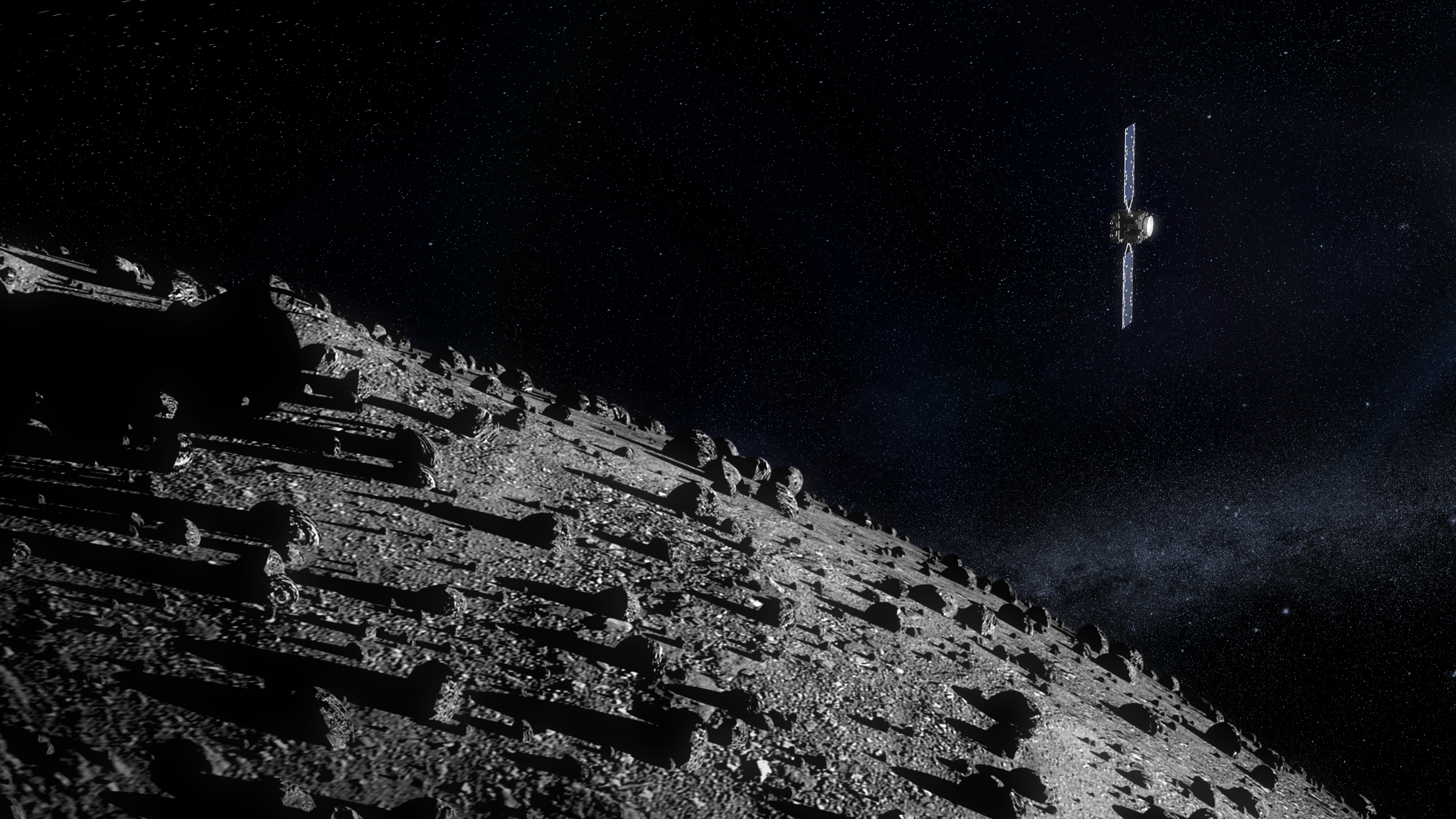
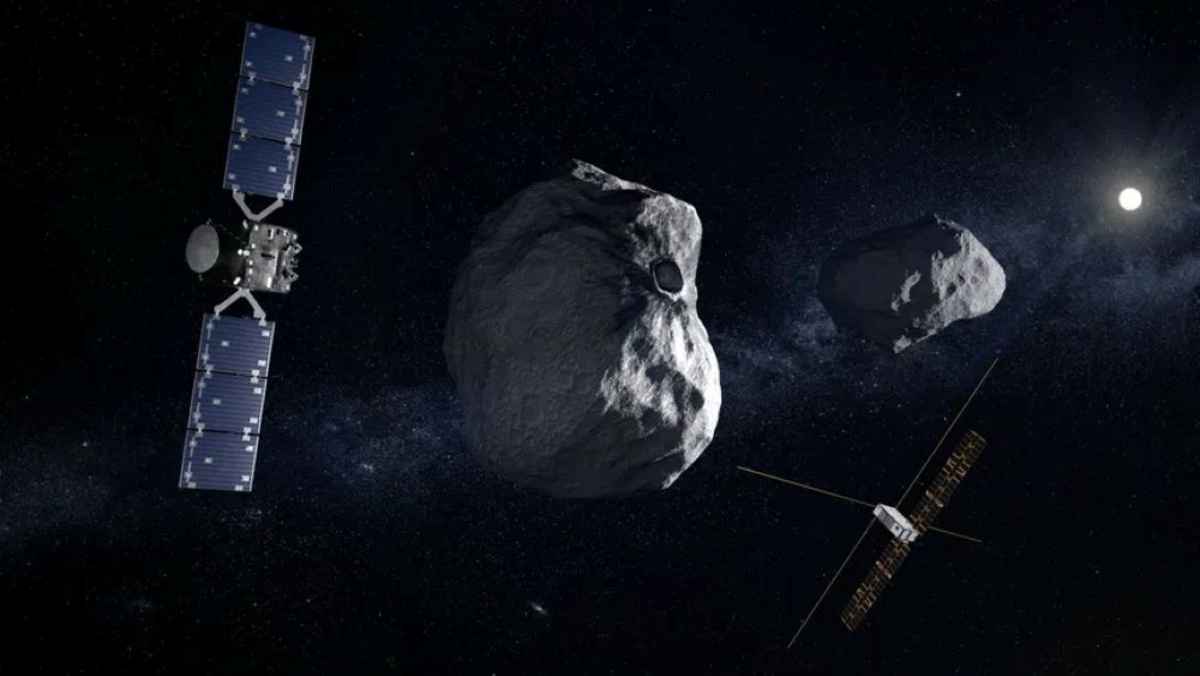
ESA’s Hera spacecraft has returned the first close-up images of asteroid Dimorphos since NASA’s DART mission slammed into it four years ago, revealing a stadium-sized crater that nearly spans the moonlet’s entire body.
ESA released the images Wednesday. They show the first direct look at the impact site since the Italian cubesat LICIACube photographed the debris plume in 2022. The pictures confirm what simulations had only predicted: the kinetic impact appears to have reshaped the whole asteroid.
- Hera arrived at the Didymos-Dimorphos system in late October after a two-year, 122-million-mile journey.
- Early images show a crater almost as large as Dimorphos itself, plus hundreds of previously unknown boulders surrounding the binary pair.
- The impact shortened Dimorphos’s orbit around Didymos by 33 minutes — far more than the 73-second benchmark NASA set for success.
- Dimorphos is now tumbling chaotically instead of keeping one face locked toward Didymos as it did before impact.
Crater nearly as wide as the asteroid
“The crater is almost as large as the body itself, which is really, really spectacular,” said Sabina Raducan, a planetary scientist on the Hera science team, at the Berlin briefing. “And as a crater person, I can also say it's beautiful.”
🎮 Want to walk on an asteroid? ☄️👣 With Guardians of Earth 2.0 VR experience on Meta Quest 3, you can walk on Dimorphos, currently being explored by @esa’s #Hera mission. 🛰️ You can also explore Hera – in your living room! 📷Hera Dimorphos: ESA-Science Office 📷Hera at home:… pic.twitter.com/S12zHwfMbY
Raducan’s 2024 simulations, published in Nature Astronomy, had forecast this outcome: a weak rubble-pile structure would let the crater grow until it encompassed the entire moonlet, ejecting roughly 1% of Dimorphos’s mass into space and shifting another 8% around the body.
Patrick Michel, Hera’s principal investigator, framed the mission’s role simply: “Hera is a sort of Inspector Columbo going back to the crash scene to investigate what is the outcome of this impact.” DART was destroyed on impact, leaving scientists without close-up data on the asteroid’s final state — until now.
A moonlet knocked into a tumble
Before the September 26, 2022 collision, Dimorphos was tidally locked to Didymos, showing the same face to its larger companion just as Earth’s moon does to us. “Before the DART impact, Dimorphos was more like our own moon,” Raducan explained. “Now it's very, very chaotic — it's tumbling.”
She compared the motion to “a barrel that you throw down the stairs, and the barrel is rolling and it’s moving, and basically that’s what Dimorphos does right now around Didymos.” Since the impact, Dimorphos is now tumbling as it orbits, which complicates the task of measuring Dimorphos’s mass — a critical number for calculating how efficiently DART’s momentum transferred to the asteroid.
In 2022, NASA struck an asteroid—a dress rehearsal for saving the world. It was a triumph, but much about the asteroid remained a mystery. Now, Europe's Hera spacecraft has arrived. Turns out NASA made a spectacular, history-making mess. Me @NYTScience https://t.co/CR14xIefVn
Hundreds of boulders, origin unknown
Hera’s cameras also revealed an unexpected swarm of boulders encircling the binary system — more than 100 objects ranging from tens of centimeters to meter-scale rocks. “As we approached Didymos and Dimorphos, we quickly realized the asteroids were not alone,” said Naomi Murdoch, a planetary scientist at the University of Toulouse and Hera team member. “In fact, they had a lot of company.”
The origin remains unclear. “We cannot say today, with the information that we have, whether these were debris coming from the DART impact or whether there's another origin, for example, coming off the primary asteroid,” Murdoch said. Determining the source will require tracking the boulders’ orbits over the coming months.
Thermal eyes see what visible light misses
Hera’s Thermal Infrared Imager (TIRI), provided by the Japan Aerospace Exploration Agency (JAXA), captured the first successful thermal imaging of a binary asteroid system on October 31 from 57 kilometers away. The instrument recorded Dimorphos passing into Didymos’s shadow — a sequence visible-light cameras could not resolve — and revealed surface temperature variations that betray rock density and porosity.
Solid rock dissipates heat much more slowly than porous or fragmented rock, so it will also give a good indication of how solid Didymos really is. The thermal data complement visible-light and multispectral observations from Asteroid Framing Camera and HyperScout H instruments, each adding a different layer to the physical characterization.
From test to toolkit
The DART impact shortened Dimorphos’s orbital period from 11 hours 55 minutes to 11 hours 22 minutes — a 33-minute change that exceeded NASA’s minimum success threshold of 73 seconds by a factor of 27. But the deflection efficiency, known as the momentum enhancement factor (beta), still carries uncertainty.
BIG NEWS! We have a whole new look at Dimorphos, the first asteroid humans have ever moved 👀☄️ @ESA_Hera mission has captured Dimorphos completing a full orbit around its larger companion, Didymos. Look closely and you will see the impact site come into view, and Dimorphos… pic.twitter.com/jWsuwz3H98
Early estimates ranged from 2.2 to 4.9; a March 2026 NASA update placed it around 2. Hera’s precise mass measurement, obtained by tracking the wobble of Didymos as Dimorphos orbits it, will finally nail down beta.
“It would help us to predict what would happen if we had to hit another asteroid,” said Prof Simon Green, a planetary scientist on Hera’s science team. “We [could] measure its properties and say: 'Well, we need this mass of spacecraft, travelling at this speed, this early, in order to deflect it enough so that it misses the Earth'.”

Thermal imaging reveals surface properties
JAXA reported that Hera’s Thermal Infrared Imager recorded Didymos and Dimorphos from 57 kilometers away at 11:19:52 UTC on October 31, 2026, in the first successful thermal imaging of a binary asteroid system.
Hera shifts to closer orbit for detailed observations
Hera is currently operating at 25–30 kilometers from the asteroids. Next week it will transition to a bowtie-shaped hyperbolic orbit for closer observations.
Four years ago, humans moved an asteroid for the first time. Tonight, you get to see what we did to it.@ESA_Hera's first close-up images of Dimorphos go live from 19:45 CET, on ESA WebTV and our YouTube channel.
Ian Carnelli, Hera’s mission manager, described the goal as “making asteroid deflection a reliable tool for protecting our planet.” The data from this first planetary defense test will feed directly into mission designs for future threats — including the asteroid Apophis, which will pass within 32,000 kilometers of Earth in April 2029 and will be visited by NASA’s OSIRIS-APEX and the ESA-JAXA Ramses mission.
Dimorphos, a 177-meter-diameter moonlet orbiting Didymos, was a tidally locked, oblate spheroid covered in boulders and virtually devoid of craters before the September 26, 2022 DART impact. Post-impact observations indicate the moonlet is now tumbling chaotically rather than keeping one face toward Didymos, a state expected to persist for decades before tidal forces restore lock.
“We all know what happened to the dinosaurs, right? And we don't want that to happen to us,” said Carolyn Ernst of the Johns Hopkins Applied Physics Laboratory, who works on both DART and Hera. “The good news for us is that there are far fewer potential threats out there in the Solar System than there were millions of years ago. But there are objects out there.”
Worth a look

Sherwood Forest Hospitals Declares Critical Incident as East Midlands NHS Pressure Mounts
Sherwood Forest Hospitals NHS Foundation Trust declared a critical incident on Wednesday afternoon, citing sustained operational pressures across...

TN IAS Association Urges Action Against TVK MLA Arul Vignesh
The Tamil Nadu IAS Officers Association has urged Chief Secretary Sai Kumar to act against Kallakurichi MLA C...

Rockstar Games Locks GTA 6 Hurricanes Behind Freddie Gibbs Mission
Grand Theft Auto 6 players can unlock dynamic hurricane weather by completing a multi-stage side mission involving rapper...

Kalimantan Fires Burn 684,000 Hectares; 12.5M Exposed to Smoke, Ministry Says
Around 684,000 hectares burned in Kalimantan between January and September, 36 percent of Indonesia’s fire total from only...