
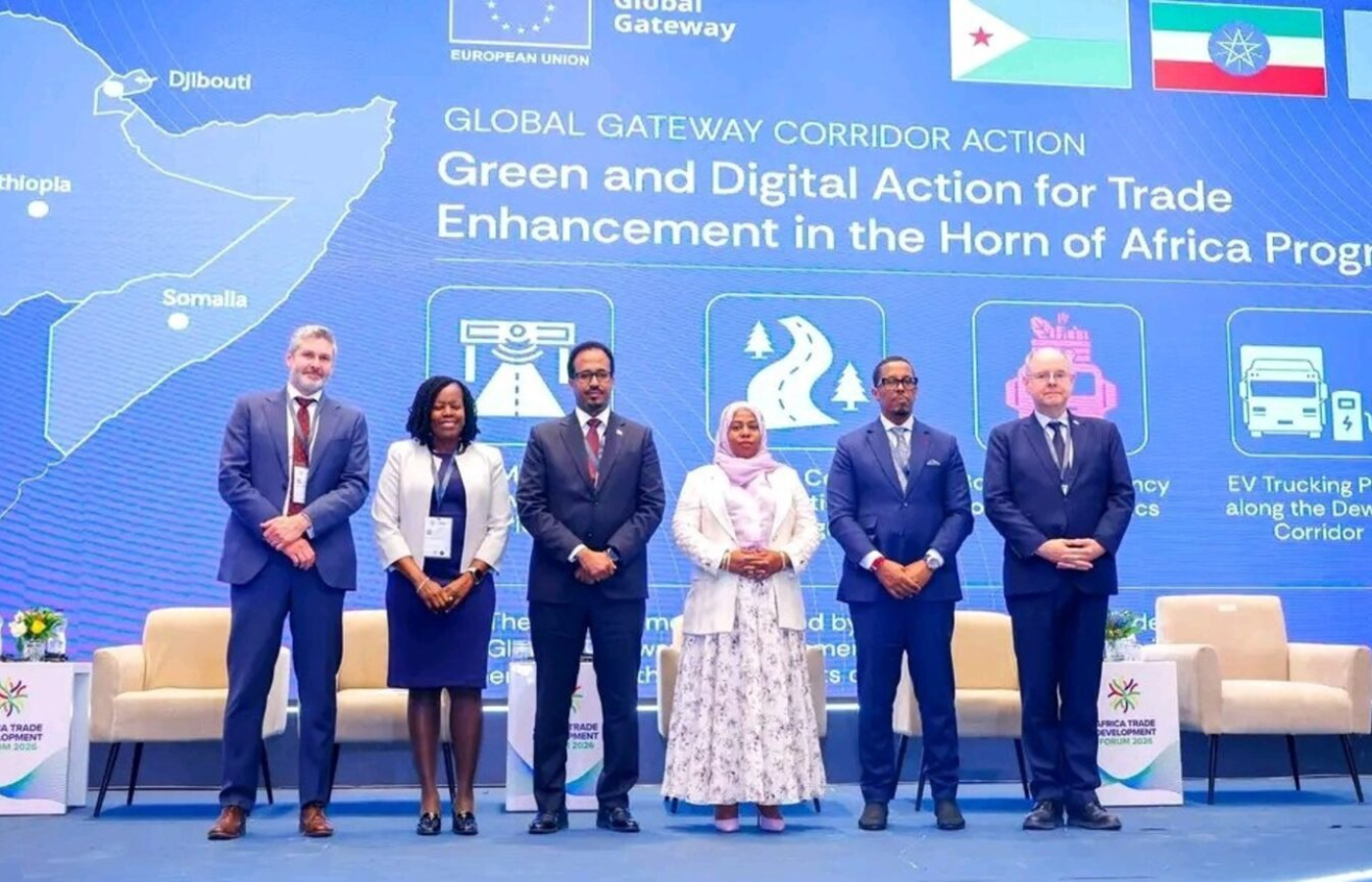
The European Union committed €20 million on November 23 to a four-year trade programme spanning Ethiopia, Djibouti and Somalia, expanding a corridor that already handles 95 percent of Ethiopia’s import-export volume, according to Serrari Group.
The agreement was signed on the sidelines of the Africa Trade and Development Forum in Addis Ababa. TradeMark Africa will implement the project under the EU’s Global Gateway strategy. It builds on an existing €32 million Djibouti–Ethiopia corridor programme that has already digitised phytosanitary certificates for more than 80 Ethiopian exporters and completed cargo-tracking trials across 13 monitoring zones in Djibouti.
Ethiopia’s Minister of Trade and Regional Integration, Yasmin Wohabrebbi, said the funding would “bolster national import-export operations, upgrade vital trade corridors linking Ethiopia, Djibouti, and Somalia, and enhance the competitiveness of local products in regional and global markets”. She added that cross-border modernisation is “an integral part of Ethiopia’s broader economic reforms”.
The signing ceremony was witnessed by H.E. Yasmin Wohabrebbi, Ethiopia’s Minister of Trade and Regional Integration; Hon. Orbis Helaf Orbis, Minister of Commerce and Tourism, Djibouti; and Amb. Gamal Hassan, Minister of Commerce and Industry, Somalia. The partnership agreement was signed on November 23–24, 2026, during the Africa Trade and Development Forum (ATDF) 2026 in Addis Ababa.
Bilateral corridor becomes regional framework
The new programme widens the geographic scope beyond the Addis–Djibouti axis that has carried virtually all of Ethiopia’s maritime trade. According to October 2026 data from the International Organisation of La Francophonie cited by TradeMark Africa, roughly 95 percent of Ethiopia’s exports and 80 percent of its imports move through Djibouti’s ports.
That concentration leaves Ethiopian businesses exposed to single-corridor disruptions, freight surcharges and border delays that inflate import prices and erode export competitiveness.
The existing €32 million programme, financed by the EU and delegated to Agence Française de Développement, runs from July 2022 to December 2027. Its results so far include an electronic phytosanitary system (ePhyto) linking Ethiopian exporters to a network covering nearly 110 countries, and a drop in False Codling Moth interceptions from seven cases in 2023–24 to zero in 2024–25.
In Djibouti, user acceptance testing for the Electronic Cargo Tracking System is complete across 13 monitoring zones and 12 cargo-control modules, while a central Control and Monitoring Centre is under installation.
At the Galafi crossing, Ethiopia and Djibouti are advancing a joint roadmap toward a One-Stop Border Post to coordinate border agencies. The programme has also developed a Corridor Transport Observatory to track logistics performance and transport emissions, and delivered FIATA-aligned logistics training alongside capacity building for women traders.
Somalia enters the corridor
Somalia’s inclusion marks the first time EU-backed corridor work extends formally into its territory. The Somalia regional road infrastructure programme identifies transport connectivity and cross-border commerce as development priorities, but weak infrastructure and fragmented trade procedures have limited logistics investment and regional supply-chain participation.
Coordinating digital documentation and transport standards could help Somali businesses engage neighbouring markets, though the €20 million programme cannot resolve every infrastructure, security or political constraint affecting regional trade.
Specific ports, road networks and border crossings in Somalia that will benefit have not been publicly identified. Country-level funding allocations, infrastructure investment targets and quantified goals for reducing transportation costs and transit times also remain undisclosed.
Minister outlines reform agenda
Ethiopia’s Trade and Regional Integration Minister Yasmin Wohabrebbi told the signing ceremony that cross‑border modernisation is an integral part of the country’s broader economic reforms. Enhanced regional transport and logistics networks will allow Ethiopian goods to access markets throughout the Horn of Africa and further abroad, broadening prospects for international commerce. The project will place particular emphasis on developing more efficient freight transportation suited for agricultural products.
EU programme targets AfCFTA trade barriers with infrastructure financing
The EU commitment sits alongside separate infrastructure financing. The EU programme is designed to support the African Continental Free Trade Area by addressing practical barriers — clearance times, inconsistent documentation, unreliable freight — that persist even when tariffs fall. Ethiopia began exporting under AfCFTA on October 9, 2025, with initial shipments to Kenya, Somalia and South Africa.
The partnership’s success will be measured through clearance times, logistics costs, digital system adoption, shipment reliability and participation by smaller enterprises. As the EU delegation noted, announcing funding or installing equipment is only an intermediate step; the region needs coordinated institutions, reliable digital systems and commercially efficient logistics to convert preferential market access into actual transactions.
The initiative focuses on digital trade and transport platforms, agricultural export logistics, greener freight operations, and regional trade integration. It aligns with the African-led Horn of Africa Initiative and reinforces the African Continental Free Trade Area (AfCFTA), while advancing Somalia’s integration into regional and international trading frameworks.
Ethiopia launched exports under the continental trade framework on October 9, 2025, with initial shipments destined for Kenya, Somalia and South Africa. Prioritising agricultural logistics in the new programme is especially pertinent to Ethiopia’s export profile, given the importance of coffee, oilseeds, pulses, horticultural products and other agricultural commodities to foreign exchange earnings.
Earlier reforms have enabled more than 80 Ethiopian exporters to exchange electronic phytosanitary certificates. The programme supports regional integration and the implementation of the African Continental Free Trade Area.
Related reading

SEARHC Hiring for 5 Dental Roles in Juneau With Pay Up to $77/Hour
Southeast Alaska Regional Health Consortium is hiring for five dental roles in Juneau with hourly pay ranging from...

Rangers Shuffle Lines, Start Garand vs. Blackhawks After Perreault Injury
New York Rangers coach Peter Laviolette shuffled his forward lines for Friday's game in Chicago, moving Taylor Raddysh...

Employer Denies Nurse Contract Threat Over Poilievre Photo, Investigation Launched
Calian Health denied Friday that a nurse’s contract was threatened over a photograph with Conservative Leader Pierre Poilievre,...

Sedan Strikes O’Hare Shuttle Bus, Injuring 4 on Bessie Coleman Drive
Four people were injured Friday when a sedan struck an airport shuttle bus on Bessie Coleman Drive at...