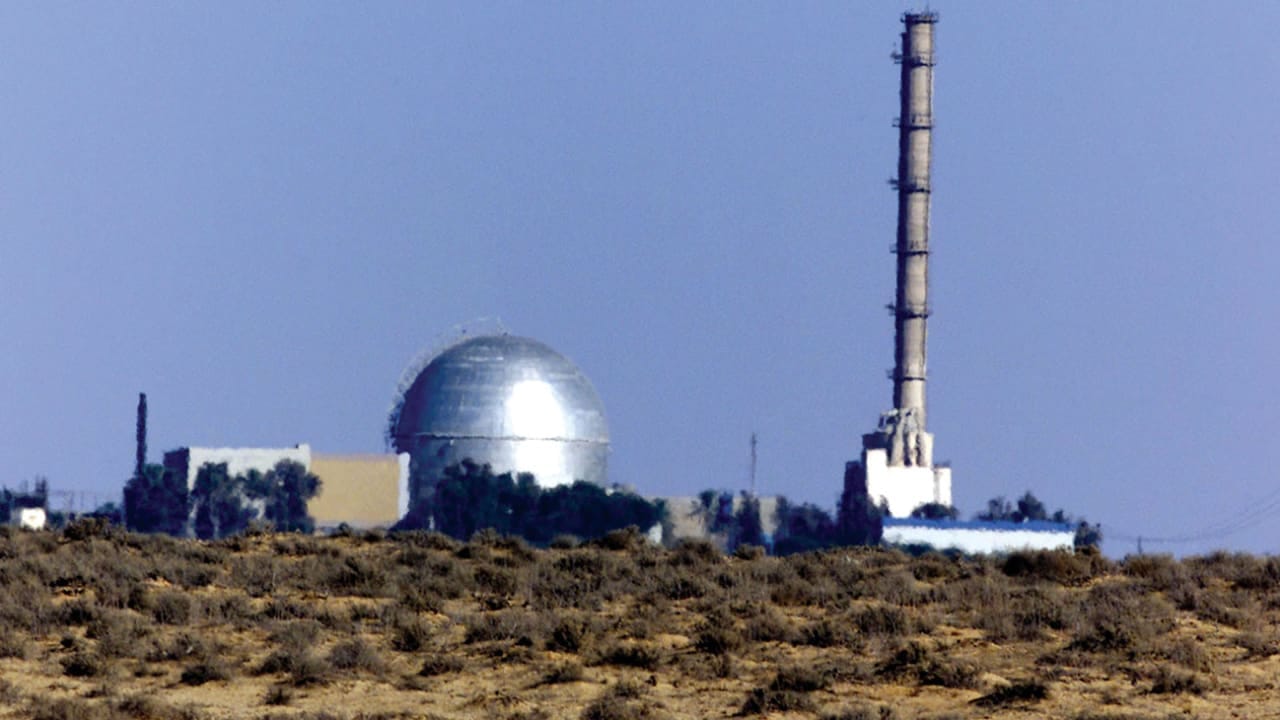
American researchers published a new assessment on November 10 estimating Israel’s nuclear arsenal at roughly 90 warheads, unchanged from their 2021 count, while satellite imagery shows the largest construction project in decades at the Dimona nuclear complex.
The Federation of American Scientists (FAS) study, authored by Hans M. Kristensen and Mackenzie Knight-Boyle and published in the Bulletin of the Atomic Scientists, draws on satellite photos, declassified documents, plutonium production estimates, and analysis of delivery systems. The Stockholm International Peace Research Institute (SIPRI) also listed Israel among the world’s nine nuclear-armed states in its 2026 annual assessment.
- FAS estimates 90 warheads, same as 2021; SIPRI agrees Israel is nuclear-armed.
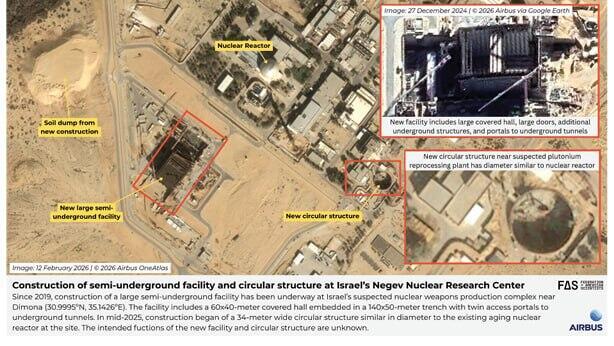
- Satellite images reveal extensive new excavation and a circular structure at Dimona.
- 30 House Democrats pressed Secretary of State Marco Rubio in May for transparency on Israel’s program.
- U.S. policy rests on a 1969 Nixon–Meir understanding accepting Israeli ambiguity.
Dimona Satellite Images Show Extensive Excavation
Commercial satellite imagery examined by FAS researchers shows extensive excavation, underground tunnels, and a new circular structure with a diameter similar to the existing heavy-water reactor dome at the Shimon Peres Negev Nuclear Research Center near Dimona. The construction, visible in images from February 2026 and earlier, represents the largest building project at the site in decades.
New Study Estimates Israel Has 90 Nuclear Warheads as Dimona Construction Raises Questions#Dimona #IsraelNuclearProgram #NuclearWeapons American nuclear researchers estimate that Israel possesses approximately 90 nuclear warheads, according to a November 2026 assessment pu… pic.twitter.com/0e1A5IHvXR
The researchers caution against drawing definitive conclusions from the imagery alone. They note the aging reactor is nearing the end of its planned lifespan, though Israeli officials have said they intend to operate it until 2040.
The new structure may be related to lifespan extension, but FAS stresses there is currently no indication it is an additional reactor. Accelerated underground work was linked by sources to defensive hardening after Iranian missile strikes on Dimona and ongoing threats from Tehran.
Plutonium Stockpile Far Exceeds Warhead Count
The study cites an early 2025 assessment by the International Panel on Fissile Materials estimating Israel has accumulated 800 to 1,000 kilograms of weapons-grade plutonium. Theoretically, that stockpile could support 160 to 250 nuclear weapons, well above the 90-warhead estimate. FAS researchers say the gap likely reflects material held as a strategic reserve and constraints from the number of available delivery systems and operational requirements.
Delivery Systems: Missiles, Aircraft, Submarines
The FAS assessment surveys Israel’s suspected nuclear-capable delivery triad. Researchers estimate ballistic missiles, including older Jericho 2 variants with a range exceeding 1,500 kilometers and Jericho 3 missiles with an estimated 4,000-kilometer reach — enough to strike Iran, Pakistan, and much of western Russia including Moscow. The Jericho 3 was first tested in 2008. Over the years, satellite imagery points to upgrades at facilities tied to Israel’s missile arsenal.
On the air side, the study examines fighter jets. An American official reportedly remarked in September 2019, when Israel sent F-15I jets from Tel Nof to an exercise in Britain, that “Israel sent its nuclear squadron”. The study also covers the modernization of the Israeli Air Force’s fighter fleet, including advanced F-35 and F-15 aircraft.
At sea, Israel operates six Dolphin-class submarines out of Haifa. The study notes longstanding speculation that the Dolphin submarines may carry nuclear-capable cruise missiles, possibly a submarine-launched version of the Popeye Turbo.
Congressional Democrats Challenge U.S. Silence
In May, 30 Democratic members of Congress led by Texas Representative Joaquin Castro sent a letter to Secretary of State Marco Rubio demanding greater transparency about Israel’s nuclear program. The lawmakers argued Congress needs a fuller understanding of the regional nuclear balance following the U.S. and Israeli war against Iran, and questioned whether Washington can pursue a consistent nonproliferation policy while maintaining silence on Israel’s capabilities.
At a June 2026 House Foreign Affairs Committee hearing, Rubio acknowledged the open secret: “If we’re being honest, I think most of the world believes they do. But they’ve never publicly acknowledged it, and as part of our foreign policy, we don’t discuss it in those terms either.” The State Department has consistently referred questions about Israel’s capabilities to the Israeli government.

Satellite Imagery Pinpoints New Underground Work at Dimona
Engineering work newly identified by satellite imagery is concentrated roughly 13 kilometers southeast of the city of Dimona, inside the security perimeter of the Dimona nuclear complex at the geographical coordinates 30°59’58.07″N 35°8’33.29″E. The imagery reveals a large expansion of deep excavation, the building of underground floors and tunnels, and a new structure next to the dome of the old heavy-water reactor.
Dimona Mayor Benny Biton warned on November 17 of an imminent security escalation amid a U.S. naval buildup in the Middle East.
Expanded Delivery Capabilities Detailed in FAS Assessment
The Federation of American Scientists study examines the potential capabilities of the six Dolphin-class submarines operated by the Israeli Navy, noting longstanding speculation that they may carry nuclear-capable cruise missiles, possibly a submarine-launched version of the Popeye Turbo.
The 1969 Understanding That Still Shapes Policy
U.S. reticence traces to a reported 1969 understanding between President Richard Nixon and Israeli Prime Minister Golda Meir. Declassified documents reviewed by the National Security Archive show successive American administrations refrained from publicly challenging Israel’s nuclear policy on the condition that Israel maintained its ambiguity.

Israel’s official position remains that it will not be the first country to introduce nuclear weapons into the Middle East. Israel has never joined the Nuclear Non-Proliferation Treaty (NPT).
The Federation of American Scientists (FAS), a nonprofit policy think tank founded in 1945 by Manhattan Project scientists with the stated intent of using scientific analysis to make the world more secure, published the November 2026 assessment estimating Israel’s arsenal at roughly 90 warheads.
Organized under its Nuclear Security program, FAS researchers Hans M. Kristensen and Mackenzie Knight-Boyle authored the study in the Bulletin of the Atomic Scientists, drawing on satellite photos, declassified documents, plutonium production estimates, and analysis of delivery systems to produce the estimate.
FAS’s nuclear assessments are widely considered authoritative because the organization has played a historical role in the control of atomic energy and weapons and in advancing international monitoring of atomic activities since its founding.
According to the FAS researchers, satellite imagery and changes to weapons systems point to continued investment in infrastructure linked to Israel’s presumed nuclear capabilities.
Related reading

KC Homeowner’s Renovation Drags On; AG Office Urges Written Contracts
Beth Sullivan expected her Kansas City home exterior renovation to finish in six to eight weeks, but delayed...

Jacksonville Lets Developers Pay $20K-plus to Expedite Permits
Jacksonville developers can now pay at least $20,000 to jump the permitting line after City Council approved Ordinance...

Vanderbilt Hosts No. 7 Tennessee; Stowers Leads SEC in Receptions
Vanderbilt hosts No. 7 Tennessee on Saturday at 6 p.m. CT at FirstBank Stadium, the Commodores' official athletics...

Kelsey Defends Fifth-Year Transfers, Tells Critics ‘Bring It’ After Upset
ESPN columnist Myron Medcalf reported Tuesday from Las Vegas that Louisville coach Pat Kelsey defended fifth-year transfers after...