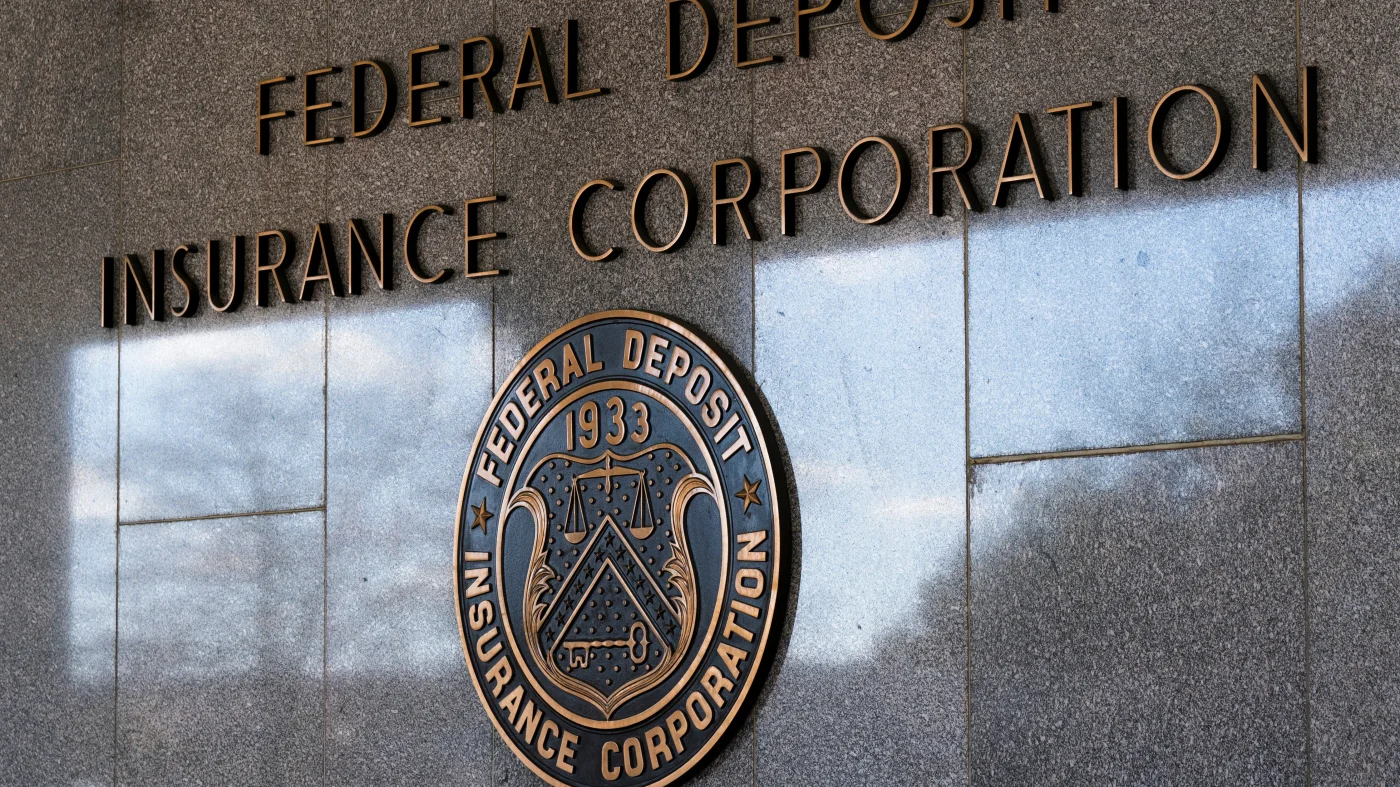
Federal regulators seized and closed United Fidelity Bank on Friday after finding the Evansville, Ind.-based institution could no longer sustain operations.
The move marks the largest U.S. bank failure in more than two years, according to the Federal Deposit Insurance Corporation.
The Office of the Comptroller of the Currency, an independent arm of the Treasury Department, appointed the FDIC as receiver after determining the bank was “in an ‘unsafe or unsound condition to transact business'” and “likely to be unable to pay its obligations or meet its depositors’ demands in the normal course of business,” the OCC said in a statement.
First Citizens Bank has agreed to acquire “substantially all” of United Fidelity’s assets and assume all customer deposits, excluding certain brokered deposits and excluded accounts. The North Carolina-based bank will take over 20 branches across Indiana, Illinois, Colorado, and Florida, as well as two branches in the U.S. Virgin Islands operating as Bank of St. Croix. The deal also includes United Fidelity’s subsidiaries, including real estate development and management company Pedcor Homes Corporation.
United Fidelity Bank had $5.9 billion in total assets and $5.4 billion in total deposits as of Sept. 30, 2026, according to the FDIC.
The bank had about $4.5 billion in deposits and $3.1 billion in loans as of that date. The failure will cost an estimated $1.83 billion to the Deposit Insurance Fund.
First Citizens Bank said it won the deal through a competitive bidding process with an asset discount of about $2.6 billion and no deposit premium.
The branches are scheduled to reopen as First Citizens branches on Saturday, Nov. 28.
“Customers do not need to change their banking relationship and will retain all of their funds and deposit insurance coverage,” the FDIC wrote in a statement.
I am tracking United Fidelity Bank’s failure yesterday. I am already working with the FDIC and OCC to limit impact on depositors and ensure a smooth transition. As a member of Senate Banking Committee, my priority is to make sure Hoosiers are protected. I will receive a full…
United Fidelity’s collapse is the seventh U.S. bank failure this year and the largest since April 2024, when Republic First Bank was closed for being in “unsafe and unsound condition.” That bank had $6 billion in assets and $4 billion in deposits at the time. The failure highlights ongoing stress in the regional banking sector. The shock of United Fidelity’s seizure has put regional banks back under the spotlight, potentially reshuffling where deposits, trust, and future deal flow end up.
The outlet highlighted three regional bank stocks—Hancock Whitney, WaFd, and United Community Banks—as part of its Stronger U.S. Regional Banks and Consolidators theme. “We believe this transaction is both financially and strategically compelling, and we look forward to welcoming our new customers, earning their trust and positioning our company for continued success,” Frank B. Holding, Jr., chairman and CEO of First Citizens Bank, said in a statement.
Worth a look

Medina/P-B’s Bohl Named Class B First-Team All-State, Outstanding Senior Athlete
Violet Bohl earned Class B First-Team All-State honors Wednesday, capping a four-year varsity career that included a state...

CardinalAuthority Split on Louisville vs Creighton Title Game Predictions
No. 25 Louisville will face Creighton tonight in the Players Era 16 Championship in Las Vegas with tip-off...

Carlos Santana Signs Minor League Deal With Mariners; Former Brewers Noted for 2027 Returns
Carlos Santana signed a minor league contract with the Seattle Mariners on Tuesday, returning to the organization for...

FC Cincinnati Upsets Nashville SC to Advance in MLS Cup Playoffs
FC Cincinnati eliminated Supporters' Shield champion Nashville SC from the MLS Cup playoffs Saturday with a 1-0 victory...