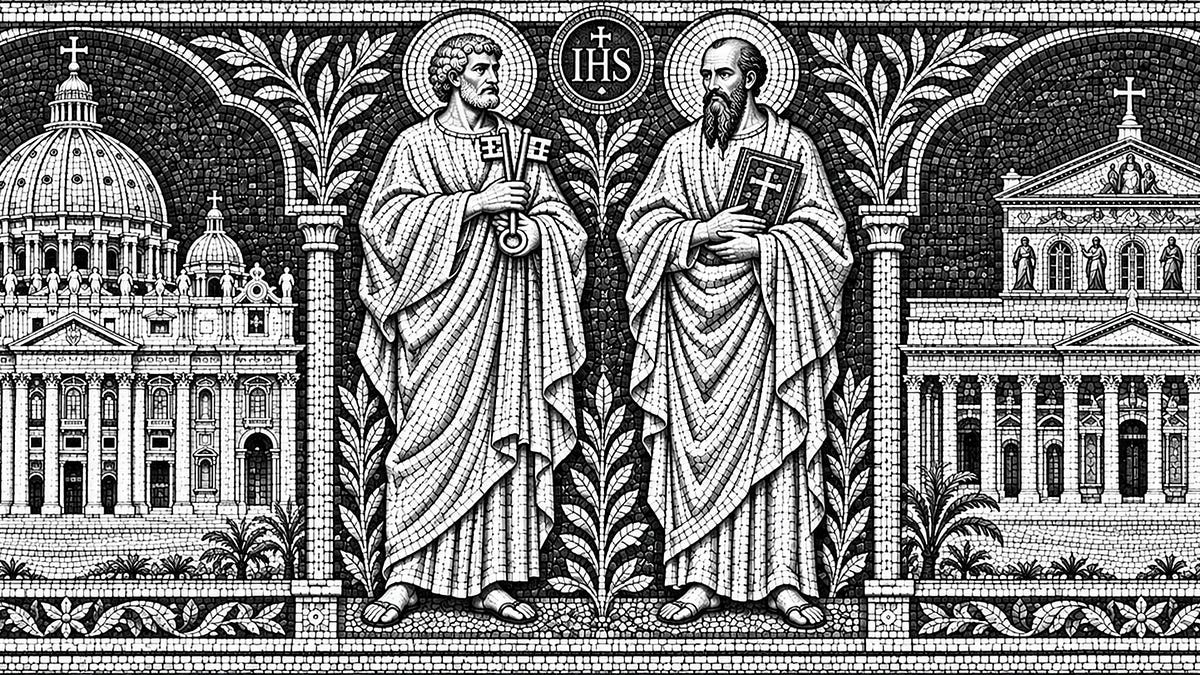
On the Feast of Dedication of the Basilicas of Saints Peter and Paul, Apostles, observers gather to reflect on the legacy of two foundational figures in Christian history.
The dual celebration turns attention away from the magnificent architecture, marble, mosaics, and the splendour of their altars to the earthly remains that lie beneath the Basilica of Saint Peter on Vatican Hill and the Basilica of Saint Paul Outside the Walls.
Peter and Paul were two men with very different lives and extraordinary journeys of faith whose hearts were transformed by an encounter with the living Christ, neither of them having been perfect.
Peter was an impulsive and outspoken fisherman who loved Jesus deeply, yet promised never to abandon his Lord before denying even knowing Him three times as the darkness of Good Friday approached. Saint Luke tells us that Peter went outside and wept bitterly after that terrible moment.
Today the Church celebrates the feast day of Sts. Peter & Paul. As early as the year 258, there is evidence of an already lengthy tradition of celebrating the solemnities of both Saint Peter and Saint Paul on the same day. Together, the two saints are the founders of the See of… pic.twitter.com/JYfyxWzldp
Yet Peter’s story did not end in that courtyard, as Jesus did not abandon Peter because Peter had abandoned Him. After the Resurrection, beside the Sea of Tiberias, Jesus came looking for him beside a charcoal fire and asked:
“Simon, son of John, do you love me?“””
According to the homily, Jesus did not ask why Peter denied Him or how he could have failed, but simply asked if he loved Him. When Peter answered, Jesus entrusted him with the care of His sheep, knowing Peter’s weakness, fear, and failure, yet also knowing the love that remained within his heart.
Paul was educated, zealous, and convinced of his own righteousness, and he persecuted the early Christians while believing he was defending God, until everything changed on the road to Damascus when a voice asked:
“Saul, Saul, why are you persecuting me?“””
The persecutor became the preacher, the enemy of the Church became its great apostle, and the man who had sought to destroy Christianity surrendered his life rather than deny Christ. Saint Clement of Rome, writing towards the end of the first century, remembered these apostles as examples of extraordinary endurance, noting that Peter suffered many trials before his martyrdom, while Paul endured imprisonment, persecution, and hardship in proclaiming the Gospel.
Almost two thousand years later, these men are still remembered while the empire that condemned them has disappeared.
Keep reading

PCA Boys Fourth, Ivey Fourth at LHSAA Division V State Meet
Providence Classical Academy finished fourth in the Division V boys category on Tuesday at the Sugar Bowl LHSAA...

Paula Josephine Duncan Spent 20 Years Driving School Buses for Middletown and Steel High
Paula Josephine Duncan spent 20 years driving school buses for Middletown and Steel High, followed by 14 years...
Oregon Violent Crime Falls 7.9% in 2025, FBI Reports
“These reductions reflect the work being done every day by federal, state, local, and tribal law enforcement agencies,...

Mandan Braves Hockey Team Honors Two Classmates Killed in Bismarck Crash
The Mandan Braves hockey team is honoring two classmates killed in a fatal Bismarck crash as the team...