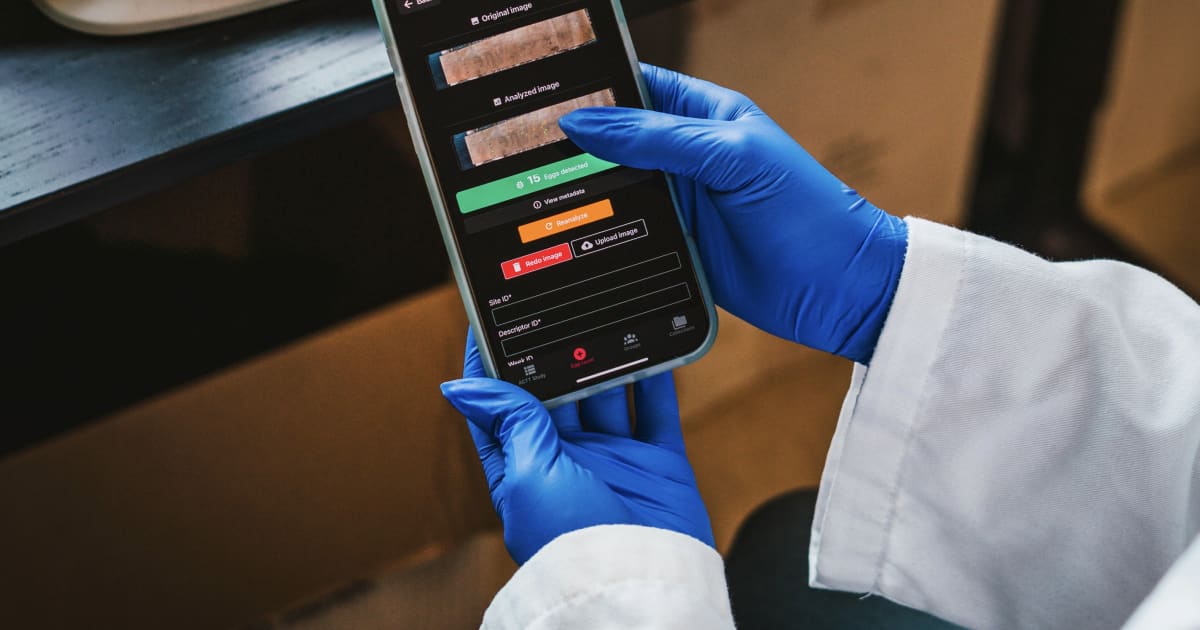
Researchers have developed a smartphone-based tool that uses artificial intelligence to identify and count mosquito eggs, potentially streamlining the labor-intensive surveillance required to track disease-carrying insects.
The project, led by FIU’s Andre Costa-da-Silva, aims to assist mosquito control teams by automating a process that has traditionally relied on manual microscopic examination.
The surveillance infrastructure relies on ovitraps—small, water-filled containers—that attract female Aedes mosquitoes. Once the mosquitoes lay their eggs on brown paper strips inside these traps, the strips are typically collected for analysis. Identifying the specific count of eggs on these strips is a task that is both time-consuming and prone to error.
The new tool, known as AeEggCounter, utilizes a machine learning model to detect and count these eggs from smartphone images. Behind the software is an algorithm called YOLO, or “You Only Look Once,” which identifies and locates multiple objects within an image in a single pass. This allows the system to process samples efficiently, even when eggs are obscured by environmental debris.
“The idea was to develop this app based on a machine learning model,” said Andre Costa-da-Silva, an assistant professor of biology and researcher in the Biomolecular Sciences Institute at FIU. “It’s the first mosquito egg-counting tool capable of analyzing real-world field samples using images captured with different smartphone models.”
To train the model, researchers manually labeled 4,398 individual mosquito eggs across 168 smartphone images. In initial laboratory tests, the AI correctly identified 88.3 percent of the eggs it flagged and detected 91.7 percent of the total eggs present in the images. When the team moved to 76 previously unseen field samples, the performance declined, though the results showed a strong correlation with those of human counters.
Despite the technological advancement, the researchers emphasize that the tool is intended to augment, not replace, human oversight. “It doesn’t replace the human,” Costa-da-Silva said. “We still need humans to confirm the results, especially in sensitive areas where it’s important to avoid mistakes.”
The research team included representatives from FIU, the University of South Carolina, Boston University, Baylor College of Medicine, and Texas Children’s Hospital, with findings published in the Journal of the American Mosquito Control Association. The resulting app, ACTT-Study, is currently available for Android and iOS devices, providing a digital resource for public health monitoring.
The practical application of the app is already underway in local settings. Matthew DeGennaro, director of the Biomolecular Sciences Institute and a co-investigator on the study, is using the app to improve his CDC-funded field studies in Little Havana and East Hialeah. The initiative is also being integrated into undergraduate education, where students have used the app to screen for eggs in their own homes as part of their coursework.
For students like Melissa Gonzalez, a second-year biology student, the ability to test the technology firsthand bridged the gap between theory and field application.
“Living in Miami was a great aspect to the class because we were able to actually set out ovicups at our homes to screen for eggs,” said Melissa Gonzalez. “When we got back to class, we counted them both manually and with the app.”
Beyond the immediate goal of mosquito surveillance, the researchers view the project as a foundation for training the next generation of scientists in AI-powered methodologies.
Keep reading

Alabama vs. LSU Game Draws 8.9 Million Viewers in 2026 Season
Southeastern Conference football viewership surpassed expectations after shifting its primary TV contract from CBS to ABC and ESPN,...

Frankfort and Ironman Reach Tentative Agreement for 2027 Race Deal
The City of Frankfort has moved one step closer to hosting the Ironman 70.3 Michigan in 2027, but...

Kansas Lawmakers Meet to Address Online Child Predators
Kansas lawmakers gathered at the statehouse in Topeka on Nov. 16 as the “Kansas Committee on Protecting Children...

Iowa State Defeats Cincinnati in Five-set Volleyball Match
Sydney Nolan delivered a commanding 29-kill performance for the Cincinnati volleyball team on Monday, yet the Bearcats ultimately...