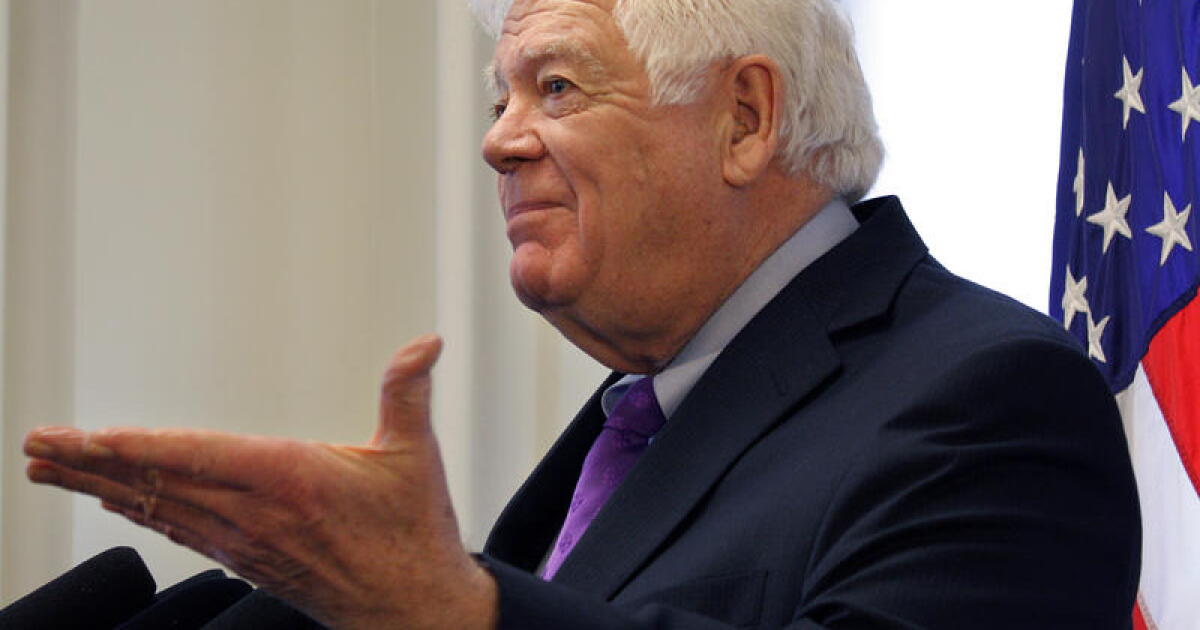
Jim McDermott, the Seattle congressman whose career was defined by a fierce anti-war stance and a relentless push for healthcare reform, has died at age 89.
According to reporting from The Seattle Times, the former representative passed away Thursday night at Harborview Medical Center.
McDermott’s tenure in Congress, spanning from 1989 to 2017, marked a distinct era of progressive politics in the Pacific Northwest. Before his time in Congress, he built a foundation in medicine and state governance, serving as a Navy psychiatrist in California during the Vietnam War and later winning election to the Washington state Legislature in 1970.
His influence on local policy was perhaps most tangible in his work on the Basic Health Plan, a program former Gov. Gary Locke credits as a precursor to Obamacare. “I was in awe of him,” Locke told KUOW, reflecting on their time together in the Legislature. “He was tireless. He had so much energy, and he had a joy about him that made you like him so much.”
A Reputation for Poking the Bear
McDermott was rarely a figure who sought consensus for the sake of comfort. His legislative career was punctuated by high-profile clashes, most notably in 1997, when he allegedly leaked a recorded phone conversation between then-Speaker of the House Newt Gingrich and then-Rep. John Boehner. A court later determined that McDermott had broken the law by accepting the tape from a Florida couple who had recorded it using a scanner.
Despite these partisan fractures, some political opponents found room for professional respect. Former Republican Congressman Dave Reichert, who represented Washington state in Congress from 2005 to 2019, described him as a “good friend” who understood the necessity of working across the aisle.
“He had a reputation for sort of trying to poke the bear a little bit. But you look past that and try to work with people, Reichert told KUOW. There were some conservative ideas that he was open to discussing and obviously some more liberal ideas that at least I was open to hearing — not always agreeing.”
The Baghdad Jim Controversy
The defining moment of McDermott’s national profile arrived in 2002. As the Bush administration built its case for the invasion of Iraq, McDermott traveled to Baghdad to personally challenge the government’s narrative regarding weapons of mass destruction. The trip earned him the nickname “Baghdad Jim” from conservative critics, but he remained steadfast in his public warnings.
“Mr. President, there’s an old saying that you should beware of what you wish for ’cause you might get it,” McDermott said at a press conference in D.C. in October 2002.
“Now, if you get the power… to go to war whenever you want, you have an enormous responsibility to the American people, to all the people who will die, to the families who will lose people, and to the millions of Iraqis who will die in that same process.”
A Mentor to the Next Generation
Beyond his national policy battles, McDermott was deeply involved in local advocacy, particularly regarding the civil rights of marginalized communities. Rep. Pramila Jayapal, who succeeded McDermott in Congress, credits him as an “inspiration and mentor to me personally” who helped her manage politics following the September 11, 2001, terrorist attacks.
“He immediately jumped into action and before I knew it, he had worked with me to organize a massive press conference at the Seattle Center to declare Washington State a hate-free state,” Jayapal said in a statement. “He was always willing to stand up with us—even before it was popular—for immigrant justice.”
Washington Sen. Patty Murray also recognized his legacy in a statement, noting that he was “one of the first and most powerful voices fighting to fix our broken health care system in Congress.” She described him as “passionate and fearless,” leaving a legacy on WA state and its people.
Paul Berendt, who chaired Washington’s Democratic Party from 1995 to 2006, summarized McDermott’s political identity for KUOW: “McDermott was a great all-around liberal. He fought for health care for all, he fought against these foreign interventions resulting in war, but he was also a major environmental advocate.”
While his legislative career ended in 2017, his influence on the state’s political trajectory is a point of reference for those currently managing Washington’s healthcare and immigrant rights policies. His death marks the closing of a chapter for a politician who was as comfortable battling members of his own party as he was taking on those across the aisle.
Keep reading

UMBC Defeats Morgan State 85-50 to Advance to 410 Invitational Final
The lopsided victory sends the Retrievers straight to the tournament championship game. They will face Towson on Sunday...

Kentucky Escapes Northern Arizona After Wilkins Buzzer-Beater
Kentucky Basketball fans watched their team, a 30.5-point favorite, nearly collapse against an 0-3 Northern Arizona squad. The...

DA Says No Charges for Driver in Wichita Stryker Sports Complex Tragedy
The Sedgwick County District Attorney’s office announced Thursday that no criminal charges would be filed against the woman...

Texas Longhorns Resume Travel to Baton Rouge After FAA Ground Stop
The Texas Longhorns are scheduled to depart Austin for Baton Rouge at 10:17 p.m. CT on Friday, following...