
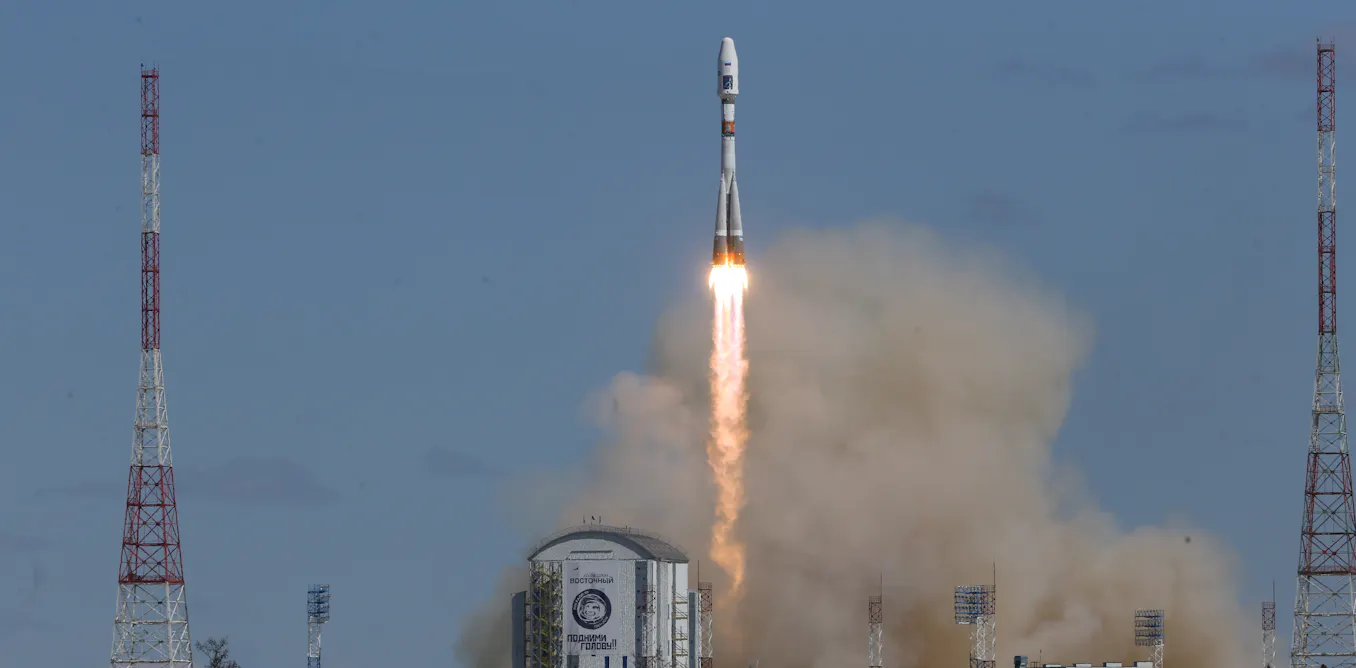
German intelligence agencies have warned NATO allies that Russia may launch a nuclear-armed satellite, dubbed Sputnik-S, within 60 days, potentially detonating it in low Earth orbit to disable thousands of satellites, The Guardian reported.
Public broadcasters NDR and WDR and the newspaper Süddeutsche Zeitung reported that western intelligence services, including Germany’s Bundesnachrichtendienst (BND) and armed forces, have shared assessments showing the satellite was assembled years ago and is stored near Moscow. A German government spokesperson said Berlin takes the intelligence “very seriously.”
What a detonation would do in orbit
In the vacuum of space there is no mushroom cloud; energy releases as radiation. A blast in low Earth orbit — up to 1,200 miles up, where roughly 17,000 satellites operate — would have two main effects, said Jonathan McDowell, astrophysicist at the Durham University Space Research Centre.
X-rays and other radiation would zap everything in line of sight, damaging or destroying satellites across thousands of miles. Radiation particles would also form an artificial Van Allen belt, trapping high-energy particles that degrade electronics for years.
Precedent: Starfish Prime, 1962
The United States tested a thermonuclear weapon 250 miles up in 1962, a shot code-named Starfish Prime. It shortened the lives of the Telstar 1 and Ariel-1 satellites and, McDowell said, “caused severe radiation over a period of months to at least half the satellites then working on orbit.”
The artificial belt persisted for about five years. Keith Ryden, professor of space engineering at the University of Surrey, said that modern low-orbit satellites are built for low natural radiation and “would be vulnerable to unexpected increases.”
Scale of exposure today
The European Space Agency estimates about 15,800 functioning satellites now circle Earth, supporting GPS, banking, telecommunications and military command links, The Conversation reported. Elon Musk’s Starlink constellation — critical to Ukraine’s defense — orbits in the most vulnerable band, as does the International Space Station, where Russia is a partner. Higher-altitude GPS and broadcast satellites would be less affected.
Recovery would take years
McDowell said trapped particles could take “several years, up to a decade” to diffuse. Ryden added that the space industry lacks the capacity to rebuild and launch replacement craft quickly. Starfish Prime also knocked out streetlights and set off burglar alarms in Hawaii, 800 miles away; McDowell warned of similar ground-level electronic disruption under the detonation footprint, along with vivid auroras.
Treaties ban nuclear weapons in orbit
A detonation would violate the 1963 Partial Nuclear Test Ban Treaty, which bars nuclear explosions in space, and the 1967 Outer Space Treaty, which prohibits placing weapons of mass destruction in orbit. The Outer Space Treaty contains no verification mechanism for inspecting a satellite’s payload, The Conversation noted; three think tanks recently concluded verification is “feasible,” though challenging.
NATO vows defense as Russia rejects allegations
NATO Secretary General Mark Rutte, visiting Berlin on Monday, vowed the alliance “will always make sure that we defend every inch of NATO territory, and that includes making sure that we are safe when it comes to the space element,” according to Asharq Al-Awsat. Chancellor Friedrich Merz called the reports “no less shocking” and said they “reveal the level of escalation Russia is evidently prepared to pursue.”
Russia’s embassy in Berlin “categorically reject[s] all these groundless allegations,” calling them “propaganda” and insisting Moscow “strictly adheres to the fundamental 1967 Outer Space Treaty,” The Conversation reported. Kremlin spokesman Dmitry Peskov dismissed the stories as citing “unknown sources” that are “hardly worth taking seriously,” Dmitry Peskov added. The embassy also insisted Russia’s space activities “are strictly peaceful and in compliance with international law,” The Moscow Times reported.
Assessments of intent
A European security official told The Guardian the move looks like a bluff: “It would be shooting themselves in the leg,” damaging Russian and potentially Chinese satellites. McDowell called a detonation “such a stupid idea” because it would be seen as an act of war.
The U.S. Defense Intelligence Agency warned last month that Russia was developing a “satellite designed to carry a nuclear weapon,” The Kyiv Independent said. In 2024, Russia vetoed a U.S.–Japan UN Security Council resolution reaffirming the Outer Space Treaty’s prohibition.
More on Russia
Related reading

Lifetime Signs Wanda Dench and Jamal Hinton for Thanksgiving Movie
A decade after a mistaken text message sparked an unlikely friendship, Arizona grandmother Wanda Dench and Jamal Hinton...
Crimean Bridge Closure Forces Russians Into Hazardous Land Corridor Through Occupied Ukraine
Ukraine’s destruction of the road section of the Crimean Bridge has turned a summer holiday drive into a...

Egypt Detains Driver After Cairo Fuel Tanker Fire Kills 31
Thirty-one people were killed and 21 others injured when a fuel tanker overturned and burst into flames on...

Two Italian Technicians Killed in Iranian Drone Strike on Kuwaiti Air Defence Station
Two Italian technicians died Thursday after an Iranian drone strike hit a Kuwaiti air defence station where they...