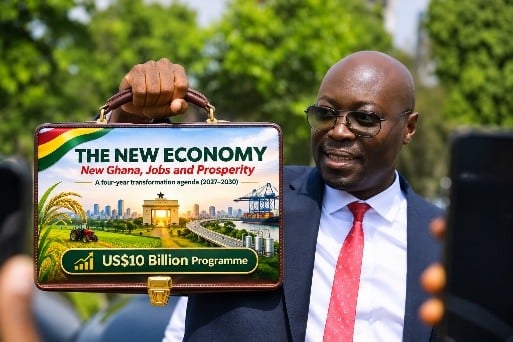
Ghana’s government presented its 2027 Budget Statement to Parliament on 12 November 2026. It includes a US$10 billion, four-year “New Economy” masterplan to shift the nation from raw-material exporting to industrial value addition, according to Modern Ghana.
The strategy, which runs from 2027 through 2030. It aims to transform the economic structure through eight pillars, such as commercial agriculture, energy infrastructure, and critical minerals. The plan seeks self-reliance. But it faces immediate scrutiny regarding its financing, political longevity, and the potential for procurement abuse.
Investment Pillars and Financing
The government committed GH¢10 billion to the programme over its four-year lifespan. This initial allocation is equivalent to 1.5 per cent of Gross Domestic Product.
The policy theme is “Financing Industrialisation for Inclusive and Sustainable Development.” Its goals are to increase productive capacity, provide business support, boost exports, and generate better income and job prospects.
| Sector | Proposed Investment |
|---|---|
| Commercial Agriculture | US$3 billion |
| Energy Infrastructure | US$2 billion |
| Critical Minerals Value Addition | US$1.5 billion |
| Tourism, Textiles, and Pharmaceuticals | US$1 billion each |
| Technology | US$300 million |
The government plans to invest GH¢30 billion for the 2027 phase. This is about 1.7 per cent of projected GDP.
Ghana unveils $10 billion 'New Economy' plan in 2027 budget https://t.co/85i5LlLVoh
According to the 2027 Budget Statement, two-thirds of this financing comes from reducing the primary surplus target. The overall deficit on a commitment basis will rise from 2.0 per cent of GDP in 2026 to 2.9 per cent in 2027.
Political Continuity and Economic Risks
The programme spans the December 2028 general elections. This creates uncertainty about whether a future administration will maintain the policy.
Mr Seth Terkper, Presidential Advisor on Economy, said the country must prioritize responsible borrowing and sustainable repayment. He said previous debt challenges are a lesson for the current administration. He suggested Ghana establish dedicated repayment accounts to prevent future defaults. Mr Terkper also pointed to the recent sale of a US$1.5 billion international bond. This bond carries an interest rate of 8.375 per cent, showing that investors are regaining confidence.
During the 66th Annual General Meeting of the Association of Ghana Industries, Mr Terkper urged stakeholders to “see beyond one fiscal year and one electoral cycle” to ensure the agenda’s success. He asked the Association of Ghana Industries to collaborate with government and financial institutions to translate the agenda into outcomes.
A speaker said, “I expect that the opposition will come on board, the Minority, and Afenyo-Markin is sitting here. I’m telling him this is a national programme, it’s not a partisan programme.”
It might keep you out of power for a very long time, you must support it in the interest of Ghana.
— a speaker at the AGI meeting
Industrial Collaboration and Procurement
Mr Kofi Nsiah-Poku, President of AGI, said financing for energy efficiency and cleaner production is essential for international competitiveness. He advocated for credit guarantees and working capital to help small and medium enterprises adopt digital technologies and modern machinery.
NEWSPAPER HEADLINES – Friday, November 13, 2026 📰 The Ghanaian Times 📌 2027 Budget: Govt unveils $10bn New Economy plan. (GH¢30bn allocated for 2027; targets 8% growth, unemployment below 8%). 📌 Minority dismisses New Economy plan as recycled promises. 📌 A new face for… pic.twitter.com/qAxC4lfq7G
A speech read on behalf of the Minister of Trade, Agribusiness and Industry, Mrs Elizabeth Ofoe’s-Adjare, said the government is working to secure long-term, competitive financing for industries to promote economic growth.
Concerns remain regarding the execution of the $10 billion capital injection. Public debt grew from 44.7 per cent of GDP to 47.5 per cent between the end of 2025 and October 2026.
Seth Terkper brings extensive fiscal oversight experience to his current warnings, having served as Ghana’s Minister for Finance and Economic Planning from 2013 to 2017. During this tenure, he managed complex national budgets and medium-term expenditure frameworks, providing him with a direct track record in navigating the country’s debt and revenue policy.
This background in both international institutional policy and domestic ministerial leadership bolsters his current advocacy for establishing dedicated repayment accounts to mitigate the financing risks associated with the 2027 budget.
The Minister of Trade, Agribusiness and Industry urged public and private sector organizations to prioritize made-in-Ghana products in their procurement activities. This helps the country move away from consuming imported goods. It is unclear if the government has a specific plan to ensure the political opposition will support this long-term investment strategy after the next election.
Keep reading
Maine Celebration of Lights Fun Run: Run Through Holiday Lights Dec. 15 at Cumberland Fairgrounds
A special fun run joins the annual drive-through display where visitors view lights from vehicles between 5:00 PM...

Oklahoma Lawmakers Examine Permitting Bottlenecks as Housing Demand Rises
Oklahoma lawmakers and municipal leaders examined housing development bottlenecks on October 28, 2026, during an interim study hosted...

Burlington Stores Reports Q3 Earnings Tuesday After Revenue Miss
Burlington Stores reports third-quarter financial results on Tuesday morning following a previous period that missed revenue expectations.The off-price...

MIX 105.1 Text-to-Win Contest Offers Universal Orlando Trip With Epic Universe Tickets
MIX 105.1 opens a text-to-win contest Monday at 7 a.m. Eastern, offering a Universal Orlando Resort vacation valued...