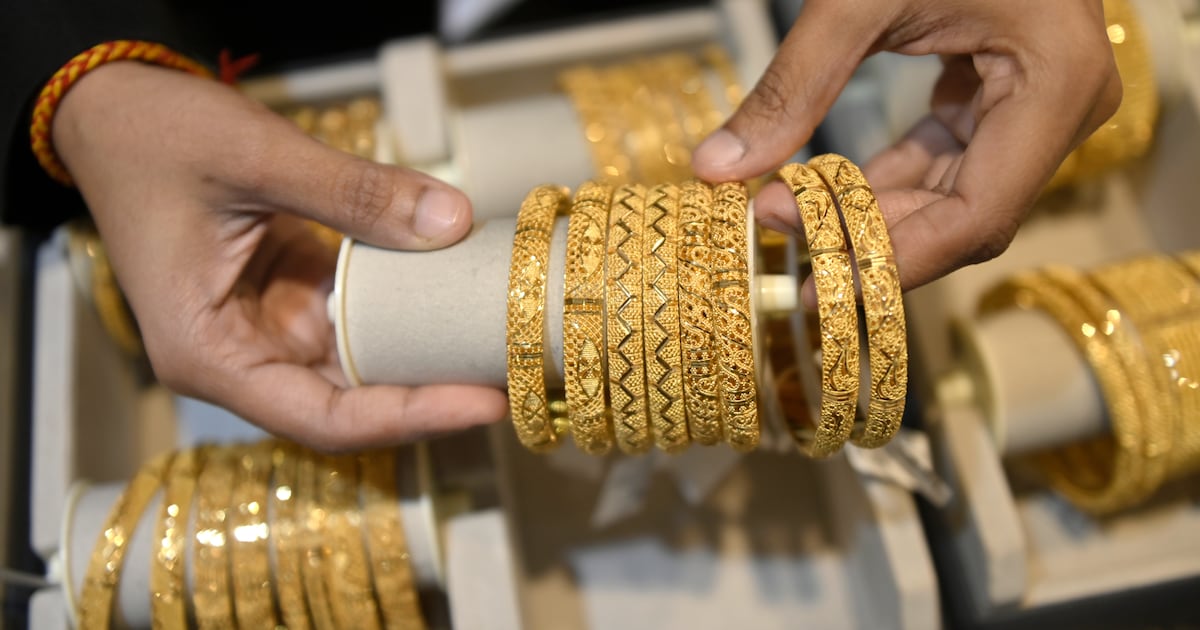
Gold is on track for its worst weekly decline in eight months, down roughly 9 percent to near $3,525 an ounce as hawkish Federal Reserve expectations and a selloff in AI-linked equities force investors to raise cash across asset classes.
The slide has erased more than a third of the metal’s gains since its January peak of $5,589.38, with spot gold touching a 14-month low on Friday. Analysts say the selloff reflects a shift in gold’s behavior — it is acting more like a risk asset than a haven — and warn that a sustained break below $3,500 could open the door to the $3,400–$3,300 region.
Fed Hawks and a Stronger Dollar Rewrite the Playbook
Markets have fully priced in a quarter-point rate increase at the Fed’s December meeting, with further tightening expected into 2027. The U.S. Dollar Index touched a 19-month high before easing slightly, and gold’s sensitivity to the dollar has reached multi-decade extremes — a 1 percent rise in DXY has been associated with a roughly 2.5 percent decline in gold over the past year.
Higher rates increase the opportunity cost of holding non-yielding bullion. “Cash maintains purchasing power, and you don't need to put it in an illiquid asset or one where you're relying on another person to see the value,” said Marc Chandler, managing partner and chief market strategist at Bannockburn Capital Markets. The Fed’s benchmark rate now sits at 3.75–4.00 percent, up 25 basis points from the previous range.
AI Selloff Turns Gold Into a Liquidity Source
Gold and silver were smashed again on Thursday as risk appetite reversed sharply alongside Anthropic’s blockbuster IPO. “At the same time, the sell-off in AI-linked equities has prompted investors to raise cash across asset classes instead of driving them into havens,” said Chris Weston, head of research at Pepperstone. Gold, highly liquid and easy to sell, becomes the first asset dumped in a dollar squeeze.

Jeff Currie, founder of Real Macro, described the dynamic bluntly: “Gold is not a hedge against a liquidity crisis. It's a liquidity provider.” He said that in every recent crisis, gold gets sold first because it’s the easiest thing to unload. The Nasdaq Composite, Dow Jones Industrial Average, and S&P 500 are each down more than 5 percent this week, amplifying the scramble for cash.
From Record Highs to a 37% Retracement
The current price around $3,525 represents a roughly 37 percent pullback from the January 28 high of $5,589.38. Gold had hit records 53 times in 2025, fueled by physical demand starting in 2022 and a surge in ETF inflows. SPDR Gold Shares (GLD) led the way, adding roughly 800 tons last year. “There was a lot of one-way interest, a lot of appetite to buy but not to sell,” said Cooper, describing the ETF-driven phase.
BREAKING: Gold falls below $3,550/oz and silver falls below $42/oz as the selloff gains momentum. Gold and silver have now lost a combined -$15 trillion in market cap from their record highs. pic.twitter.com/A5PZIATMSI
That dynamic reversed as the Fed’s stance shifted. “In 2026, the Fed has leaned more toward higher interest rates,” said Mills. Gold stopped acting as a portfolio safe haven and became a source of cash. The VanEck Gold Miners ETF (GDX), which tracks major gold-mining companies, has fallen 14.7 percent over the past month and 23.1 percent over three months.
Key Levels and the $3,500 Test
Technical analysts are watching the $3,500 level closely. A sustained break below it could expose the $3,400 to $3,300 region, where longer-term investors and physical buyers may step in, according to Weston. On the upside, bullion would need to reclaim $3,600 before moving toward $3,700; the former support zone of $3,800 to $3,850 could now act as resistance.
Frank Walbaum, market analyst at Naga.com, warned that a move below $3,500 “could expose the metal to further losses towards the $3,200 level.” The daily RSI sits near 25, signaling oversold conditions, but spot gold remains well below its 21-, 50-, 100-, and 200-day simple moving averages, indicating a sustained downside bias.
Portfolio Exposure and the Retail Impact
The decline hits millions of Americans with gold in retirement accounts and portfolios. State Street Investment Management found that 27 percent of client portfolios held physically backed gold products in 2025, up from 12 percent a year earlier. The average commodity allocation rose from 3.1 percent to nearly eight percent, with gold averaging around 4.5 percent of portfolios.
The selloff across the commodities complex, including gold and other metals, has broadened and deepened. Do you think the drivers are centered on risk aversion and liquidity needs, or also starting to reflect growth worries?#markets #commodities #gold #economy #copper
Assets under management in gold ETFs fell 6 percent to $542 billion as lower prices outweighed new inflows. Retirees and near-retirees are especially vulnerable, lacking time to recover from significant losses. In India, MCX gold November futures slipped to around ₹1,21,424 per 10 grams, down roughly 33 percent from the year’s high of ₹1.8 lakh. Four Chinese banks issued risk warnings on the same day, urging customers to manage positions and avoid herd behavior.
What Comes Next: December 9 and Beyond
The next key date is the Fed's December 9 meeting, where a quarter-point hike is fully priced in. Bloomberg reports that markets expect rates to keep rising into 2027 before a prolonged pause until 2031. Goldman Sachs forecasts gold could reach $5,600 by 2028 once cutting cycles begin, but Bloomberg experts disagree on the timing.

The Federal Reserve was created on December 23, 1913, after the Panic of 1907 exposed the fragility of a banking system with no central backstop. Congress designed it to furnish an elastic currency and act as a lender of last resort, a role it was later criticized for failing to fulfill during the bank runs that deepened the Great Depression.
Its structure remains unusual: twelve regional banks operate with operational independence from political branches, while the Board of Governors in Washington sets the framework. The Federal Open Market Committee, which sets the benchmark rate now at 3.75–4.00 percent, did not exist at the founding; it was formalized in the 1930s as the Fed’s remit expanded from crisis management to the dual mandate of maximum employment and stable prices.
Gold and silver remain under pressure as rising yields, dollar strength and tightening liquidity weigh on prices. Gold hits a 15-month low, silver is down over 60% from its peak, yet ETF holdings remain resilient. Is this a cyclical correction or something more? Our latest…
“I'm confident gold prices will return to their upward trajectory in 2027 as oil prices normalize and prices fall at the pump, allowing interest rates to stabilize,” said Diehl. For now, analysts advise patience and a staggered approach to buying rather than committing all at once. The weekly chart shows gold breaking down from a large head-and-shoulders top, with the neckline near $3,870–$3,960 now decisively breached.
Worth a look

Carys Douglas Says Parents Warned Her About ‘Nepo Baby’ Label
Carys Douglas, the 23-year-old daughter of Catherine Zeta-Jones and Michael Douglas, told Elle Spain that her parents warned...

Depardieu and Houellebecq Investigated Over 2018 Gang Rape Allegations
"The monster of cinema has fallen," the assistant director whom Gérard Depardieu sexually assaulted said this week after...

Noah Kahan Opens Dublin 3Arena Run With Hozier Duet, OCD Confession and ‘Radical Honesty
Noah Kahan opened a sold-out three-night run at Dublin's 3Arena on November 19, delivering a nearly flawless two-hour...
Journalist Claims “Very Famous” Celebrity Still Working Despite Sexual Assault Allegations
A veteran comedy journalist has confirmed the existence of a "very, very famous" entertainer still working despite multiple...