
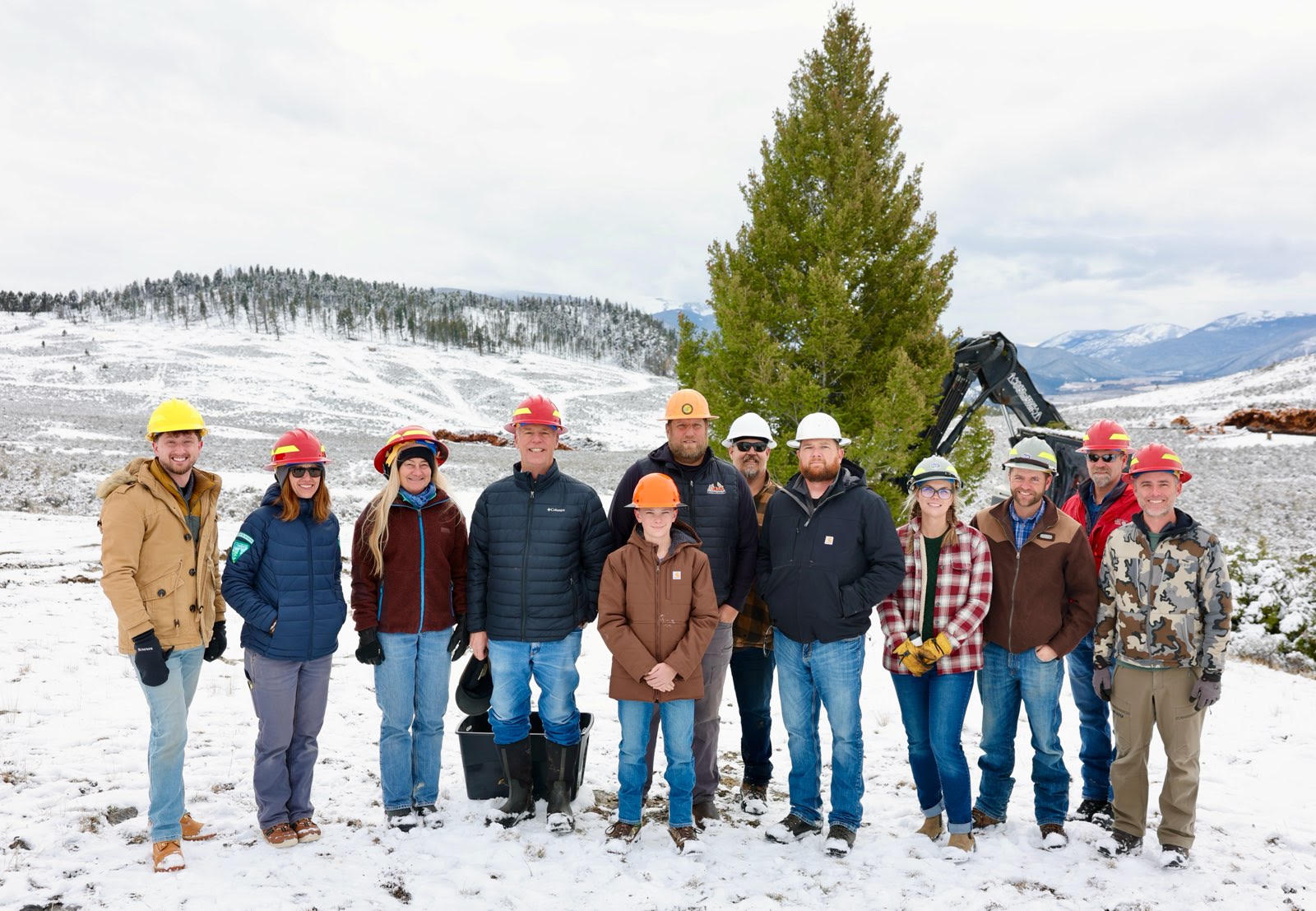
“Each year, it’s a privilege to harvest a Montana tree from our public lands and display it in the State Capitol for all to enjoy,” Gov. Greg Gianforte said Thursday as crews felled this year’s Capitol Christmas tree on Bureau of Land Management ground near Wise River.
The 2026 tree — a Douglas fir cut in coordination with the Department of Natural Resources and Conservation, KLM Contracting and the Montana Logging Association — will stand nearly three stories tall under the Helena rotunda, draped in more than 3,500 lights.
Its harvest coincides with a memorandum of understanding signed earlier this month by the governor, the BLM and DNRC to expand their Good Neighbor Authority partnership, which has run fuels-reduction and timber-sale projects since 2019.
The choice of BLM land is deliberate. “It’s fitting that this year’s tree is from a BLM timber harvest given the recent expansion of our shared partnership to improve forest health and reduce wildfire risk,” Gianforte said in a statement released by his office. The Good Neighbor Authority lets the state manage certain federal forestry work, a model the new MOU aims to scale up across more acres.
Montana’s Capitol tree comes from a different parcel of public land each year, mirroring the U.S. Capitol’s practice of selecting a new National Forest annually.
The last Montana tree to make the trip to Washington was a 79-foot Engelmann spruce from the Kootenai National Forest in 2017. This year the “People’s Tree” in D.C. is a 76-foot Engelmann spruce from the Nez Perce-Clearwater National Forest in northern Idaho, which arrived Friday.
The Helena tree will be decorated in the coming days. The governor and first lady invite the public to the lighting ceremony on Monday, Nov. 30, at 5 p.m. in the Capitol Rotunda.
Gianforte encouraged Montanans to continue the family tradition of harvesting their own trees from public lands, arguing the practice benefits forest health, resiliency and wildlife habitat. Permits differ by land manager:
The Bureau of Land Management, created in 1946 by merging the General Land Office and the Grazing Service, oversees more than 247.3 million acres — one-eighth of the nation’s landmass — mostly across 12 western states including Montana. Its holdings were once described as “land nobody wanted” because homesteaders had passed them by, yet today the agency manages 263 wilderness areas, 31 national monuments and nearly 700 million acres of subsurface mineral estate.
- State trust land: $10 per tree through a local DNRC field office.
- National Forest land: $5 per tree via recreation.gov, with height and species restrictions that vary by forest.
- BLM land: permits available in person at Montana/Dakotas field offices, with some offices offering online purchase.
The state does not track how many families cut trees each year; neither state nor federal agencies compile that data.
Worth a look

Colts Release Daniel Jones; Schefter Says They Rebuffed Trade Interest
The Indianapolis Colts released Daniel Jones on Friday, Nov. 20, one day after a 26-3 loss to the...
BCSO Releases Body-Camera Video of Deputy Shooting Bicyclist After 3-Month Delay
"Why are they out?" Sheriff John Allen asked Thursday. "We keep dealing with this over and over and...

James A. Hanoian, Navy IT Veteran and Augusta Resident, Dies at 75
James A. Hanoian, who spent two decades managing the flow of data aboard Navy ships before bringing that...

Omaha Stuns Creighton 2-0 to Advance in NCAA Men’s Soccer Tournament
Omaha stunned fifth-seeded Creighton 2-0 Thursday night in the first round of the NCAA men's soccer tournament at...