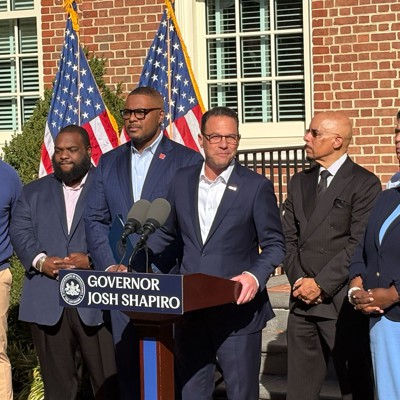
Gov. Josh Shapiro stood at a lectern in the Governor’s residence in Harrisburg on Wednesday and told Pennsylvanians he has a mandate to lead, one day after Democrats scored sweeping midterm victories that hand the party control of both chambers of the state legislature for the first time in decades, City & State Pennsylvania reported.
Shapiro won his own reelection race by a 21-point margin, and down-ballot, Democrats flipped four seats in the state Senate to seize a 26-24 majority — the first Senate majority for the party in decades — while expanding their House majority to at least 113-90 after flipping at least 11 seats. With both chambers now in Democratic hands, Shapiro and legislative leaders said they intend to move quickly on a long-stalled agenda.
A 100-Day Agenda Takes Shape
Flanked by House Speaker Joanna McClinton, House Majority Leader Matt Bradford, House Appropriations Committee Chair Jordan Harris, state Sen. Vincent Hughes, and Senate Democratic Leader Jay Costa, Shapiro used the Wednesday press conference to sketch out the priorities of his second term: mass transit funding, raising the minimum wage, codifying abortion rights, and investing in housing.
“What last night’s election showed is that I have a mandate to continue to lead our commonwealth forward,” Shapiro said. “Now I’ve got a whole lot more partners in progress, a whole lot more GSD Democrats, ready to do this work alongside me.”
Shapiro said he and top-ranking Democrats in the General Assembly will release a formal agenda for their first 100 days of 2027 in the coming weeks. Costa, whom Shapiro said will likely serve as the Senate’s next president pro tempore, pointed to a backlog of legislation: House Democrats have passed more than 200 bills — including a minimum wage increase and mass transit funding — that died in the Republican-controlled Senate.
“These are issues that pass the House in many cases in a bipartisan way, but our obstructionist Senate Republican colleagues do not want to see any action on them. We need to move those bills forward,” Costa said.
Credit Where It’s Due
Both Costa and Hughes credited Shapiro with personally campaigning to flip legislative seats. Hughes said the governor and Lt. Gov. Austin Davis “put it all on the line and sacrificed their own political advance to make sure that the House grew and that the Senate flipped,” adding, “You all need to understand that — he was the leader in making that happen in Pennsylvania.”
Shapiro, for his part, framed the Republican losses as a referendum on obstruction. “Oftentimes, they were enabling the president and stopping progress in this commonwealth,” he said. “The voters saw right through that.”
Still, the governor struck a conciliatory note, vowing to work with Senate Republicans if they engage. “I’m someone who wants to bring people together to get stuff done,” Shapiro said. “If they want to work with us, we will work with them. If they choose to be intransigent, well, then there’ll be 24 ‘no’ votes, and these guys will put up 26, and we’ll make progress. But I want them at the table.”
The Republican Response
State Sen. Greg Rothman, chair of the Pennsylvania Republican Party, acknowledged the results in a Wednesday statement, writing that “elections bring both victories and setbacks, but our responsibility to the people of Pennsylvania doesn’t change.” He said the party will “take the time to analyze these results, strengthen our organization, and ensure we are prepared for the challenges ahead.”
What the Shift Means for Pennsylvanians
For years, SEPTA and other transit agencies have faced funding cliffs that Harrisburg’s divided government could not resolve; a minimum wage stuck at the federal floor of $7.25 has drawn repeated House passage and Senate inaction; and abortion rights, currently protected by executive action and court rulings rather than statute, remain a priority for Democrats seeking to lock them into law.
With 26 votes in the Senate and at least 113 in the House, Democrats can now advance legislation without a single Republican vote — a structural shift that will define Pennsylvania politics through at least the 2027 session. The first test comes in the coming weeks, when Shapiro and legislative leaders release their 100-day agenda and begin moving bills that have languished for years.
For a party that held a one-seat House majority in 2022 and no Senate majority in decades, the arithmetic in Harrisburg has changed overnight — and with it, the pace at which long-debated bills can become law.
Related reading

WSBA Executive Committee Meeting Remains Unscheduled Despite Urgent Role
The Washington State Bar Association's Executive Committee exists to handle emergent, non-policy-making matters that need timely attention between...
Secretary Warner reveals logo for West Virginia Office of Entrepreneurship
Charleston Unveiling Puts Gear at the Center Secretary of State Kris Warner unveiled the new logo of the...

NC Rep. Virginia Foxx Trails Democrat Chuck Hubbard by 99 Votes in Tight District 5 Race
Republican U.S. Rep. Virginia Foxx trails Democratic challenger Chuck Hubbard by just 99 votes in North Carolina's 5th...

New Burlington Mural Unveiled at Water Resources Building
On a Wednesday in Burlington, eight young artists celebrated the unveiling of a mural they had spent four...