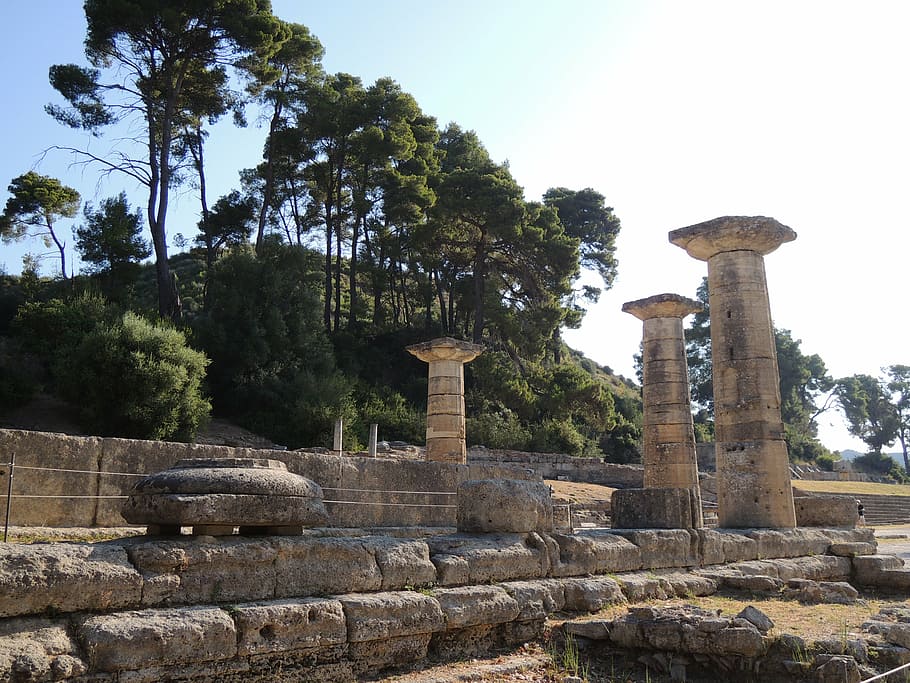
Thousands of spectators once braved the rugged, dangerous terrain of ancient Greece, traveling for days to witness the Panhellenic Games.
While modern tourism often focuses on convenience, the trek to Olympia—one of the most important sporting and religious centers of the ancient world—was a grueling logistical feat. As reported by GreekReporter.com, up to 50,000 people converged on the site, turning a sacred sanctuary into a bustling, chaotic epicenter of human activity.
The journey was rarely easy. Greek society was fragmented, and the mountainous terrain made the construction of reliable roads prohibitively expensive. Travelers faced the constant threat of highwaymen, often necessitating large, protective entourages.
For Athenians, the trip took five to six days, while those arriving from southern Italy endured six days of sailing. Despite these barriers, the sacred nature of the games prompted a temporary truce across the Greek world, ensuring safe passage for the massive crowds.
Olympia was far more than a sports arena; it was a primary hub for intellectual and cultural exchange. “Olympia was the most important meeting point for literary and intellectual activities in Ancient Greece, because authors and thinkers gave publicity to their works and ideas there, exploiting the fact that the Olympic Games gathered together the greatest crowd of Greeks,” Fernando Garcıa Romero, a professor of Ancient Greek at the Universidad Complutense de Madrid, said.
The presence of thinkers like Anaxagoras in the fifth century BC, Plato and the mathematician Euclides in the fourth century BC, or the Pythagorean Apollonius of Tyana in the first century AD transformed the event into an intellectual spectacle. Romero said that the site was a microcosm of ancient life, where one could encounter everyone from sophists shouting their theories to peddlers selling their wares.
The scale of these gatherings inevitably led to the friction of mass tourism. Accommodation was notoriously scarce, forcing most visitors into makeshift tents and reed huts. The disparity between the wealthy and the common spectator was stark. While the average traveler struggled with heat and overcrowding, elites often engaged in displays of extreme opulence.
The orator Andocides, in a speech from the 5th century BC, famously condemned the display of Alcibiades at Olympia, noting that the Ephesians had erected a Persian pavilion for him that was twice as large as the official Athenian delegation’s quarters.
This ostentation did not always sit well with the public. When the tyrant Dionysius I of Syracuse brought his lavish, decorated pavilions and chariot teams to the Games of 388 B.C., an angry crowd eventually destroyed his tents in protest against his “unbearable ostentation,” as documented by the historian Diodorus of Sicily.
The physical discomforts of the event were equally legendary. The satirical writer Lucian of Samosata compared the stifling conditions at Olympia unfavorably to other festivals, and the philosopher Epictetus later suggested that the discomforts were simply the price of witnessing such a memorable spectacle.
By the later centuries of antiquity, the sheer volume of visitors necessitated the birth of the tour guide. These individuals were tasked with explaining the artistic and architectural marvels of the site, though they were not always appreciated.
Ancient sources indicate that some visitors grew frustrated with the guides’ rigid scripts and long-winded explanations. As one account in the treatise On the Oracles of the Pythia complained, travelers begged the guides to “cut short their harangues” and focus less on prearranged programs.
The commercial frenzy at Olympia, famously summarized by the poet Menander as a mix of “crowd, market, thieves, dice games, chatters,” reveals that the challenges of modern tourism—overcrowding, inflated prices, and logistical headaches—have deep historical roots.
The site functioned as a temporary city that appeared and vanished with the rhythm of the games. For the thousands who endured the heat, the dust, and the chaos, the draw was the unique prestige of the event itself.
Even the greatest minds of the era were not immune to the physical demands of the pilgrimage. As Epictetus observed, the spectators bore the tumult, the shouting, and the cramped conditions because they were balanced against the singular importance of the spectacle. The phenomenon of the Games remains one of the most vivid windows into the complexity of human nature in the ancient world.

Rocket’s $40-50M Fundraise Collapses After EY Finds Revenue One-Tenth of $60M Claim
Surat-based vibe-coding startup Rocket saw its $40–50 million fundraising round collapse in mid-2026 after Ernst & Young due...

Madison Chair Vaughn Delivers First State of County, Outlines $150M Courthouse Plan
“Our goal is to maintain the roads operating around the courthouse square, that’s the first priority,” Chairman Rex...

Wyoming Guard, Tunisia Partners Strengthen Ties With Visit
C-130 aircraft and military readiness brought U.S. Ambassador to Tunisia Bill Bazzi and members of the Tunisian Armed...

Charleston County Confirmed Data Removed in Cyber Incident, SLED Assisting
Charleston County confirmed Monday night that data was removed from its government systems during a cybersecurity incident detected...